Are you a supertaster?
Have you ever heard of supertasters?
Supertasters experience bitter tastes more strongly than other people because they have a higher number of taste receptors within their fungiform papillae – the big pink bumps on your tongue which contain your taste buds.
By counting the number of fungiform papillae on your tongue, you will be able to determine whether you are a supertaster, a taster or a non-taster.
The Vamps investigate taste
We asked music superstars The Vamps to show us their tongues to find out which of them is a supertaster. After watching the film, you'll have the chance to have a go yourselves and find out how many supertasters there are in your class.
The Vamps investigate taste
Tristan Evans:
Hello, we are The Vamps.
James McVey:
And we are here in London's oldest food market to find out all about taste.
Bradley Simpson:
Shall we go have a bite?
James McVey:
We shall.
Tristan Evans:
Okay.
James McVey:
Pancakes.
Tristan Evans:
Oh, the pancake.
James McVey:
Oh yeah.
Bradley Simpson:
We've got very different food tastes.
Tristan Evans:
I'm a big fan of curries.
Woman on stall:
Chilli jam?
Bradley Simpson:
This is his breakfast.
Tristan Evans:
It's hot. It's hot. No, that's fine actually.
Bradley Simpson:
Yeah.
Tristan Evans:
Oh, it's so big.
James McVey:
Oh my God.
Bradley Simpson:
Connor and James aren't big fish fans.
James McVey:
What is that?
Bradley Simpson:
But sushi's probably one of my favourites. You can have a lot of different fish and a lot of different tastes in one sitting.
James McVey:
I love like a good pizza but everyone does. I think for me, I just like trying new things.
Connor Ball:
Cheese and more cheese.
James McVey:
Cheese and more cheese.
Connor Ball:
Cheese is my worst thing in the world. Like I can't think of anything worse.
James McVey:
Even though I eat a lot of vegetables, I hate cucumber.
Bradley Simpson:
I'll try a bit of that, yeah.
Connor Ball:
I like steak.
Tristan Evans:
A good fillet, don't you? Fillet steak.
Connor Ball:
Good fillet steak, yeah.
Bradley Simpson:
So to find out why all of our tastes are so very different, we are going to meet an expert who will put all of our taste buds to the test.
Professor Jackie Blissett:
So I'm here to help The Vamps learn a little bit more about taste. I've got some foods for them to try and we've got a little investigation for them to do.
Professor Jackie Blissett:
So I've got a few things here today that I'd like you to taste and let's see whether you guys might be super tasters or not.
Tristan Evans:
Okay.
Connor Ball:
Alright. Cool.
Bradley Simpson:
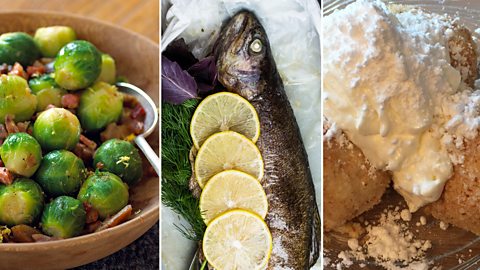
Do you want me to start with the sprouts?
Professor Jackie Blissett:
So let's start with the sprouts.
Professor Jackie Blissett:
A super taster is somebody who has a high concentration of taste buds on their tongue, and they tend to taste quite intensely. So it can be difficult for them to accept perhaps very bitter foods or sour foods or foods that have other strong flavours.
Bradley Simpson:
I quite like the texture in a roast, um, but I'd never go out my way to have a sprout.
Professor Jackie Blissett:
Okay.
James McVey:
And I like sprouts so I eat them most weekends.
Connor Ball:
It's like… just that.
Professor Jackie Blissett:
It's quite a bitter taste.
Professor Jackie Blissett:
Sprouts are a good example of a vegetable that's got something in them called polyphenols. Really good for us but they taste really bitter.
Professor Jackie Blissett:
Okay, let's go coffee next.
Bradley Simpson:
Ooh.
Connor Ball:
This is too strong for me.
Professor Jackie Blissett:
Yeah.
James McVey:
It's quite strong for an espresso, this one especially.
Connor Ball:
It's awful.
Professor Jackie Blissett:
So coffee's a really bitter flavour that some people will find really difficult.
Professor Jackie Blissett:
So this is grapefruit.
Bradley Simpson:
Grapefruit. See, I'd usually have this with a bit of sugar for my breakfast.
Tristan Evans:
Yeah.
Professor Jackie Blissett:
Okay.
Bradley Simpson:
And I don't mind it then.
Professor Jackie Blissett:
Okay.
Connor Ball:
I quite like that.
Tristan Evans:
It's quite sour. It's quite sour but I like it.
Professor Jackie Blissett:
Quite sour.
Professor Jackie Blissett:
A super taster will often not enjoy grapefruit, or they'll need to have a lot of sugar to find, find it acceptable.
Connor Ball:
Yeah, that one's good, yeah.
Bradley Simpson:
Is it intrinsic in a person to dislike bitterness from a young age?
Professor Jackie Blissett:
It is. Bitterness is a clue really for us as animals that something might be poisonous or toxic.
Bradley Simpson:
Okay.
Professor Jackie Blissett:
But the good news is you can learn to like these things. There's one way that we can find out with a bit more confidence whether or not you're a super taster and that's to count the number of taste buds on your tongue.
Professor Jackie Blissett:
Whether you like a food or not depends on lots of different things. Your genetics, so whether or not you're a super taster. But it also depends what you've been exposed to. So if you've had a taste of a lot of wide variety of foods, then you come to like a wide variety of foods.
Tristan Evans:
One, two, three, four… five.
Bradley Simpson:
I had about five taste buds, which was spot on. I kind of like most foods.
Connor Ball:
There is not one on there.
Tristan Evans:
Yeah.
Connor Ball:
There is none.
Bradley Simpson:
You have no taste.
Connor Ball:
There's nothing.
Bradley Simpson:
You've got two at the bottom.
Connor Ball:
Oh, it's come out, it's sprouted, yeah.
James McVey:
Two?
Bradley Simpson:
Two.
James McVey:
Am I dead? Where am I?
James McVey:
I love flavours and I thought that meant that I'd have more taste buds but it's kind of opposite. It means that because I have fewer taste buds, I'm open to trying more things.
Bradley Simpson:
One, two, three, four, five, six. About six.
Bradley Simpson:
13.
James McVey:
13?
Bradley Simpson:
13.
Tristan Evans:
Apparently, I'm a super taster. Super human.
James McVey:
Which was not as expected, was it?
Connor Ball:
No, no.
James McVey:
Surprise.
Tristan Evans:
Very.
Bradley Simpson:
13.
Tristan Evans:
Even though I am a super taster, I do really like food and I'm very open-minded to food. I think it's all about how much you want to enjoy food, and if you want to like it, you can actually learn to love a certain type of food.
Tristan Evans:
No?
Bradley Simpson:
I'm not a big fan of gherkins.
Tristan Evans:
You sure? You want?
Connor Ball:
No, no, I'm good.
Bradley Simpson:
Now it's your turn to find out if you're a super taster or not. We'll see you all very soon. Lots of love. Mwah. We've been The Vamps.
How to do the Taste investigation
This short film tells you all you need to know to set up and conduct our Taste investigation. It is designed to be used alongside the activity sheet found with our teaching resources. Please note - this investigation will require adult supervision!
How to do the Taste investigation

Your turn
Now it's your turn to take part in the test with your class!
Get your students to work in groups. Each child in the group will have their fungiform papillae (the pink bumps on their tongue) counted by the other members.
The person who is going to have their fungiform papillae counted first needs to sit down comfortably with their elbows on the table, supporting their chin. They will probably need to sit like this for up to five minutes, so make sure they are comfortable.
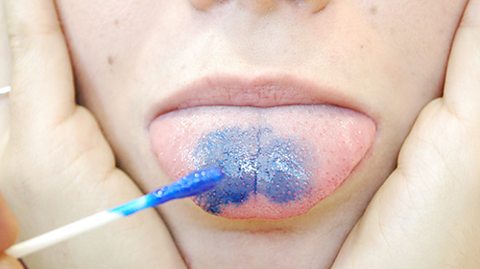
Poke out your tongue
Ask the child who's having their fungiform papillae counted first to poke out their tongue, so that the tip sits well over their lips.
Now paint it!
One of your group should place a cotton bud into the mini cup of blue food dye until it is well coated. Using the cotton bud, coat the front third of the tongue with the dye. Make sure they don't close their mouth or the dye will come off!
Remember: Only dip the cotton bud in the food dye once. Throw away the cotton bud once it has been used.
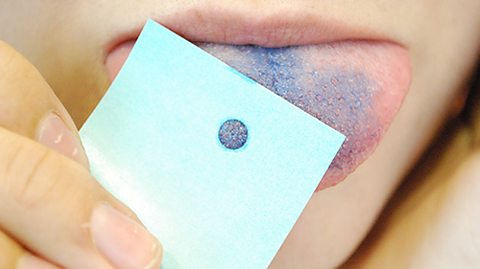
Place your card
The blue dye will stain the tongue but slide off the prominent pink fungiform papillae.
One of the group should carefully place a hole-punched card on the tongue over the blue food dye.
Ask the person whose tongue has been dyed to push their tongue into the hole.
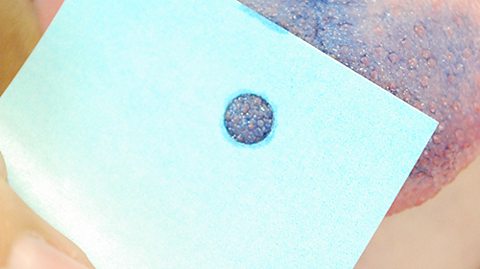
Count the pink bumps!
Count how many pink bumps you can see on the tongue inside the hole in the card.
Make sure you write down and record your result. Your teacher will be able to tell you the number of visible bumps to tell if you're a taster, non-taster or supertaster - these can be found in our activity plan.
Taste - Investigations additional resources
A collection of fun resources based around the topic of taste
Why do we like some foods more than others? interactive
Have you ever wondered why there are foods that everyone seems to love, like chocolate, while others don't have many fans?
