Why use games within education?

For over fifty years, digital games have become an increasingly prominent part of our lives, and their potential in the classroom has grown.
Games, and play more generally, are powerful learning tools that encourage new forms of engagement, enable students to explore new situations, and provide a fantastic context for collaboration and creativity.
This is because games promote a different kind of participation in people; one that is often voluntary, creative and free.
If this is new to you as a teacher, even if you have experience of playing games yourself, this article will demystify game-based learning by focusing on its key benefits and some considerations to take into account for those using games in their teaching.
How digital games can support learning
Digital games can support learning through both their themes and mechanics.
Themes allow students to explore different contexts that they cannot experience in other ways, for example a specific historic period, a distant geographical area or a scientific experiment that poses risks.
Mechanics are how students interact with this context, and can encourage students to develop and apply skills and knowledge. For example, a resource management mechanic can help students to understand the impact of making difficult decisions in a complex system.
What is game-based learning?
What is game-based learning and what do we learn from playing?
Games can have a powerful effect on engagement with learning. Gamification is the use of points, badges, or leaderboards to motivate learners. These extrinsic rewards can work well to increase engagement… but they don’t create deeper understanding.
In contrast, game-based learning fosters intrinsic motivation by making learning immersive. Playing the game is the learning process. It’s learning through doing, in a playful way.
Educational games are specifically designed to teach particular skills, or concepts, through immersive activities and narratives. There are two key ways this can happen:
A game based on learning through a theme can immerse students in a setting that reflects the subject matter, helping students grasp concepts in context.
A historical game, for example, might situate players in the industrial revolution in Britain, allowing them to have a first-hand experience of key issues - and making history tangible, relatable, and far more memorable.
A game based on learning through a mechanic requires students to apply their knowledge and cognitive processes, targeting specific skills. A geography game, for example, can be built around a cause-and-effect system, allowing students to make choices and then see and feel the impact, helping them to understand the consequence of their decisions.
So, through games, students learn to evaluate decisions, assess risk, and develop their critical thinking skills, as they see how their actions play out in a safe space.
By using game-based learning you can create a supportive, dynamic environment that fosters problem-solving, curiosity and a love for learning.
What are the benefits of game-based learning?
Games provide a safe space for experimentation and failure which students might not get elsewhere.
The benefits of game-based learning with students include:
- increased engagement
- enhanced collaboration
- the development of a sense of creative agency
Explore more of the benefits in the film below.
Why use game-based learning?
Why use game-based learning?
Game-based learning delivers a range of benefits, and opens up opportunities to teach and learn through direct experience.
Using educational games unlocks experiences that the limitations of time, resources, or cost might not otherwise allow. For example, within a science game, students can conduct experiments at home, applying classroom knowledge to different scenarios.
Students can complete tasks safely, without supervision, and receive instant feedback allowing them to reflect on and evaluate their choices.
As gameplay often involves initial failure by design, playing encourages students to simply try things out and fearlessly experiment with new approaches - helping them build resilience.
Game-based learning offers a personalised experience, letting students progress at their own pace.
Multiplayer games promote teamwork, collaboration, and learning from peers who can model how to solve certain problems or approach things in a different way.
So, to summarise, game-based learning is a powerful way to create a dynamic and supportive learning environment.
It allows knowledge application within context.
Supports learning in a safe, controlled environment.
Personalises learning experiences and progress.
Provides instant feedback.
Encourages teamwork, problem solving and reflection.
AND normalises failure as part of the learning.
This all leads to increased engagement! Learning through experience sparks curiosity, builds confidence, and develops lifelong learners.
Using games in primary schools
In primary settings, games are a powerful way to explore new topics and to engage pupils in collaborative, creative ways. Younger children are used to learning through play, so digital games can capture this sense of playfulness and channel it towards specific learning outcomes.
Watch this film to see teachers’ and pupils’ reflection on using games in the classroom.
Video: Case study
I started using games in my class because I just thought that it was a different way for children to learn. It gives children the chance to use a bit of technology which they might not normally use and sometimes that can be through a game and sometimes its not going to be through a game but either generally there is something that will add to the learning for the children.
Playing games makes me lots more confident. I try my hardest and its lot more fun.Some children they don’t find class as interesting they don’t like school but they might find it more fun playing a game that still helps you learn.
One of the major positives of game-based learning is that you don’t have a fear of failure, and you just feel like I can achieve throughout this and my teachers not judging me on it. It gives you a chance to just level up your way through the game at your own pace.
When you lose and you try again then it builds resilience and maybe next time youll get it.
It doesn’t tell you exactly what to do every single step otherwise that wouldn’t be as fun you have to try figure it out yourself and use your knowledge and even though it might take a bit of a while once you’ve achieved it, it makes you feel really happy.
I think games support the learning for all students because it feels accessible to everybody really helps to build a collaborative atmosphere. There can be challenges with games sometimes because you realise that children have had different exposure to tablets or laptops and actually you need to learn how to use them before you can access the games but for the most part children find them quite intuitive and they can just get started. So regardless of what the game is or what the subject is, it feels like everyone’s starting on the same page and can work their way through it. Its there to support the teacher and support the children and its quite an easy way for them to realise oh actually I can access this at home and practice more.
For like revising and stuff things that you’ve already learnt before- its quite nice it doesn’t feel like you’re revising.
It would encourage me to try my best.I think my advice for teachers who don’t feel particularly confident using games in their learning would be to make sure you spend the time to find what is out there because actually the games are tailored to the curriculum, it can really add to the learning rather than make it more difficult for the teachers.
Using games in secondary schools
In secondary settings, the focus of game-based learning can shift. Games might go deeper on subject specific skills or focus on revision and application of prior knowledge in anticipation of exams.
Having said this, play is a useful tool for learning, even into adulthood, and using games can also be a way to reconnect older children with the ways of learning through play that they may have encountered at primary school.
Video: Case study
I like learning through games because it's like education but also fun.
You can learn from your mistakes.
Figure out the information on your own.
Look around and think outside the box.
We’ve been using games for about seven or eight years. Main reason is that I think that the students just respond really well to it. Theres games that you can do for more or less every subject.
As a history teacher, I have no way of taking my students back to the Tudor age but a game can.
With game-based learning, they can use lots of different skills. They’ve obviously got communication if it’s a team based scenario, follow instructions, problem solve.
A really important skill that I think students develop when they’re using game-based learning is critical thinking.
They are going to have to work things out for themselves. That’s perfect for us because when they go and sit their exams, they’re going to be given source material that they’ve never seen before. You can’t prepare them for everything. If they are finding it out for themselves, then they’re owning that information. And if they own that information, they retain it better. And actually they enjoy having it more.
In a normal lesson because you have so many worksheets, having a game once in a while make it more memorable.
Going in a game, you’ve got steps and then you’ve got a bit of information and then maybe something else and then another bit. So, you’re taking it at a different speed.
If I make a mistake in a game, most of the time it gives me an option to retry.
It make it a lot easier to take risks and try new things, because you don’t have to worry about missing out whereas in a classroom, you’d have to worry about your teacher moving forward with you still being stuck where you are.
Game-based learning is fantastic because it's pure differentiation, pure adaptation. For any student whether they need more challenge or whether they need more support There is not way I can plan 30 different lessons, but I can use this game-based learning 30 different ways because it's going to adapt that for me.
The advantage of having the online based games is that you can say to students to carry on and actually play the games at home, and I think it also means that they maybe relate more to the teacher for the fact that you’re actually using games and allowing them to have that freedom, that time, that sort of independence.
Once you leave school, you don’t have that teacher telling you what to do anymore. We have to get students ready to not need us and game-based learning is doing that. We can get them going on it but the more they do, the less they need us and that’s not a bad thing. That’s brilliant. That’s what we want.
Considerations
Games need to be taught. As mentioned above, it's easy to assume that children and young people are ‘digital natives’ who will have a naturally affinity for video games. However, digital play is a literacy in its own right, from understanding how to use games controls, to interpreting instructions on screen. Good games will successfully teach players how to play them, but different children will have had different prior experiences with games and these cannot be taken for granted. Give your pupils time to learn the game before they learn from the game.
How does the game align to the curriculum? Games are powerful tools that can bring subjects to life, but it is worth noting how each game links to your curriculum so that you can maximise its potential in your teaching practice.
Games aren’t just for subject-knowledge and engagement. Sometimes the benefits of games are much more simple than their complexity might suggest. Young children can develop fine motor and coordination skills through gameplay, and older children might develop time management skills and confidence as they build their digital games literacy.
Games can cost money. Some commercial games come with an additional cost to play which needs to be considered. Free games, on the other hand, are often supported by advertisements, which similarly need navigating carefully with children. It’s worth exploring platforms like Bitesize where games can be accessed for free without adverts.
Games use data. Online games may come with the requirement to create user accounts and/or log in, especially if they track progress over time. Be aware of the ways in which websites hold and manage user data and make sure that you’re comfortable with this, both for your pupils and yourself.
Games can’t fix everything! Not all pupils will engage with a game, and some will get more out of playing games than others. Make sure the ‘problem’ you are addressing by introducing games to your classroom is one that can be solved by games. Alternatively, try not to focus on the problem in the first place! Injecting play into your practice can often lead to unexpected outcomes, and if you’re willing to embrace the unexpected games can be incredibly powerful for your professional practice too.
BBC Bitesize games
There are lots of excellent games out there offering a range of experiences. The advantages of BBC Bitesize games are:
- They are aligned with the curriculum, covering a wide range of subjects.
- They have been specifically designed to engage learners of all abilities, ensuring both enjoyment and educational benefit.
- They are advert free so the students can play uninterrupted.
BBC Bitesize offers a variety of games for primary and secondary school children, which they can play at home or in school, either independently, collaboratively, or with support.
Coming soon: BBC Bitesize is launching an educational experience for 11–14-year-olds on Roblox – find out more here.
Primary games
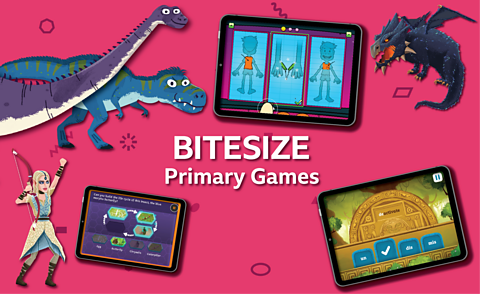
Bitesize Primary: Games
Secondary games
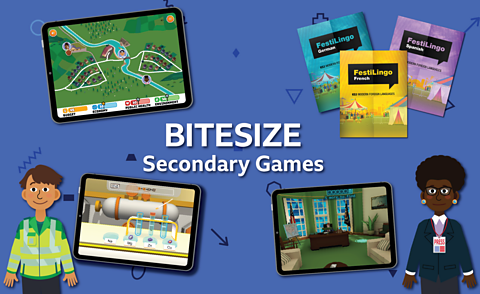
Bitesize secondary: Games