In short...
Themes: Holocaust Memorial Day; significant individuals; making a difference.
Summary: Barbara Winton - the daughter of Sir Nicholas Winton - relates events in 1938/9 when her father arranged the rescue of 669 children from Prague in Czechoslovakia (now Czechia). The story is an audio drama with scrolling text and has two episodes. The content is suitable to use as part of activities to mark Holocaust Memorial Day which falls on 27 January. In January 2024 the feature film One Life was released, starring Sir Anthony Hopkins as Sir Nicholas Winton.
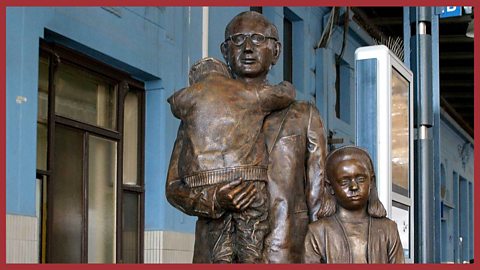
Resources: The framework to download / print (pdf), and an image of the statue of Sir Nicholas in Liverpool St station in London.

Part 1: Prague
New Year's Eve 1938, the city of Prague, Czechoslovakia. My father, Nicholas Winton, known to all as Nicky, arrived in the city from his home in London to meet his friend Martin Blake. He walked to Martin’s hotel through the wintry streets, crowded with families looking cold and tired. Nicky hadn’t planned to be there; he and Martin had arranged to spend the Christmas holiday skiing, but all that had changed with a phone call just a few days before. A phone call that changed his life and that of hundreds of children.
FX: 1930s phone ringing
Nicky: Hello.
Martin: Nicky, it’s Martin.
Nicky: Martin. Good to hear you. I’m just packing my bag. How’s Switzerland? How’s the snow?
Martin: I’m not in Switzerland, Nicky. I’m in Prague.
Nicky: What?
Martin: I’m in Prague…in Czechoslovakia.
Nicky: I know where Prague is, Martin. What on earth are you doing there?
Martin: Something’s happening here, Nicky. Something awful. People need help.
Nicky: What are you talking about?
Martin: I…had to come…see what I could do to help.
Nicky: I’m sorry Martin I don’t understand.
Martin: It’s hard to explain over the phone, Nicky. Why don’t you come out here and see for yourself.
My father’s adventurous nature and his curiosity over what Martin had told him was enough for him to change his plans. The two of them had often talked about the terrible things happening in Europe and if Martin had gone to help, then why shouldn’t Nicky go himself? He had his two weeks holiday booked and his suitcase ready.
FX: Steam train hissing, carriage doors slamming
Mother: I don’t understand, Nicky. I thought you were going skiing.
Nicky: Change of plan, Mother.
Mother: But Czechoslovakia’s a dangerous place. They say there’s going to be a war.
FX: Train starts to pull away. Nicky has to shout over the noise
Nicky:(Going off) I’ll be fine, Mother. I won’t be gone for long. I’ll write. Don’t worry. I’ll be fine!
A few days later Nicky had arrived in Prague to meet Martin, who introduced him to the woman he had gone to help. She was a brave British woman called Doreen Warriner.
Some background: three months before, the German army had crossed the border into Czechoslovakia and thousands of families had fled from their homes in fear of their lives. Prague was full of these families, many of whom were Jewish, who were hoping to find a safe place to stay while seeking an escape. Doreen was hard at work trying to help them - and the many others threatened by the Nazis. She could tell immediately that Nicky was concerned about the suffering of all the people who were now homeless and she encouraged him to visit the refugee camps that had sprung up around Prague, housing families who had escaped empty-handed from the invading Germans. So my father set off to see a camp in the company of a businessman he had met on the journey to Prague. While looking around the simple shelters, with children living in small unheated huts and tents and snow on the ground, he noticed his companion was in tears.
FX: Barking dog. Crying child
Man: This is horrible, Winton. People can’t live like this.
Nicky: It’s going to get worse. Some here are going to die.
Man: I can’t bear to look.
Nicky: We have to do something.
Man: It’s hopeless. There’s nothing we can do but hand out a bit of food.
Nicky: It’s not enough. Handing out food is not enough. There are hundreds of children here and they’re in real danger. Look at this little boy.
Man: I don’t want to look. I’m sorry. I’m going back to the hotel.
Nicky: Look at him! Look at his face. He’s already starving…and when the Germans get here it’s going to be even worse for him. We have to have to find a way to get him out.
Man: You want to get this little boy out of Czechoslovakia?
Nicky: Not just him. All the children. I want to get them all out.
Back in Prague, my father told Doreen and other aid workers what he had decided to do: to take as many children as possible to safety in Britain. No-one had any idea how he would do it but he was not put off. He was determined to try whatever was needed.
Before long the rumour of a young Englishman trying to help children at risk spread through the city. He was quickly surrounded in his hotel room by desperate parents, pleading with him to take their children out of danger. Over the next few weeks Nicky worked furiously, talking to hundreds of parents and writing to his mother in London with questions about how to tackle such a task. His holiday was long over and he had angered his boss by taking an extra week away.
At last a list of children was drawn up and Nicky returned home to London, hoping to get permission somehow to bring them into this country to safety. Several British aid organisations were already at work bringing children in danger from the Nazis out of Germany and Austria but none were helping the children of Czechoslovakia. Those in charge told him that the government would not agree to a separate operation and he should be patient, things would work out in the end.
The last thing my father had was patience. He was sure war was on the way and if he waited, those Czech children would be in terrible danger. He decided to carry on regardless of those who told him to wait and spoke to Martin about his decision.
Nicky: We have to start moving these children now, Martin. Before it’s too late.
Martin: That’s not going to happen, Nicky. The government’s working with the refugee teams and they’re all saying the same thing. German and Austrian children go first.
Nicky: Then we have to change their minds. If the other teams won’t help I’ll set up my own team.
Martin: You think you’re going to persuade the government…to let those children in.
Nicky: I’m not going to persuade them. I’m going to tell them. I’m going to tell them it’s going to happen. Those children are coming to Britain.
So Nicky went by himself to the government officials in charge and argued his case for carrying out his plan. Against all expectations, they agreed. He had to follow their rules but he could go ahead. At last he was ready to put his idea of rescuing children from Czechoslovakia into action. All he needed now was a way of convincing people here in Britain to help him and he was determined he could do it. His project to save the children had begun.
At Christmas 1938 Nicholas Winton - a 29 year old stockbroker from London - was preparing to spend the holiday skiing in Switzerland when he received a phone call from his intended companion, Martin Blake. Martin explained that he had gone instead to Prague and persuaded Nicholas - 'Nicky' - to join him there.
In Prague Martin introduced Nicky to Doreen Warriner, a British aid worker helping with the refugee crisis engulfing Prague following the German occupation of the Sudetenland. Doreen encouraged Nicky to visit the refugee camps springing up around the city and it is following one such visit that Nicky determined he would find a way to help the refugee children.
The task would not be an easy one though: the British government was already involved in helping children leave Germany and Austria, and had no desire to add children from Czechoslovakia to the list. Nicky had to find a way to persuade them.
Duration: 6' 53"
End of speech: '…His project to save the children had begun.'
Video questions
- Sir Nicholas Winton was born Nicholas Wertheimer in 1909 to German Jewish parents who had moved to London. Why do you think the family changed the name to Winton?
- What do you think made him so determined to help the children he saw in Prague when others chose a different path?
- Put yourself in the place of one of the people in the story: whose place would be the most challenging and why? Is there anyone in the story that you identify with? Why?
- After the war, Winton told no-one about what he had done, not even his wife, Grete. Why do you think he made this decision?
Part 2: London
London, February 1939. My father, Nicholas Winton, was hard at work. But his job in the City of London finished mid-afternoon and it was now evening. He was at home doing what he considered was his real work. A plan he had created to bring endangered, mostly Jewish, children out of the hands of the Nazis in Czechoslovakia was just beginning. Hitler’s army was moving into their country and thousands of families had fled from their homes to try to find safety. Many were living in cold and damp tents with little food and no heating and my father had become determined to help them after seeing their terrible situation on a recent visit.
Nicky: Look at him! Look at his face. He’s already starving…and when the Germans get here it’s going to be even worse for him. We have to have to find a way to get him out.
Man: You want to get this little boy out of Czechoslovakia?
Nicky: Not just him. All the children. I want to get them all out.
Against all expectations Nicky, as he was known to his friends, had managed to persuade the British government to allow him to bring Czech children into Britain. These were children whose parents had begged him to take their child to safety when he had met them in Prague, the capital of Czechoslovakia that January. The British government’s conditions for agreeing to the operation were that each child must have a foster family who would look after them and a sum of money to cover the cost of their return journey when it was safe to go home again. My father’s job now was to find as many families as he could who were willing and able to take a child into their home, to love and care for them. How was he to find so many kind and generous people at a time when life was hard in Britain and fears of war grew day by day?
FX: Rustling of papers. Ticking of a clock.
Mother: You look tired, Nicky. You need to get some sleep.
Nicky: I’m too busy to sleep, Mother. There’s so much to be done. I’ve got to raise money to pay for the trains…got to find families prepared to look after the children when they get here…there are forms to fill in and hundreds of letters to write…then I’ve got to…
Mother: You can’t do it all, Nicky. Not on top of your job. You need someone to help. Someone who could work full-time on this.
Nicky: Yes. You’re right.
Mother: Have you got someone in mind?
Nicky: Yes. You mother.
Mother: Me?
Nicky: Would you? Would you work with me?
Mother: Hand me those papers. Where do I start?
While my father was writing to newspapers and organisations asking for homes and money, Trevor Chadwick, an English schoolteacher, was busy at work in Prague. He had met Nicky there in January and heard about his plan. Without hesitation he offered to help in Prague organising the special trains to Britain once homes were found for each child. He was making lists of children whose parents were pleading for their rescue and sending the information to Nicky in London. The first group who had been found homes in Britain left Czechoslovakia in mid-March 1939. As so many parents had feared, the day after that first group had left, the German army invaded the city and took charge of all travel from Prague. Now all future trains would have to leave under the gaze of Nazi soldiers.
It was a frightening and tense time for the families, anxious that their children would not be allowed to leave. Trevor spent days bargaining with the Nazi chief, going from angry shouting to quiet pleading and back again to get his way. Once the children’s travel documents were stamped, they could join the next train to safety, with tearful goodbyes from parents uncertain when or even if they would see their children again.
FX: Steam train. Carriage doors. Running footsteps.
Czech mother:(Approaching) Mr Chadwick…Mr Chadwick. This is my daughter. Margit Wohlmann.
Chadwick: Margit Wohlmann…yes. She’s on the list. You need to put her on the train now. It’s about to leave.
Mother: She’s only six years old. I want to go with her.
Chadwick: You can’t. It’s just the children. You know that. We can only take the children.
Mother: I know. She will be safe?
Chadwick: She will be safe. There’s a family in London waiting to look after her.
Mother: They are good people this family in London?
Chadwick: They are good people. You have my word.
FX: Train whistle.
Chadwick: Please Mrs Wohlmann. You have to put Margit on the train.
FX: Door opening
Chadwick: Now.
Mother: Yes. Yes, I know…
FX: Door slamming shut. Whistle. Training pulling away
Mother: It’s alright Margit don’t cry…you’re going to have a lovely time in England…it will be like a holiday…Mummy will come soon…everything will be alright…don’t cry…
FX: Train wheels on the track
All through the summer train after train carried hundreds of children of all ages, from babies to teenagers, to Britain. Each child was only allowed one suitcase and a small rucksack which contained some food and drink for the journey. The carriages were locked once the train left the station and soldiers came in to the carriages and hunted through the small suitcases for valuables to steal.
Many of the younger children were too frightened to eat and sat together holding hands. Older girls were given the young babies to look after for the journey and they played games and sang songs to keep up their spirits and stop the babies from crying. The journey through Germany took a whole day but eventually they arrived in Holland, where at last they were out of reach of the German soldiers. There the carriages were unlocked and kind local people gave the children hot chocolate and bread to eat.
Everyone relaxed, knowing the danger was over. A ship took them overnight to England and the final part of their journey to London, where they were met by Nicky and his mother and introduced to their foster parents who had come to the station to collect them and take them home to start their new lives.
By August 1939 eight trains had brought 669 children to England. But on the first of September bad news came about a large group of children due to leave Czechoslovakia that day.
Nicky: Mother. They stopped the train.
Mother: Our train?
Nicky: Yes.
Mother: But it was all arranged. There were supposed to be 250 children on that train.
Nicky: The Germans wouldn’t even let them into the station.
Mother: What will happen to them?
Nicky: I don’t know.
Mother: There’ll be other children, Nicky. Other trains.
Nicky: There’ll be no more trains, Mother. The Germans have invaded Poland. They’ve closed all the borders. There’ll be no more children coming to England from Prague. We can’t save any more. It’s finished.
Mother: You did your best, Nicky.
Nicky: I feel so sad.
Mother: You should feel proud not sad, Nicky. You saved 669 children.
Nicky: It wasn’t enough, Mother. We should have saved more.
Two days after the German army invaded Poland, Britain declared war on Germany. World War Two had begun. Of the two hundred and fifty children who were turned away from that last train, nearly all were sent with their families to concentration camps where they perished during the war.
My father lived a long and active life and was always working to help those in need. So for 50 years he didn’t think much about those eight busy months in 1939 and the children who he had brought to safety. When he was already nearly 80 years old, the story was told on TV for the first time and lots of people started coming to meet him to learn about the rescue. Some of them wanted to say thank you - they were the children - now grown up - who discovered at long last the man who had saved their lives.
Barbara Winton continues the story of events in 1939, when her father arranged the rescue of 669 children from Prague.
Nicholas Winton - Nicky - returned to England early in 1939 with the intention of helping refugee children leave Prague. To his surprise the British government gave consent to his plans, stipulating that each child must have a foster family in the UK willing to look after them and a sum of money as surety and to cover the cost of travel home again.
Nicky threw himself into the task of finding foster families and raising money to cover the cost of transporting the children by train from Czechoslovakia.
In Prague Nicky was assisted by Trevor Chadwick, an English schoolteacher who had met Nicky in January. Trevor negotiated with the occupying German forces for the safe departure of the trains from Prague.
Once the children's travel documents had been finalised they could join the next train leaving Prague for safety in the UK. There would be tearful farewells at Prague station as parents said goodbye to their children, not knowing when - or even if - they would see them again.
In total 669 children escaped Prague to begin new lives in the UK. But on 1 September 1939 there was bad news: Germany had invaded Poland and the borders were now closed. A train due for departure that day with 250 children on board never left the station.
Duration: 7' 49":
End of speech: '…who discovered at long last the man who had saved their lives.'
Video questions
- How should Nicky feel at the end of the story - ‘sad’, ‘proud’…or both?
- Talk about the people who helped Nicky and made ‘his’ story possible (eg Doreen Warriner, his mother, Trevor Chadwick, Martin Blake).
- What are the qualities of a hero/superhero?
- How is Sir Nicholas Winton different to some of the other heroes/superheroes you are familiar with?
Key links
Assembly framework (pdf) document
Download / print the assembly framework ready for use
Image: Sir Nicholas Winton's statue in Liverpool St Station, London. image
Click to display the image full-size
Suggested framework
The content includes two episodes (audio with scrolling text) which are both comparatively long - 6' 53" and 7' 49" - so rather than include a single continuous framework the suggestions here are for some elements to use and / or adapt as you wish over two or more sessions.
Introduction
You could begin by asking some of the following questions before Part 1:
- Can one person change the world? Discuss with a partner.
- How is your school community a diverse community? What benefits are there to being a group of many different individuals?
- How are people who are different from each other welcomed as part of your school community?
- How would your community change if one group were treated differently just because they were different?
- What risks might you be prepared to take to stand up for someone who is being treated unfairly?
- What do you know about World War II and the Holocaust in particular?
- Are there examples like this still happening in our own time? Where?
You could ask some of these questions before before Part 2:
- Have you ever had to spend time away from your family? How did it feel? How long were you away?
- Talk together about what you think might happen next in the story of Nicholas Winton and the ‘kindertransport’.
- What dangers might they and the children face?
The video
Explain that the children are going to listen to a true story, set in the months immediately before the outbreak of World War II. It recounts the actions of Sir Nicholas Winton, who rescued 669 children from Prague (which was then the capital of Czechoslovakia) who were at immediate threat from the Nazis, by arranging for them to come to homes in Britain.
The events begin at Christmas 1938 when Nicholas Winton receives a phone call from his friend Martin Blake that will take him to Czechoslovakia and change his life… The script has been co-written by Nicholas Winton’s daughter, Barbara.
Some questions to discuss after Part 1
- Sir Nicholas Winton was born Nicholas Wertheimer in 1909 to German Jewish parents who had moved to London. Why do you think the family changed the name to Winton?
- What do you think made him so determined to help the children he saw in Prague when others chose a different path?
- Put yourself in the place of one of the people in the story: whose place would be the most challenging and why? Is there anyone in the story that you identify with? Why?
- After the war, Winton told no-one about what he had done, not even his wife, Grete. Why do you think he made this decision?
- The Holocaust is a horrific event in world history. Why do you think we choose to remember it?
Some questions to ask after Part 2
- How should Nicky feel at the end of the story - ‘sad’, ‘proud’…or both?
- Talk about the people who helped Nicky and made ‘his’ story possible (eg Doreen Warriner, his mother, Trevor Chadwick, Martin Blake).
- How is Sir Nicholas Winton different to some of the other heroes / superheroes you are familiar with?
Opportunity to reflect
Think to yourself about what it means to be a hero…and what it takes to be a hero…
Do heroes always have to be a certain type…for example, very courageous…?
Think about what we've heard about Nicholas Winton… What qualities has he demonstrated…?
It can be easy to think that a problem is so big that there's nothing that can be done about it…
Think about how you might try to show the same qualities of caring…courage…and determination…
Suggested songs
Song: 'Being a friend' (All about our school, no 8. Vocal version)
Being a friend is the best thing you can be,
‘Cos in the end friends are something we all need.
You could score a goal for England,
Be a pop star on TV,
But being a friend
Is still the best thing you can ever be.
Being a friend is the best thing you can do,
Time and again it’s our friends that help us through.
You could be a millionaire,
Or fly a rocket to the moon,
But being a friend
Is still the best thing you can ever do.
Whatever we grow up to be,
And live in harmony,
Together we all need to see
That friendship is the key!
Being a friend is the best thing you can be,
‘Cos in the end friends are something we all need.
You could score a goal for England,
Be a pop star on TV,
But being a friend
Is still the best thing you can ever be.
Being a friend
Is still the best thing you can ever be.
'Together' (All about our school, no 13).
- Work together, not alone,
Gather round and share a problem.
Work together, hand in hand,
Gather round and work things out.
Chorus
‘Cos together, we can work it out together,
We can ride the stormy weather,
As long as we’re together we’re strong!
- There’s a setback, don’t despair,
Gather round and share your feelings.
Why just worry on your own?
Gather round and work things out.
Chorus
- If there’s trouble big or small,
Gather round and find an answer.
If you stumble there’s a friend,
Gather round and work things out.
Chorus
Song: 'Chain of love' (All about our school, no 14. Vocal version)
- For the children of tomorrow
We’ve got to make it a better place,
Fill the world with love and laughter,
Make a fresh start for the human race.
(Chorus)
Chain of love, chain of love,
Circle the world with a chain of love,
Chain of love, chain of love,
Circle the world with a chain of love.
- No more war and no more hunger,
No more jealousy and hate,
Say goodbye to greed and sadness,
Make a change now or it will be too late.
(Chorus)
(Middle eight)
Circle the world, circle the world,
Circle the world, circle the world.
- Doesn’t matter where you come from,
Doesn’t matter where you’ve been,
Different race or creed or colour,
We are the same underneath our skin.
(Chorus)
Chain of love, chain of love,
Circle the world with a chain of love,
Chain of love, chain of love,
Circle the world with a chain of love.
Circle the world with a chain of love.

