In short...
Themes: George Floyd; the Black Lives Matter movement; racism; equality.
Summary: This assembly commemorates the death of George Floyd, a black man who was killed by a white police officer in Minneapolis in America on 25 May, 2020. His death triggered protests in many countries across the world, including the UK. Many protesters marched as part of the Black Lives Matter movement - which campaigns for freedom, justice and equality.
Update: On 20 April 2021 Derek Chauvin, the former police officer responsible for George Floyd's death, was convicted of his murder. On 25 June 2021 Chauvin was sentenced to 22.5 years in prison. More information from BBC Newsround.
Update: On 7 July 2022 Derek Chauvin was given a 21 year jail sentence for violating George Floyd's human rights. The sentence will run at the same time as his murder conviction
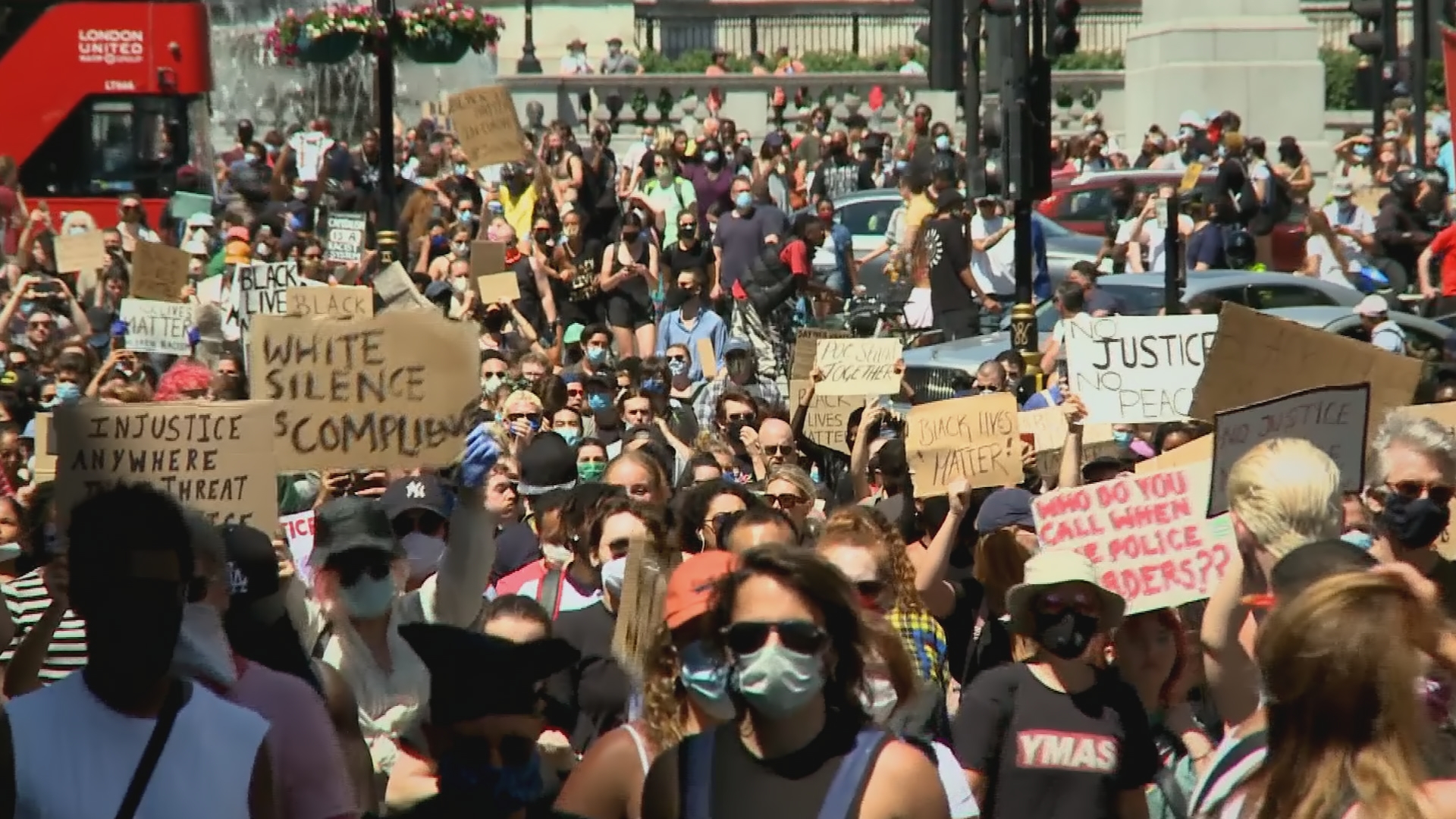
Resources: The framework to download / print. This assembly includes a still image that shows a Black Lives Matter protest in London.

The video
Title: The death of George Floyd and the Black Lives Movement
On the 25th May 2020, a black man called George Floyd was killed by a white police officer during an arrest in Minneapolis in America.
His death was captured on video, and seen by many people. The pictures showed the police officer kneeling on George Floyd’s neck for nearly 9 minutes.
“He was defenceless, he was handcuffed, he couldn’t do anything. And he was asking for him to just like get off of him”
George Floyd wasn’t the first black person to be killed by police in America.
It had happened many times before…and it’s happened since.
So, for many people when George Floyd died, enough was enough.
It shone a light on how badly black people are treated by others in our society - not just in America, but in countries all over the world. Including the UK.
Within days, thousands of people, in over 60 countries, had taken to the streets to express their anger at the unfair treatment of black people by the police, and to protest against the racism in America, and in their own countries.
All part of the Black Lives Matter movement.
{Crowd chanting}
“Black lives matter! Black lives matter!”
“Black lives matter! Black lives matter!”
There have been huge marches.
And in some cities, statues have been toppled by anti-racist protestors.
{people cheering}
But - what is the black lives matter movement, and why are people pulling down statues?
To understand, let’s start with a simple question.
What is racism?
“Racism is all about when you’re being mean about someone’s skin colour, their language and their religion”
“We all need to be treated equally. If someone’s treated badly, and the other person gets treated, um, really nicely, it isn’t fair”.
That’s right. Racism is when people treat other people unfairly, and assume bad things about them that aren’t true, just because of the colour of their skin.
All people of colour can experience racism in their lives.
But, in many countries - like America and the UK - black people are more likely to experience racial inequality than any other group.
The Black Lives Matter movement has been protesting the unfair treatment of black people - including by the police and other authorities since 2013 - long before the death of George Floyd.
They want to show people that black people matter just as much as everybody else, and to end racism for good.
By raising awareness about the issues faced by black people through protests.
And encouraging everybody to take action against racism. Not just by not being racist. But by being actively anti-racist.
“I think that everyone coming together and fighting for justice is such a beautiful thing to see. People from all walks of life.”
“I’m just happy that something is finally being done about it, and we’re all trying to push this movement further.”
“We need to change the system…People of colour deserve the same rights that white people do. And that’s what we’re fighting for.”
But - what does pulling down statues have to do with ending racism?
Well, the statues in our towns and cities remember important people from the past. But many of those people grew rich and powerful because of their involvement in the slave trade – the buying and selling of slaves from Africa.
Slavery caused unimaginable suffering for millions of African people.
And, even though it was abolished many years ago, it is still a source of much of the racism in our society today.
So for many people, the statues of slave traders proudly displayed in our towns and cities are a painful reminder that the suffering of black people is still not recognised widely today.
So they want the statues to be removed.
So that everybody in our society can live with equal respect and dignity.
“Equality. It means to me everybody is treated equally, and when I walk down the street or road I don’t have to be looked at differently just because of the colour of my skin.”
“Everyone’s different, and everyone’s special in their own equal way.”
“Everybody has equal rights. There should be no exceptions. Black lives matter.”
The video begins with the death of George Floyd, a black man who was killed by a white police officer in Minneapolis in America on 25 May 2020. Video footage of the arrest showed the police officer, Derek Chauvin, kneeling on George Floyd's neck for several minutes before his death.
George Floyd's death sparked protest marches in countries around the world, including the UK. Many of the protesters marched as part of the Black Lives Matter movement - a decentralised global network that campaigns for justice, equality and an end to racism.
In the UK several statues were pulled down or had words of protest written on them. These statues were generally of historical figures with links to the slave trade - for example, the statue of Edward Colston in Bristol. The protesters' actions have not only raised awareness of the UK's involvement in the slave trade but have also raised questions about how we record history and 'cancel culture'.
In April 2021 Derek Chauvin was convicted of George Floyd's murder and on 25 June he was sentenced to 22.5 years in prison.
Duration: 4' 59''
Last words: 'Everybody has equal rights. There should be no exceptions. Black Lives Matter.'
Video questions
- Why were people angry about George Floyd’s death? (George Floyd was mistreated by the police during his arrest - the police officer responsible for his death has subsequently been convicted of his murder; his death made him latest of many black people to die in America due to the actions of white police officers).
- Who can describe what racism is? (Being mean to someone, or treating them unfairly, because they are a different race to you or have a different colour skin). Wait for responses. Follow up with: ‘Do you think it is fair for people to be treated differently because of race?’
- Why did people pull down some statues in 2020? (The statues were of historical figures that owned or traded slaves. Looking for an awareness that although slavery isn’t around anymore, it’s the root of a lot of racism that does still exist).
- What is the main message of the Black Lives Matter movement? (That black lives matter just as much as all other lives; an end to racism). Wait for responses. Follow up with ‘Do you think the Black Lives Matter protesters want black people to be treated better than white people? (No. Looking for awareness that they just want equality).
Downloadable assembly resources
Assembly framework (pdf) document
Download / print the assembly framework ready for use
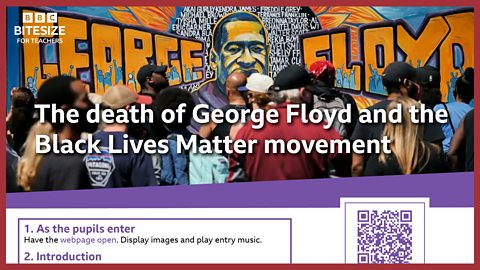
A Black Lives Matter protest in London. image
Click to display the image full-size
Suggested framework
1. Entry music
Play your chosen music as pupils enter.
2. Introduction
Tell the children that they will be hearing about the Black Lives Matter movement and the protests that took place in 2020. Explain to the group that this is a worldwide protest against people being treated differently just because of the colour of their skin. Ask pupils to think about the reasons why people are protesting while they watch the video.
3. The video
Play the video. The duration is 4' 59'' and the final words are: ' “Everybody has equal rights. There should be no exceptions. Black lives matter.” '
4. After the video
Ask everyone to turn to the person beside them and explain why it is important that we all treat each other fairly, whatever our race or skin colour.
5. Time to talk
Use the Video questions to help children to talk about the story and consolidate their recall of the events.
6. Opportunity to sing
An opportunity to sing your chosen song. Suggestions from BBC collections below.
7. Opportunity for reflection
Focus your reflection on the inequality and racism that is still part of our society today:
As you sit quietly, think about how it feels to be treated unfairly by other people…
Every person on the planet is unique…
We have different coloured skin…different coloured hair…eyes…
We speak different languages and our cultures are different…
But nobody should be treated badly or unfairly because of those differences…
Everyone has the right to be treated equally…and we can all play a part in making that happen…
…And in bringing an end to racism for good.
8. Opportunity for prayer
Use your normal form of address ('Dear God', 'Lord Jesus', 'Let us pray', etc) and:
Thank you for the courage of all those who stand up to racism and fight for our right to be treated equally.
Help us to treat everyone with the same respect, regardless of the colour of their skin.
Amen.
Suggested songs
Song: 'Together' - Vocal ('All about our school', no 13)
- Work together, not alone,
Gather round and share a problem.
Work together, hand in hand,
Gather round and work things out.
Chorus
‘Cos together, we can work it out together,
We can ride the stormy weather,
As long as we’re together we’re strong!
- There’s a setback, don’t despair,
Gather round and share your feelings.
Why just worry on your own?
Gather round and work things out.
Chorus
- If there’s trouble big or small,
Gather round and find an answer.
If you stumble there’s a friend,
Gather round and work things out.
Chorus
Song: 'While we live we learn' - Vocal ('All about our school', no 3)
While we live we learn, (while we live we learn,)
While we learn we grow, (while we learn we grow,)
And the more we grow, (and the more we grow,)
So the more we know, (so the more we know,)
And the more we know, (and the more we know,)
Then the readier we will be
For all life's big adventures
And all life's mysteries.
While we live we learn, (while we live we learn,)
While we learn we grow, (while we learn we grow,)
And the more we grow, (and the more we grow,)
So the more we know, (so the more we know,)
And the more we know, (and the more we know,)
Then the readier we will be
For all life's big adventures
And all life's mysteries.
For all life's big adventures
And all life's mysteries.