In short...
Themes: Recycling; caring for the planet; beautiful nature; pollution.
Summary:Recycle Week is supported by businesses and local authorities and aims to get everyone recycling more and to avoid unnecessary waste. Recycle Week, started by environmental campaign group WRAP, has been an annual event since 2002. In 2025 Recycle Week runs 22 - 28 October. The problem posed by waste plastic is the particular focus of this assembly.
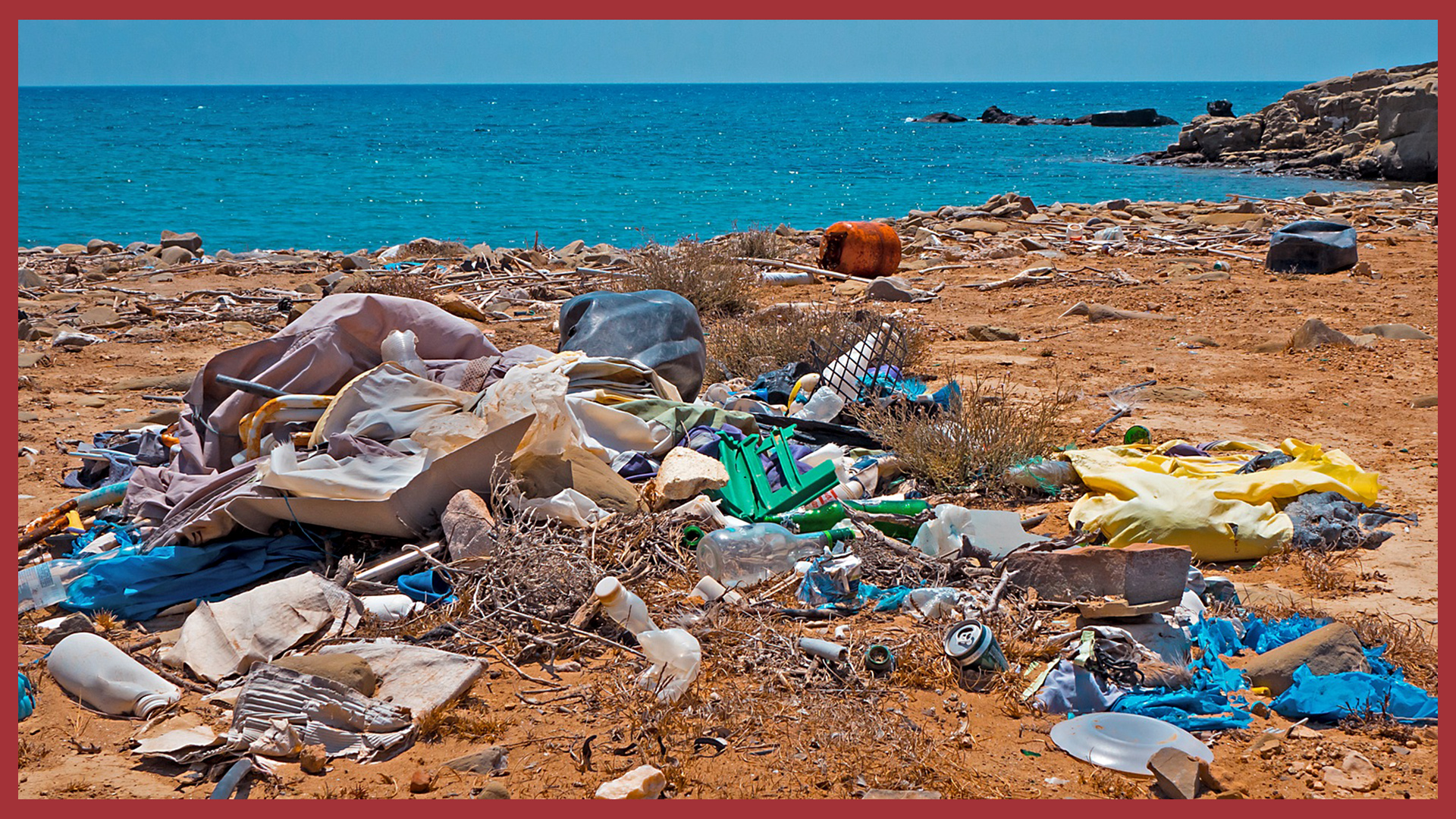
Resources: the framework to download / print and a picture of rubbish polluting a beach.

The video
This assembly features a video first published in 2018 in which Martin Dougan reports for CBBC Newsround on the pollution caused by plastic and in particular the 'trash islands' forming in places such as the Caribbean Sea.
Martin meets Richard, an expert trying to help us understand and deal with plastic pollution. Richard explains that the plastic we throw away often finds its way into the sea, where it can kill the fish, seabirds or other animals that get trapped in it or try to to eat it. Tiny, invisible bits of this plastic end up in our bodies too, when we eat fish or seafood. The warning is stark: 'Within the next 30 years the amount of plastic in our oceans could outweigh the fish.'
However, there are ways we can help solve the plastic problem by recycling when we can and choosing other materials when appropriate.
Duration: 02' 29"
Final words: 'And of course, recycle whenever you can.'
Video questions
- Before we used plastic bottles, what did we put milk or fizzy drinks in? (Bottles made of glass)
- How many tonnes of plastic do we use each year? (300 million tonnes)
- What percentage of the plastic produced is used only once? (40%)
- What four things mentioned in the video are made of plastic and normally used only once? (Plastic straws / Crisp packets / Bottles / Carrier bags)
- How many sea turtles have eaten plastic by mistake? (Scientists believe 1 in 3 turtles has eaten plastic by mistake)
Key links
Assembly framework (pdf) document
Download / print the assembly framework ready for use
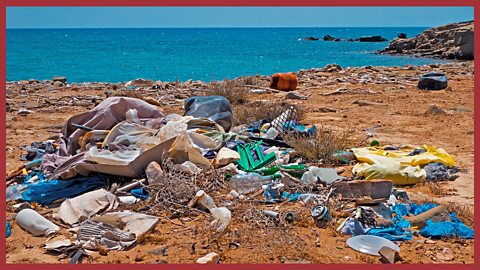
Image: plastic pollution. image
Click to display the image full-size
Suggested framework
1. Entry music
You could play the sound of the sea (search online for 'ocean sounds') or try BBC Earth, 'Ten Hours of Relaxing Oceanscapes' (also in the Related links section below) or the publicly-available BBC Sound FX library (again, also in the Related links below).
2. Introduction
Display the image of plastic waste on the seashore. Encourage pupils to identify different items. How many different plastic objects can they spot in the rubbish? What else do they think might be there? Ask: 'How do you think all these things got to the beach?' Gather pupils' responses and establish that, unless we take care, a lot of what we throw away finally ends up in the sea. Much of this rubbish, especially plastic, will stay around for hundreds of years unless we do something about it.
3. The video
Play the video. The duration is 02' 29" and the final words are: 'And, of course, recycle whenever you can.'
4. After the video
Tell the assembly: 'CBBC Newsround reports that we use more than 35 million plastic bottles in the UK every day. If that is correct, how many plastic bottles would this add up to in one year?' Invite pupils to use a calculator to work out the answer. They may find their answer is too big a number to be displayed in the usual way. Experts think that only around half of these bottles ever get recycled. Ask your calculator-bearing pupils to divide their enormous number by two: it's still an enormous number. Tell the assembly: 'Now many of these bottles may get used lots of times, so we can't be sure of the exact number of bottles we just use once. But clearly, we can do better.'
5. Time to talk
Lead a discussion by posing questions such as: 'Why is recycling so important?' / 'What stops people recycling things?' / 'Why do we throw so much stuff away?' / 'How can we get everyone to recycle more?' You could suggest that as a follow-up to the assembly pupils (and teachers) explore the 'Recycling Knowledge' resources of the Recycle Now webpage in the Related links section below. Tell the pupils about Recycle Week: seven days in September when we take some time to think about recycling, why it's important and what we can do to be better recyclers. Ask: 'Is there something you could do to help recycle plastic or to reduce plastic waste?' Encourage pupils to suggest things they could do to.
6. Opportunity to sing
If your assembly is to include a song this would be a good time for it. Suggestions from BBC collections below.
7. Opportunity to reflect
Our world is full of beauty…full of animals…and trees…and plants…and great wide oceans…
But it is fragile too and easily damaged…
Today, let's all think of ways to keep our beautiful planet healthy and unpolluted, for the animals and plants and children of tomorrow.
8. Opportunity for prayerUse your standard form of address ('Dear God', etc) and:
We thank you for our beautiful world, with its animals and trees and plants and great wide oceans.
We know it is fragile and easily damaged.
Help us today to find ways to keep our beautiful world healthy and unpolluted, for the animals and plants and children of tomorrow.
Amen.
Suggested songs
'Reduce! Reuse! Recycle!' (© BBC 2021)
We have got a message for you.
Listen to what you must do.
We need to save energy,
Protect the earth and air and sea!
Reduce! Reuse! Recycle!
Reduce! Reuse! Recycle!
We have got a message for you.
Listen to what you must do.
When you go to bed at night,
Turn off screens and turn off lights!
Reduce! Reuse! Recycle!
Reduce! Reuse! Recycle!
We have got a message for you.
Listen to what you must do.
Instead of driving, take a walk,
Then you can relax and talk!
Reduce! Reuse! Recycle!
Reduce! Reuse! Recycle!
We have got a message for you.
Listen to what you must do.
When you clean your teeth at night,
Switch the tap off, do what’s right!
Reduce! Reuse! Recycle!
Reduce! Reuse! Recycle!
We have got a message for you.
Listen to what you must do.
Try to use much less plastic,
Do your bit and feel fantastic!
Reduce! Reuse! Recycle!
Reduce! Reuse! Recycle!
Reduce! Reuse! Recycle!
Reduce! Reuse! Recycle!
Song: 'All things bright and beautiful' (Come and Praise, no 3. Vocal version)
All things bright and beautiful,
All creatures great and small,
All things wise and wonderful,
The Lord God made them all.
Each little flow’r that opens,
Each little bird that sings,
He made their glowing colours,
He made their tiny wings:
Chorus
The purple-headed mountain,
The river running by,
The sunset and the morning,
That brightens up the sky:
Chorus
The cold wind in the winter,
The pleasant summer sun,
The ripe fruits in the garden,
He made them everyone:
Chorus
He gave us eyes to see them,
And lips that we might tell
How great is God Almighty
Who has made all things well:
Chorus
Song: 'He's got the whole world' (Come and Praise, no 19. Vocal version)
He’s got the whole world, in His hand,
He’s got the whole wide world, in His hand,
He’s got the whole world, in His hand,
He’s got the whole world, in His hand.
He’s got the wind and the rain, in His hand,
He’s got the wind and the rain, in His hand,
He’s got the wind and the rain, in His hand,
He’s got the whole world in His hand.
Chorus
He’s got the sun and the moon, in His hand,
He’s got the sun and the moon, in His hand,
He’s got the sun and the moon, in His hand,
He’s got the whole world in His hand.
Chorus
He’s got the plants and the creatures, in His hand,
He’s got the plants and the creatures, in His hand,
He’s got the plants and the creatures, in His hand,
He’s got the whole world in His hand.
Chorus
He’s got everybody here, in His hand,
He’s got everybody here, in His hand,
He’s got everybody here, in His hand,
He’s got the whole world in His hand.
Chorus