And there she goes. She's underway now. The first time a jet-propelled boat has been on any slice of water anywhere in the world…
She's moving forward gently now, huge clouds of smoke coming out behind her. She's pushing the water up in front of her low-slung nose and Blue Bird's on her way now. She's whistling away down the lake now like some jet-propelled bullet.
Campbell's taking her easy. He doesn't quite know what she's going to do. There's been some fear that she might dive underneath the water because of the tremendous amount of power behind her or she might, if she went too fast, go clean up into the air.
And she's there in the middle of the lake now…and I can just see her. She's lying so flat and snug against the water that it's really the steam that I can see.
Now you can hear her at full throttle…!
1947: Sir Malcolm Campbell tests Blue Bird.
Sir Malcolm Campbell tests the latest version of his boat, Blue Bird K4, which for the first time has been fitted with a jet engine. The setting is Coniston Water in Cumbria. Campbell wasn't happy with the handling of the boat and he failed in his subsequent attempt on the world water speed record.
Campbell was the holder of 13 world speed records set in the 1920s and 1930s, both on land and water. His son, Donald Campbell, who took over the testing of Blue Bird K4 after his father died in 1948, was also the holder of both world land and water speed records. Donald later developed the Bluebird K7 (changing 'Blue Bird' to 'Bluebird') in which he broke the world water speed record 7 times in 10 years.
Donald set his first world water speed record of 202.32 mph on 23 July 1955 on Ullswater, and subsequently set new world water speed records six more times between 1955 and 1964, when he set a record of 276.33 mph on Lake Dumbleyung in Australia. Also in 1964 he set a new world land speed record of 403.10 mph at Lake Eyre in Australia.
On 4 January 1967 Donald Campbell was on Coniston Water in Bluebird when the front of the boat flipped up into the air and disintegrated just before he could attain his target speed of 300 mph. He was killed instantly. Donald Campbell's body was recovered from the lake 34 years later in 2001.
The image shows Donald Campbell in Bluebird (K7) on Coniston Water, Cumbria, shortly before his attempt on the water speed record on 4 January 1967 ended in tragedy. The audio describes Sir Malcolm Campbell testing Blue Bird (K4) for the first time in 1947.
Play next
Approaching the speed of sound. video
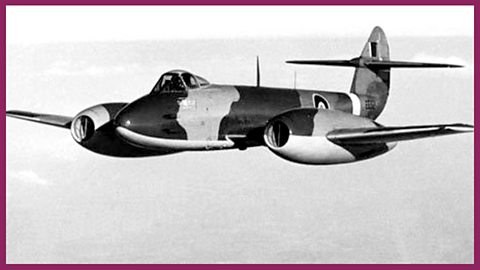
A BBC reporter approaches the speed of sound flying in a Gloster Meteor
A description of an early computer. video
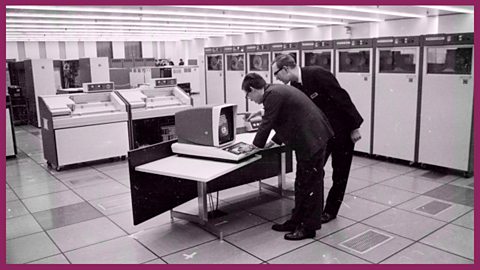
A reporter describes the computer used to assist counting at the 1955 general election
Early computers - like 'a living thing' video
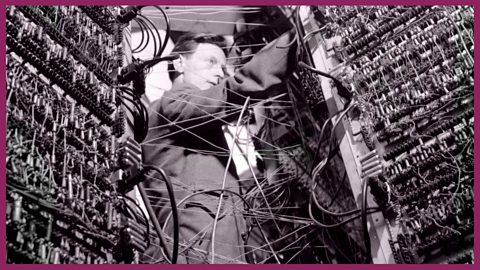
Early computers were very different from the PCs that we are all familiar with today.