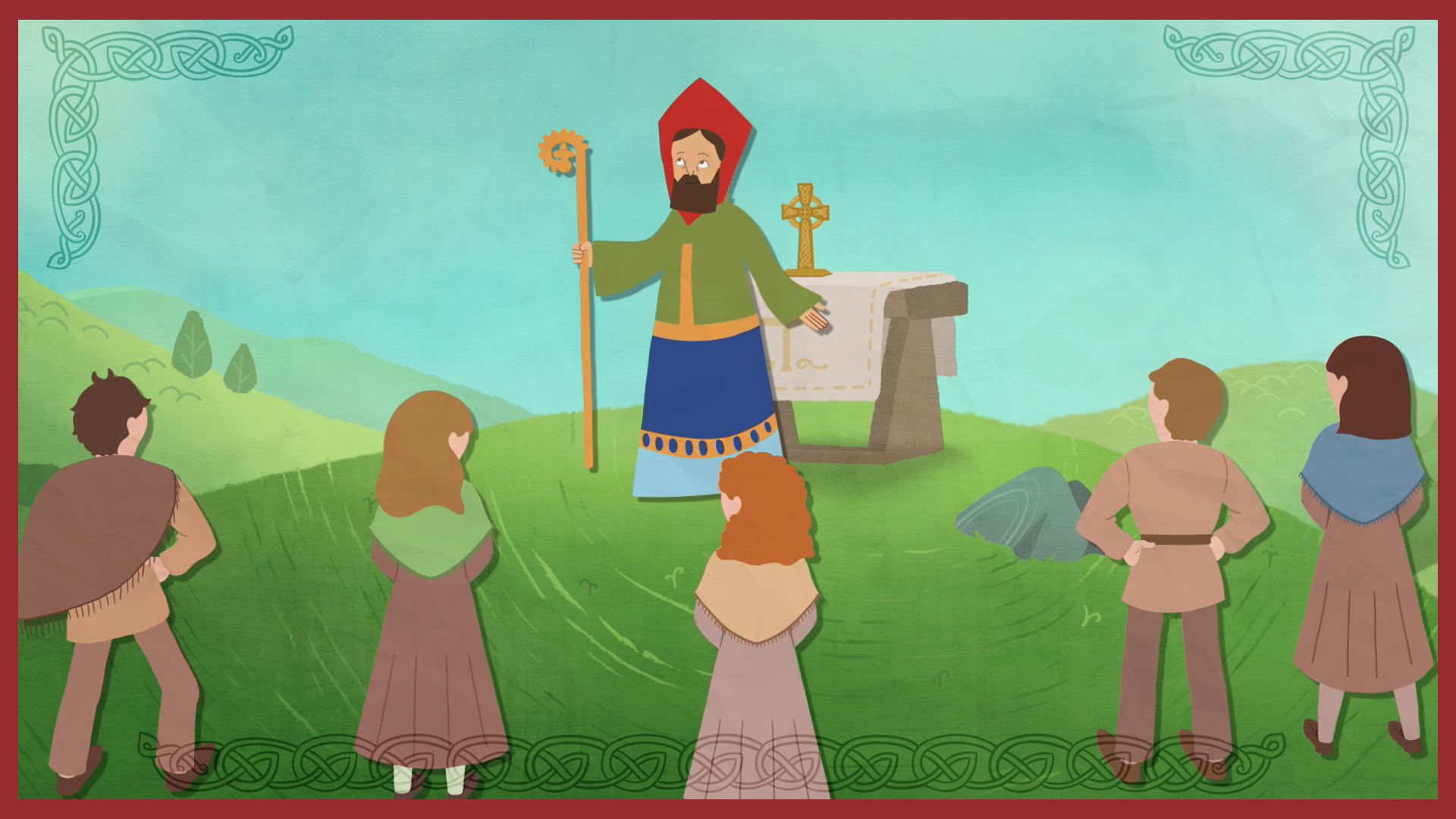
In short...
Themes: celebrating St Patrick's Day; the life of St Patrick; customs associated with St Patrick's Day around the world.
Summary: This assembly celebrates St Patrick's Day, which falls on 17 March each year. The video tells the story of St Patrick, based on his own writings about his life in the Confessio - how he was taken to Ireland by pirates and enslaved; how he eventually escaped; how he later returned to Ireland with a mission to convert the Irish to Christianity. The assembly is particularly suitable in the days preceding St Patrick's Day, or used in conjunction with our other content exploring the patron saints of the UK.
Resources: The framework to download / print (pdf), an illustration of St Patrick preaching in Ireland and a world map showing the sites of some St Patrick's day celebrations.

The video
Every year on 17 March people all over the world celebrate St Patrick’s Day.
Places like Dublin in Ireland, New York in the USA and Tokyo in Japan hold enormous parades with dancers, musical bands and giant parade floats.
Some cities even use lights to turn buildings emerald green. In Chicago, in the US, they use dye to turn the river green!
But what’s this all got to do with St Patrick?
Well, St Patrick is the patron saint of Ireland, an island long known for its green hills and fields. But it might surprise you to know that Patrick was born in Britain rather than Ireland, about 1500 years ago. And he didn’t choose to go to Ireland. You could say, Ireland chose him…
Because when Patrick was just a teenager, he was kidnapped by pirates, taken across the Irish sea…sold as a slave…and put to work looking after animals.
Lonely and afraid, Patrick turned to his Christian faith to help him through this dark time.
One night, Patrick dreamt that a ship was ready and waiting to take him home. When he awoke, he summoned all his courage and escaped to the coast, where he really did find a ship about to set sail.
After six long years he was reunited with his family.
Patrick’s Christian faith had grown during his time in captivity, and he decided to become priest.
It was around this time Patrick had another dream, in which he heard voices crying out for him to return to Ireland.
He decided this was a sign from God, and that he should do all he could to spread the Christian faith in Ireland.
By the time he returned, Patrick had become a bishop.
Now, Ireland wasn’t an easy place to convert people to Christianity. Most people were pagans, which means they already had their own religion with lots of different gods.
This meant whatever Patrick did he was in constant danger. But he still travelled far and wide, converting people to Christianity wherever he went…and he was so popular some other bishops even got jealous!
We know this is because of his book, called the Confessio, which Patrick wrote towards the end of his life. In it he describes his early life, and his time in Ireland.
Even though it was written over 1500 years ago, historians believe it gives a clear idea of what his life was like. But it does have some bits that could be…untrue. Like the bit where he says he brought people back from the dead…
In fact there are many stories about St Patrick that may have just been made up. One legend is that Patrick used the shamrock as a way to teach people about the Holy Trinity…with the three leaves meaning the ‘Father’, the ‘Son’ and the ‘Holy Spirit’.
Another story is that Patrick was responsible for driving all the snakes out of Ireland. But snakes were never there in the first place.
There’s even a legend that Patrick saved a group of hungry sailors who were shipwrecked, completely out of food. Supposedly Patrick heard about their plight and prayed deeply for their safety…and suddenly, just as the sailors had lost hope, a group of pigs miraculously appeared!
Whether these stories are true or not, we do know that by the time he was old Patrick had founded monasteries, created schools and had helped people make Ireland into a Christian country, just as he had planned.
As Irish people travelled and settled around the world they brought the story of St Patrick with them to the many different countries. Where he continues to be remembered and celebrated today, along with the Irish culture and heritage he is part of.
St Patrick was probably born on the western coast of either England or Wales, about 1500 years ago. The video animation tells the story of his life, based on his own writings in the Confessio. Patrick describes how he was captured and taken to Ireland by pirates, where he was enslaved and set to work looking after animals. Patrick says that when he escaped to the coast he found a ship and sailed away to freedom, eventually reuniting with his family about six years later.
Patrick's Christian faith grew; he became a bishop and some years later returned to Ireland on a mission to convert the Irish to Christianity. It was a difficult and dangerous time for Patrick, but over the years he established churches and schools throughout the island.
Today St Patrick's Day is a truly global phenomenon, with celebrations throughout the world.
Duration: 4' 09"
Final words: '…and heritage he is part of.'
Video questions
- What are some of the ways that St Patrick's Day is celebrated around the world? (Parades, floats, bands, turn buildings green, in Chicago dye the river green)
- How did Patrick arrive in Ireland? (He was captured by pirates and taken across the Irish Sea, where he was enslaved)
- What did Patrick dream of in Ireland? (A ship at the coast, ready to take him away)
- Why did Patrick return to Ireland? (To convert the people - who were pagans - to Christianity)
- What are some of the stories about Patrick that may not be true? (Bringing people back from the dead; driving snakes out of Ireland; performing miracles)
Key links
Assembly framework (pdf) document
Download / print the assembly framework ready for use
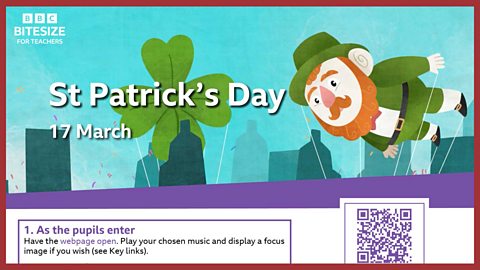
Image: St Patrick preaching in Ireland. image
Click to display the image full-size
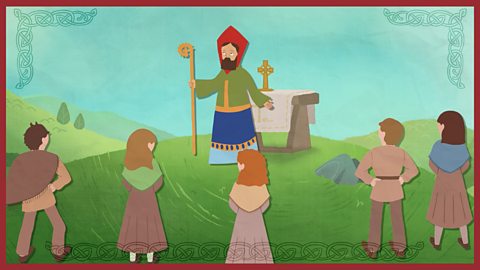
Image: world map showing St Patrick's Day celebrations. image
Click to display the image full-size
Suggested framework
1. Entry
Play your chosen music and display one of the images from 'Key links' if you wish.
2. Introduction
Begin by asking the assembly if they know what a 'saint' is? You could play the short video called What is a saint? Gather responses. Follow up by asking if anyone knows what a patron saint is? (A patron saint is a saint who has a special connection to either a particular place or a particular community of people). You could follow up by asking the names of the patron saints of the UK and Ireland and, if using the assembly in the days preceding St Patrick's Day, whether anyone can say which Patron Saint's Day is approaching.
Establish that St Patrick's Day falls on 17 March and that today the assembly will be hearing about his life and thinking about what we can learn from it.
3. Play the video
The duration is 4' 09" and the final words are: '…and heritage he is part of.'
4. After the video - time to talk
Use the Video questions to help pupils recall the events of St Patrick's life and consolidate their understanding:
- What are some of the ways that St Patrick's Day is celebrated around the world?
- How did Patrick arrive in Ireland?
- What did Patrick dream of in Ireland?
- Why did Patrick return to Ireland?
- How do we know about Patrick's life?
- What are some of the stories about Patrick that may not be true?
Ask the assembly: What can we all learn from the life of St Patrick?
5. Time to sing
Suggestions from BBC collections below.
6. Opportunity to reflect
Ensure everyone is listening carefully and focus the reflection on the courage St Patrick showed in returning to the place where he had been held captive.
Today we've heard about St Patrick - the patron saint of Ireland…
We've heard how Patrick was captured when he was just a boy and taken to Ireland, to work as a slave…
Think to yourself how Patrick must have felt - alone, separated from family and friends, uncertain of the future…
Later in his life Patrick decided to return to Ireland, even though he knew it would be dangerous…
There are times in all our lives when we have to show the courage that Patrick showed…
Think about a time when you've had to show courage and determination yourself…
7. Opportunity for prayer
Schools with a Christian ethos might say the prayer 'St Patrick's Breastplate' - see below for the words.
Otherwise:
Dear God
Thank you for the life of St Patrick and all those people who have shown great courage.
When we need to show courage ourselves help us to remember the people who can inspire us.
And help us to always do what is right - even when that means showing great courage.
Amen.
'St Patrick's Breastplate'
Christ be with me
Christ be before me
Christ be behind me
Christ be within me
Christ be beneath me
Christ be above me
Christ be at my right
Christ be at my left
Christ be in the heart of everyone who thinks of me
Christ be in the mouth of everyone who speaks of me
Christ be in every eye that sees me
Christ be in every ear that hears me
Amen
Suggested songs
'God is watching over you' (All about our school, no 7)
God is watching over you,
When you lay down to sleep,
When you wake he will keep
Always watching over you,
Now and forever more.God is watching over you,
When you lay down to sleep,
When you wake he will keep
Always watching over you,
Now and forever more.
Now and forever more.
Song: 'Give me oil in my lamp' (Come and Praise, no 43. Vocal version)
- Give me oil in my lamp, keep me burning.
Give me oil in my lamp, I pray.
Give me oil in my lamp, keep me burning,
Keep me burning till the break of day.
ChorusSing hosanna, sing hosanna,
Sing hosanna to the King of Kings!
Sing hosanna, sing hosanna,
Sing hosanna to the King!
- Give me joy in my heart, keep me singing.
Give me joy in my heart, I pray.
Give me joy in my heart, keep me singing,
Keep me singing till the break of day.
Chorus
- Give me love in my heart, keep me serving.
Give me love in my heart, I pray.
Give me love in my heart, keep me serving,
Keep me serving till the break of day.
Chorus
- Give me peace in my heart, keep me resting.
Give me peace in my heart, I pray.
Give me peace in my heart, keep me resting,
Keep me resting till the break of day.
Chorus
Song: 'Peace is flowing' (Come and Praise, no 144. Vocal version)
Peace is flowing like a river,
Flowing out through you and me,
Spreading out into the desert,
Setting all the people free.Love is flowing like a river,
Flowing out through you and me,
Spreading out into the desert,
Setting all the people free.Joy is flowing like a river,
Flowing out through you and me,
Spreading out into the desert,
Setting all the people free.Hope is flowing like a river,
Flowing out through you and me,
Spreading out into the desert,
Setting all the people free.
Related links
Video: What is a saint? - children offer their views on what a saint is (BBC Teach)
Audio: The life of St Patrick - an audio story based on what we know of St Patrick's life (BBC Teach)
Other assemblies about patron saints
St George's Day. collection
KS1 / KS2. Celebrating St George's Day (23 April); the life of St George; saints; courage.
St David's Day. collection
KS1/KS2. Celebrating St David's Day (1 March); patron saints; the life of St David; devotion.
St Andrew's Day. collection
KS1. Celebrating St Andrew's Day (30 November); patron saints; celebrating special days.