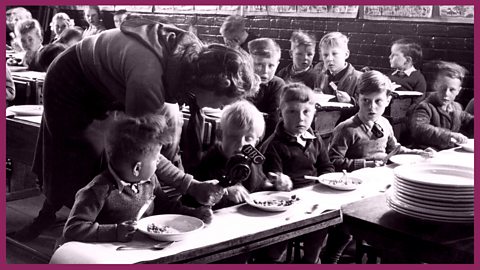
JOHN McKENZIE: Well, I think in two ways the service is very successful. It's very successful as far as the child is concerned from a social point of view. It's obviously very important for him to have chats and games with his friends in the lunch hour rather than going home as soon as lessons are over. And also from the mother's point of view, it's very successful because it gives her free time - either for part-time work or to have shopping or tea parties, whatever she wants to do, and I think this is valuable.
REPORTER: What do the children themselves think about their school lunches? The ones I spoke to this morning seemed quite satisfied with what they got.
CHILDREN: We have custard and brown pudding sometimes.
Potatoes, beans, cabbage. We get salads with beetroot and lettuce and all sorts of celery.
Sometimes we get cake and custard or you can have cake alone or custard alone.
REPORTER: But there were some other things they wouldn't mind having all the same, quite exotic too.
CHILDREN: I'd like to have curry.
Spaghetti Bolognese I'd like.
I'd like French food. Rice and all different kinds of things like rice.
I'd like chicken.
Dumpling soup. Turkey. Mushroom soup.
I did have some Chinese food when I went out to this outing. Curry, Chinese I think it was.
Would you like to have that at school?
I would like, instead of water, I'd like lemonade.
1968 - School meals were originally provided in some Victorian schools on a purely charitable basis. The malnutrition of many children was clear for all to see and in 1906 the government - in part concerned about the health of young people in the event of war - introduced the Education Act empowering local authorities to provide school meals.
Uptake remained relatively slow though until the new Education Act of 1944 made the provision of school meals compulsory. The 1946 Milk Act allowed 1/3 pint of milk to be issued free to every child under 18 - and the decision in 1971 to end free milk for children over seven became a divisive political issue.
In 1968 about 70% of children ate a meal in school at midday. The food was typically meat and two veg, or perhaps an alternative like macaroni cheese; it was 'fish on Friday' and there was always a cooked dessert like jam sponge and custard.
In this clip John McKenzie, of the Office of Health Economics, considers the benefits of the school meal service: as well as providing a nutritious meal it also allows a social occasion for the children and frees up time for parents.
The provision of school meals is never very far from the headlines. In 2003 the news that catering companies providing school meals may spend as little as 31p per child per meal sparked a national outcry.
Play next
Report on the school meal service. video
The value to children of the school meal service - and what children would like to eat.
Do children wash too frequently? video
Children give their views on whether they are expected to wash too often.

Decimilisation - a new 25p coin? video
Is a new 20p or 25p coin needed following decimilisation?