In short...
Themes: the Hindu festival of Diwali; celebrating world religions; the story of Rama and Sita; good overcoming evil; light overcoming darkness.
Summary: Diwali is a five-day festival celebrated by Hindus, Sikhs and Jains. The festival celebrates new beginnings and the Hindu New Year. It usually takes place in October or November - the exact date is determined by the Hindu lunar calendar. It is closely associated with the story of Rama and Sita.
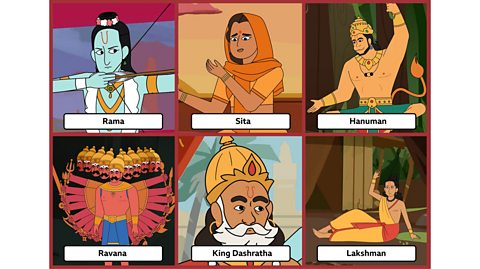
Resources: the assembly framework to download as a pdf; a poster showing the main characters in the story and a transcript of the story.

The video
Long, ago, in a kingdom called Ayodhya, there lived a king called Dashratha, who had four sons by three different wives: Rama (who was the eldest), Lakshman and Satrugna (who were twins), and Bharat (the youngest).
It was a time for rejoicing in Ayodhya. Rama had married a beautiful princess called Sita and now, at last, King Dashratha could hand over the throne to his son.
But the mother of Dashratha’s youngest son, Bharat, was jealous: she wanted the throne for her own son.
The king had once promised to grant her a wish, and now she saw her chance. She told the king that she wanted Rama to be sent away for fourteen years and her own son, Bharat, to be placed on the throne.
What was the king to do? He had made a promise, so reluctantly he banished Rama to the forest, with his new wife, Sita, and his brother Lakshman.
For some while they lived a simple, peaceful life in the forest. But one day, everything changed.
Ravana - the demon king! He had twenty arms and ten terrible heads. He spotted Sita and was so entranced by her that he decided she should belong to him. And using his magic, he created a beautiful golden deer as a trap.
When Sita saw the deer, she begged Rama to catch it for her. But first he placed Sita in a magic circle, to keep her safe from any danger.
As soon as Sita was alone, Ravana put the rest of his plan into action. He turned himself into an old man and tricked Sita into stepping out of the magic circle. Then Ravana grabbed her and swept her into his chariot, pulled by winged demons. They flew high into the sky, towards Ravana’s island home of Lanka.
Despite her fear Sita thought quickly and she dropped her jewellery, piece by piece, over the side of the chariot to leave a trail on the ground below.
Back in the forest, Rama soon realised he’d been tricked and frantically he ran back to where he had left Sita, but it was too late.
Then he spotted the jewellery on the ground - and thought how clever his wife was - and he followed it until the trail ended. Now what should he do?
As Rama sank to the ground in despair - Hanuman, the monkey king himself!
Hanuman took Rama to the monkey city, where he called together the monkey army and their friends, the great bears, all ready to search for Sita.
Hanuman was not only the monkey king: he possessed special powers - he could fly! So, naturally, it was he who found Sita, imprisoned on Ravana’s island, and received from her a pearl to take to back to Rama.
So Rama, Lakshman and Hanuman prepared for battle. But Sita was on an island - how were they to cross the sea to save her?
Hanuman had a plan and told the monkey army to work together to build a bridge out of the rocks, grass and sand that lay on the edge of the shore.
Then Hanuman’s animal army poured across the bridge and the fighting began. The battle was long and terrible, but, at last, Rama spotted the demon king. Rama pulled out the bow that he carried on his back and with it a single arrow. It had been a gift from the gods, and as Rama took aim, he chanted a prayer that the arrow would meet its target. It shot out of the bow with a blinding flash and the demon king fell to the ground, dead.
The whole world rejoiced. Not only was the evil Ravana defeated but, their exile over, Rama and Sita could return home. To celebrate the people of Ayodhya lit small lamps and placed them in the windows of their houses to guide Rama and Sita home. There seemed to be more flickering lights than stars in the sky and, with Rama now king, Ayodhya could once more be at peace.
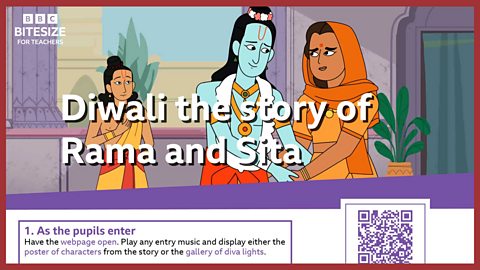
Diwali - The story of Rama and Sita
Dashratha, King of Ayodhya, has four sons by three different wives: Rama (the eldest), Lakshman and Satrugna (who are twins) and Bharat (the youngest). Rama has married Sita and Dashratha wishes to pass the throne to his eldest son. But the mother of Dashratha's youngest son, Barat, is jealous and wants her child to be king. She forces Dashratha to exile Rama, Sita and Lakshman to the forest for 14 years.
In the forest the evil demon Ravana seizes Sita and takes her to his island home of Lanka. Rama follows a trail of Sita's jewellery and then meets Hanuman, the monkey king. Hanuman uses his power of flight to discover where Sita is and then, with Rama, they raise an army of animals and march on Lanka. Rama kills Ravana with a magic arrow and then, their exile over, he returns to Ayodhya with Sita and Lakshman. The people light their way home with little lamps left outside their homes.
End of speech: '…Ayodhya could once more be at peace.'
Duration: 5' 05"
Video questions
- Who are the oldest and youngest of Dashratha's children (Rama and Bharat)
- What is the name of Rama's wife? (Sita)
- How does the evil demon Ravana trick Rama and Sita? (He magics a golden deer to lure Rama away; he disguises himself as an old man to trick Sita)
- Who is Hanuman and what special power does he have? (The monkey king; he can fly)
- How does Rama defeat Ravana? (He kills him with a magic arrow which was a gift from the gods)
- How do Rama and Sita find their way home? (The people light their way home with little lamps outside their homes)
Resources
Assembly framework (pdf) document
Download / print the assembly framework ready for use
Poster - The characters in the story. image
Display a poster of the characters in the Rama and Sita story
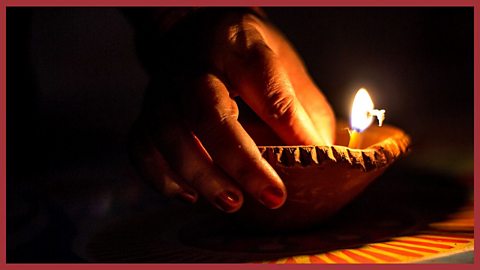
Slideshow: diva lights image
Click to display a slideshow of six images of diva lights
Suggested assembly framework
1. Entry music
As the children enter select from a range of music hinting at the theme of the assembly - eg 'Celebration' (Kool and the Gang). Or you could play a piece of Indian music (there are various songs online celebrating Rama and Sita) or you could consider using the backing tracks to the suggested songs below, which are available here.
2. Introduction
Ask everyone to close their eyes and spend a moment picturing a light shining in the darkness. If you prefer you could display the gallery of diva lights. Then ask everyone to open their eyes again and ask if anyone would like to share how the image of a light shining in the darkness made them feel. Tell the assembly that a light shining in darkness is a common feature in many stories and a theme of many festivals - including the Hindu festival of Diwali, which is known as the 'Festival of Light'. Tell the assembly that a light shining in darkness is an important feature of the story of Rama and Sita - which is an ancient story often told at Diwali.
3. The video
Play the video. The duration is 5' 05" and the final words are '…could be at peace again.'
4. After the video
Ask everyone to tell the person next to them two things they can remember from the video and their favourite part of the story. Then lead a discussion of the story by asking some or all of the following:
- What is Diwali? (The Hindu festival of light).
- What is the name of the story that Hindus remember at Diwali? (Rama and Sita).
- Why were Rama and Sita banished to the forest? (Because Bharat's mother demanded it and King Dashratha had once promised to grant her one wish).
- How did Ravana manage to seize Sita and take her away? (He created a golden deer to lure Rama and away and then disguised himself as an old man to trick Sita).
- Who helped Rama to get Sita back? (Hanuman - the monkey king).
- How did Rama defeat Ravana? (With a magic arrow).
- What role does light shining in the dark have in the story? (The little lamps lighting the way home for Rama and Sita…more broadly light overcoming darkness and good overcoming evil).
5. Opportunity to sing
An opportunity to sing your chosen song. Suggestions from BBC collections below.
6. Opportunity for reflection
Focus the reflection on 'light' - linking to a key theme of Diwali. Ask children to think carefully as you lead the reflection:
What makes you see the light…?
Sometimes we have to search hard for a light when life isn't great…
Rama and Sita were like lights shining brightly for each other…
How can you be the light shining for somebody in your life…?
How can you light the way to do the things you wish to do and become the things you wish to be…?
7. Opportunity for prayer
These thoughts could also be turned in to a prayer, using your standard form of address ('Dear God', 'Dear Lord', 'Let us pray', etc) and:
You tell me to walk in your light.
I hope that I can walk in your light and create my own light for others to see and feel.
Help me to be a bright beacon of light so that I can guide the way for others.
When I struggle to see your light, remind me where it is so that I can live a truly colourful, bright life.
Amen.
Suggested songs
Song: 'Peace is flowing' (Come and Praise, no 144. Vocal version)
Peace is flowing like a river,
Flowing out through you and me,
Spreading out into the desert,
Setting all the people free.Love is flowing like a river,
Flowing out through you and me,
Spreading out into the desert,
Setting all the people free.Joy is flowing like a river,
Flowing out through you and me,
Spreading out into the desert,
Setting all the people free.Hope is flowing like a river,
Flowing out through you and me,
Spreading out into the desert,
Setting all the people free.
Song: 'Chain of love' (All about our school, no 14. Vocal version)
- For the children of tomorrow
We’ve got to make it a better place,
Fill the world with love and laughter,
Make a fresh start for the human race.
(Chorus)
Chain of love, chain of love,
Circle the world with a chain of love,
Chain of love, chain of love,
Circle the world with a chain of love.
- No more war and no more hunger,
No more jealousy and hate,
Say goodbye to greed and sadness,
Make a change now or it will be too late.
(Chorus)
(Middle eight)
Circle the world, circle the world,
Circle the world, circle the world.
- Doesn’t matter where you come from,
Doesn’t matter where you’ve been,
Different race or creed or colour,
We are the same underneath our skin.
(Chorus)
Chain of love, chain of love,
Circle the world with a chain of love,
Chain of love, chain of love,
Circle the world with a chain of love.
Circle the world with a chain of love.
'Celebration rap' (Come and Praise Beginning, no 7).
(1) Come and shout for joy!
(2) Come and shout for joy!
(1) Come and shout for joy
and clap your hands!
(2) Come and shout for joy
and clap your hands!
(1) Come and shout for joy
and clap your hands
and stamp your feet!
(2) Come and shout for joy
and clap your hands
and stamp your feet!
(1) Come and shout for joy
and clap your hands
and stamp your feet
and turn around!
(2) Come and shout for joy
and clap your hands
and stamp your feet
and turn around!
Related links
A transcript of the Rama and Sita story to download / print.
Our KS1 assembly for Diwali. This assembly also features the story of Rama and Sita and is suitable for a younger age group.
Our KS2 assembly for Diwali, featuring a film about a Hindu family celebrating Diwali, including making rangoli decorations.
A slideshow of Diwali diva lamps, suitable to display during a time of reflection.
What is Diwali? from BBC Bitesize.

