In short...
Themes: Buddhism; the life of the Buddha; the festivals of Wesak and Parinirvana Day; the Eightfold Path.
Summary: this assembly is suitable at about the time of the festivals of Wesak (April or May) and Parinirvana Day (15 February for most Buddhists). Wesak celebrates the Buddha's birthday and, for some Buddhists, also marks his enlightenment and death. It is also called Buddha Day. In 2026 Wesak falls on 1 May. Parinirvana Day remembers the time the Buddha attained Nirvana - or enlightenment.
Resources: The framework to download / print (pdf), an illustration of the Buddha under the bodhi tree and an illustration of the Wheel of Dharma.

The video
Statues of the Buddha, Bodhi trees, and lotus flowers. They’re all important symbols of Buddhism - the religion followed by Buddhists.
Buddhism is one of the largest religions in the world. It’s the most popular religion in many Asian countries - like China, Thailand and Japan - but there are Buddhists in countries all around the world.
Rather than worshiping a god, Buddhists follow the teachings of a man who lived long ago. As a young man he was called Siddhartha Gautama.
Siddhartha lived over 2,500 years ago in a country now called Nepal, which borders India.
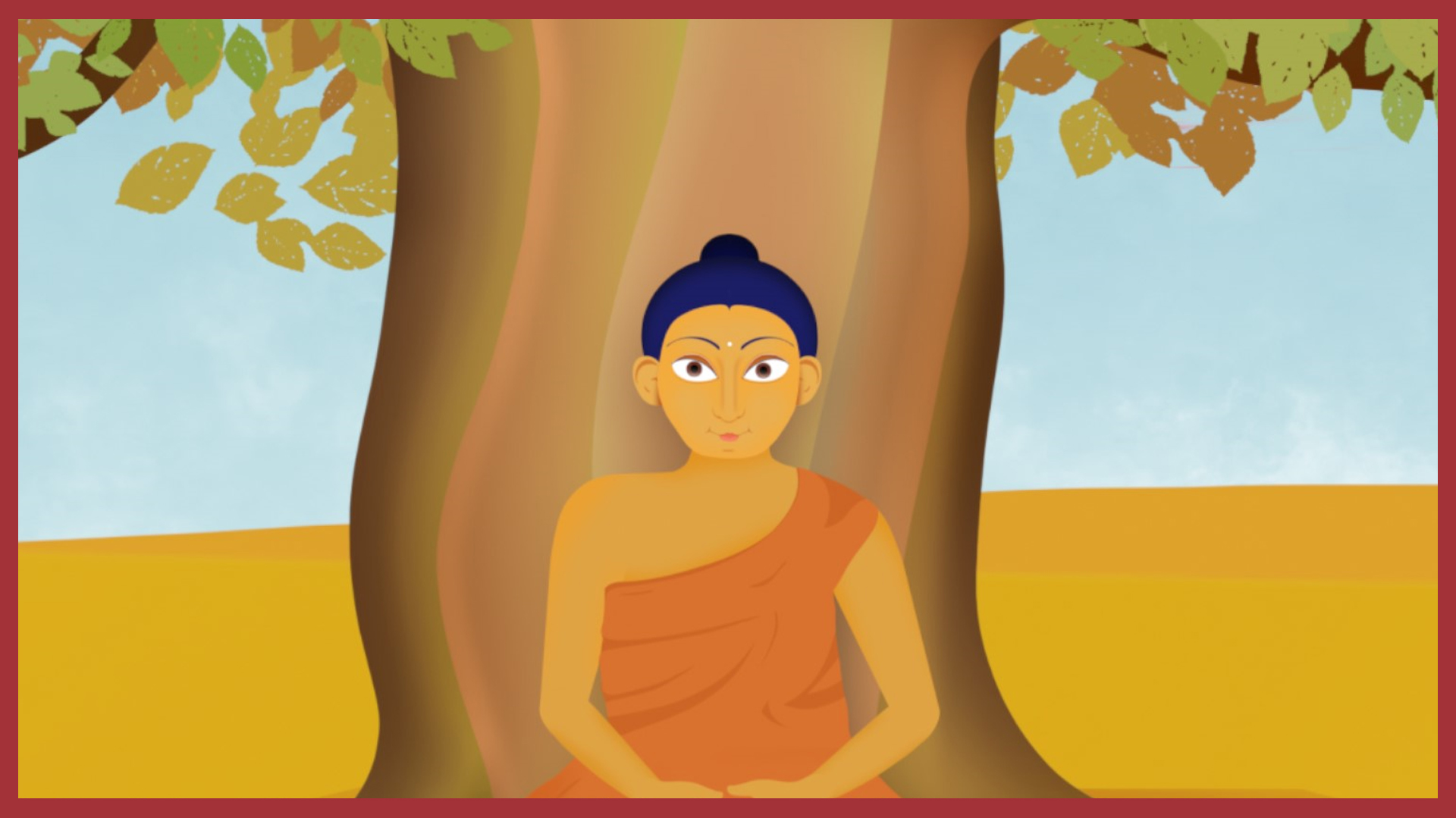
Siddharta had many questions about life…and legend has it that he sat in the shade of a bodhi tree for 49 days thinking about the meaning of life and how to find happiness.
He finally achieved enlightenment, also known as Nirvana - a spiritual state in which everything is understood.
From this day on he was known as ‘the Buddha’ – which means ‘the Enlightened One’ or ‘One Who Knows’.
The Buddha wanted to share his experience, so he became a teacher, trying to help others find the same happiness.
The Buddha taught his followers the Four Noble Truths, which is understanding that life involves suffering, but that suffering can be ended by following the Eightfold Path.
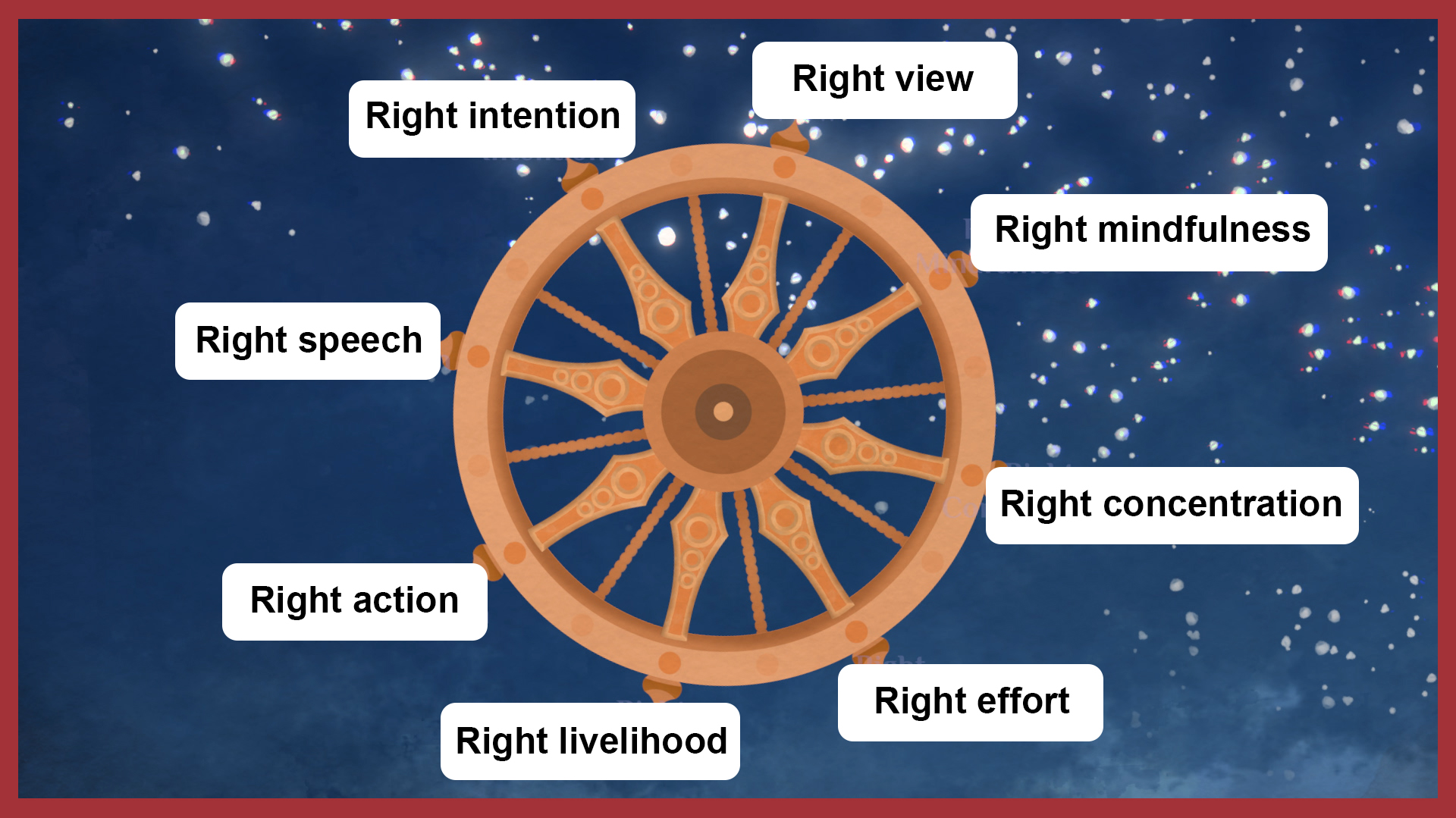
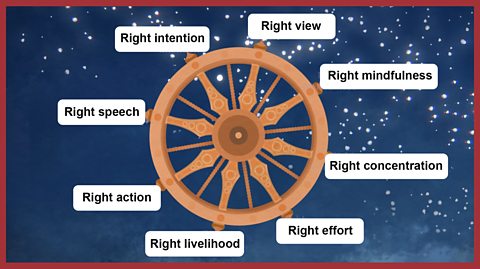
The Eightfold Path is represented by the wheel of Dharma, with eight handles representing eight ‘rights'. That is, eight right things to do in order to seek enlightenment.
They are:
Right view – understanding the Buddha’s teaching.Right intention – being committed to following his teaching.Right speech - speaking or writing truthfully and kindly.Right action – behaving kindly and helpfully.Right livelihood – doing work which helps others.Right effort – making an effort to practise the Buddha’s teachings.Right concentration – learning meditation, andRight Mindfulness – learning to be aware of yourself and others.
Many Buddhists aim to follow these 8 principles every day.
The Buddha taught that everything changes and that, even if we sometimes feel sad about change and loss, they are a completely natural part of life.
The Buddha also taught the value of meditation. It is a way to clear the mind and encourage positive thinking.
Many non-Buddhists find it helpful too, like these schoolchildren!
The life of the Buddha is celebrated with festivals: Wesak – or Buddha Day - happens at the full moon in May, and Parinirvana Day – sometimes known as Nirvana Day - happens in February.
Lanterns are released into the sky to celebrate Wesak.
These Thai Buddhists visiting a temple at Wesak are receiving a blessing from monks who splash them with water as a symbol of purity.
Many Buddhists burn incense as a symbol of respect and gratitude for the Buddha and his teachings.
The flowers symbolise change - that even beautiful things must grow old and die.
At Buddhist festivals people often visit temples, to remember the Buddha and his teachings, listen to readings and talks, and meet their friends.
There may be chanting and meditation.
Some Buddhists mark festivals by eating together and some may bring offerings to the Buddha such as money, or incense or flowers.
Both Wesak and Parinirvana Day, are an opportunity for Buddhists to give thanks for the life of the Buddha and to reflect on his teachings, including the Eightfold Path to Enlightenment.
Buddhists follow the teaching of the Buddha who, as a young man, was called Siddhartha Gautama. According to Buddhist tradition, Siddhartha thought hard about the world and its issues and eventually came to understand the Four Noble Truths: that life involves suffering; suffering is due to wants and desires; suffering can be ended by overcoming desires; and that the way to end suffering is to follow the Eightfold Path.
The Eightfold Path is represented by the Wheel of Dharma. The wheel indicates the eight right actions or approaches that the Buddha taught his followers to observe. These include consideration of others and practicing meditation.
During Wesak Buddhists will attend services at the temple and make offerings. Often lanterns are released into the night sky. Both Wesak and Parinirvana Day are an opportunity to celebrate the life of the Buddha and to reflect on his teaching, including the Eightfold Path.
Duration: 4' 25"
Final words: '…including the Eightfold Path to Enlightenment.'
Video questions
- Can you name three countries where Buddhism is the most popular religion? (China, Thailand, Japan)
- What was the name of the Buddha when he was a young man? (Siddhartha Gautama)
- In which country was he born? (Nepal)
- According to Buddhist legend, how many days did Siddharta sit under the bodi tree? (49 days)
- What does 'the Buddha' mean? ('The Enlightened One' or 'One Who Knows')
- What is the Eightfold Path? (Eight actions - or right things to do - as taught by the Buddha)
- What are the names of the two festivals explored in the film? (Wesak and Parinirvana Day)
Key links
Assembly framework (pdf) document
Download / print the assembly framework ready for use
Illustration: the Buddha. image
Click to display image full size
Illustration: the Wheel of Dharma. image
Click to display image full size
Suggested assembly framework
1. Entry
Play your chosen music and display one of the focus images if you wish.
2. Introduction
Tell the assembly:
Today we'll be hearing about a very special person - someone who has had an enormous impact on the world. But this special person isn't a king or a queen…they aren't a politician or an inventor…or even a famous footballer. Today this person is known as the Buddha and he was the founder of the religion called Buddhism. And we're learning about him today because the festival of Parinirvana/Wesak (whichever is appropriate) happens at this time of year. To find out more we're going to watch a short video and, while you watch, consider the teachings of the Buddha and what you think about them.
3. The video
Play the video. The duration is 4' 25" and the final words are: '…including the Eightfold Path to Enlightenment.'
4. After the video - Time to talk
Lead a discussion of the video by asking some or all of the following questions:
- In which part of the world is Buddhism the most popular religion? (Many Asian countries, including China, Thailand and Japan)
- Can you remember what makes Buddhism different from other religions? (Buddhists follow the teachings of the Buddha, rather than believing in a god)
- Can you remember how, according to Buddhist tradition, Siddatha Gautama achieved enlightenment? (He sat under a tree for 49 days thinking about life until he understood everything)
- How can Buddhists today try to achieve enlightenment? (They can follow the Eightfold Path - learning about the Buddha's teaching; writing, speaking, acting kindly; helping others; meditation; being aware of yourself and others)
- Why do Buddhists practice meditation? (To clear the mind and encourage positive thinking)
- Can you remember when Wesak and Parinirvana Day are celebrated? (At the full moon in May and in February)
- What are some of the ways that people celebrate during these festivals? (Lighting lanterns, splashing with water, burning incense, decorating with flowers, visiting temples, chanting and meditation, eating together, etc)
Tell the assembly:
We heard in the video that one of the Buddha's key teachings is that change and difficult times are inevitable but can be overcome with acceptance. Please turn to the person next to you and tell them about a time you experienced a change in your life.
5. Opportunity to sing
Suggestions from BBC collections below.
6. Opportunity for reflection
Focus your reflection on the Buddhist path to enlightenment…
As you sit quietly now, think about the wisdom of the Buddha and the things he taught his followers…
In our lives we can experience change and loss…but these things are natural and we can overcome them by accepting them…
Following the Eightfold Path means thinking, speaking and acting kindly to yourself and others…
People of all faiths - and none - can share that wisdom…
So during Wesak/Parinirvana Day (whichever is appropriate) - and for the rest of the year as well - we can all learn from the Buddha's teachings to make the world a better, kinder place.
7. Opportunity for prayer
Begin with your usual form of address ('Dear God', 'Dear Lord', 'Let us pray', etc) and:
Thank you for the wisdom of the Buddha and all we can learn from his teaching.
Thank you for the festival of Wesak/Parinirvana Day (whichever is appropriate) and the opportunity to come together and celebrate.
As we learn and grow throughout our time at school, help us all to follow the path of kindness and consideration, and to achieve our own sense of enlightenment.
Amen.
Suggested songs
Song: 'Peace is flowing' (Come and Praise, no 144. Vocal version)
Peace is flowing like a river,
Flowing out through you and me,
Spreading out into the desert,
Setting all the people free.Love is flowing like a river,
Flowing out through you and me,
Spreading out into the desert,
Setting all the people free.Joy is flowing like a river,
Flowing out through you and me,
Spreading out into the desert,
Setting all the people free.Hope is flowing like a river,
Flowing out through you and me,
Spreading out into the desert,
Setting all the people free.
Song: 'We will grow' (All about our school, no 10)
(Chorus)
We will grow
And share with each other,
We will show
That we care for one another,
‘Cos we know
We are sisters and brothers in the eyes of God above.
We are growing together in love.
- Some things grow very quickly,
Sometimes they’re very slow.
Sometimes you can see What they’re going to be,
Sometimes you just don’t know.
(Chorus)
We will grow
And share with each other,
We will show
That we care for one another,
‘Cos we know
We are sisters and brothers in the eyes of God above.
We are growing together in love.
- Sometimes it seems like magic
That happens every day.
But it’s all been planned,
Made by God’s own hand,
‘Cos creation it works that way.
(Chorus)
We will grow
And share with each other,
We will show
That we care for one another,
‘Cos we know
We are sisters and brothers in the eyes of God above.
We are growing together in love.
We are growing together in love.
We are growing together in love.
'Celebration rap' (Come and Praise Beginning, no 7).
(1) Come and shout for joy!
(2) Come and shout for joy!
(1) Come and shout for joy
and clap your hands!
(2) Come and shout for joy
and clap your hands!
(1) Come and shout for joy
and clap your hands
and stamp your feet!
(2) Come and shout for joy
and clap your hands
and stamp your feet!
(1) Come and shout for joy
and clap your hands
and stamp your feet
and turn around!
(2) Come and shout for joy
and clap your hands
and stamp your feet
and turn around!
Related links
BBC Bitesize - What is Wesak? - information about the festival of Wesak
BBC Bitesize - What is Nirvana Day? - information about Parinirvana Day