In short...
Themes: Remembrance Day / Remembrance Sunday; being thankful for the sacrifice of others.
Summary: A KS2 pupil whose father is an army padre describe the importance of Remembrance to her and her family. She is joined by other pupils who consider some important questions around the act of Remembrance - including why may people choose to wear poppies and what they think about during the two minute silence.
Resources: the framework to download / print (pdf) and words from 'In Flanders Fields' and 'For the Fallen' to display.

The video
This video begins with a KS2 pupil describing why Remembrance Day is important to her, explaining that members of her family have been or are in the armed forces and describing the roles that members of her family have taken during wars. She explains that her father is a padre, a priest who helps soldiers.
Other children then answer the questions: What is Remembrance Day? Do you know why we wear poppies? Which wars do we remember? What do you think about during the two minute silence? What do the armed forces do?
The film finishes with the presenter explaining more about Remembrance Day: when it is and why it takes place, and describing what she thinks about on Remembrance Day.
Duration: 3' 47"
Last words: '…how hard it must have been for him when he lost his friends as well.'
Video questions
- What did the presenter's great-grandmother do during WW2 ('drove big trucks to pick up tanks and other armoured vehicles)
- What job does the presenter's father have in the army? (He is a padre)
- Why according to the pupils do people choose to wear poppies? (Poppies grew on the battlefields of WW1)
- Can you remember three things the pupils say they think about during the two minute silence? ('the soldiers who fought for us' / 'the soldiers that died' / 'the people who served for us - that without them 'we might not be here' / 'all they did to make us feel safe' / 'how they risked their lives' / 'they allowed me to have a life')
Key links
Assembly framework (pdf) document
Download / print the assembly framework ready for use
Poetry: extracts. document
Click to display extracts from 'In Flanders Fields' and 'For the fallen'

Suggested framework
1. Entry music
The following are all appropriate pieces of music to begin (and / or end) the assembly:
'Hymn to the Fallen' - by John Williams
'Nimrod' from 'Enigma Variations' - by Edward Elgar
'Requiem' - by Gustav Faure
2. Introduction
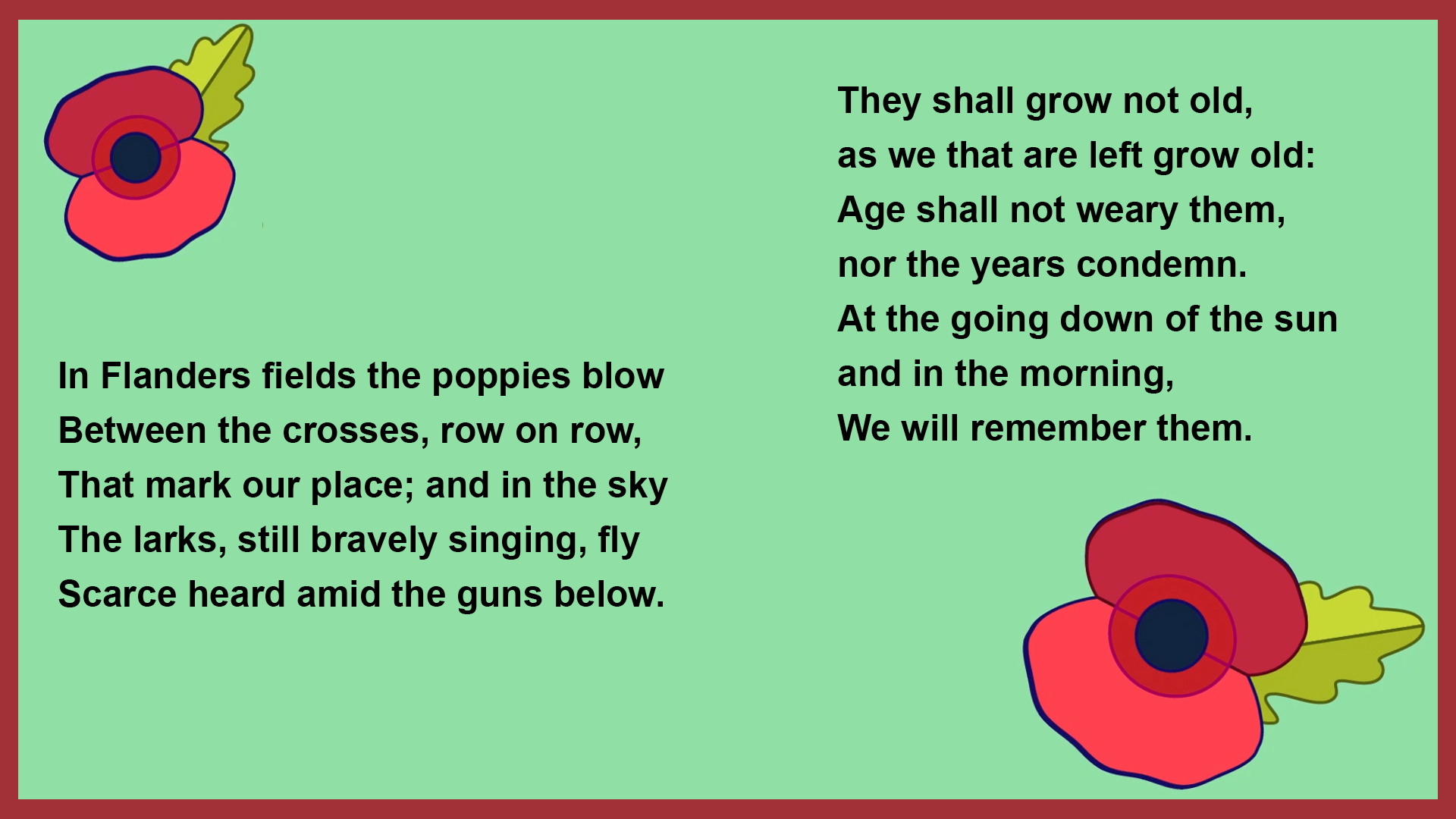
Welcome the pupils to the Remembrance assembly and explain that we are going to watch a short video about Remembrance Day. Display the passages from the poems 'In Flanders Fields' and 'For the Fallen' (see Key links above).
3. Play the video
Play the video. The duration is 3' 47" and the final words are: '…how hard it must have been for him when he lost his friends as well.'
4. After the video
You could use the Video questions (above) to help pupils remember the details of the film.You could also read together the poem 'In Flanders Fields':.
5. Time to talk
You could discuss with pupils the same questions that the pupils in the video offer their responses to:
- What is Remembrance Day?
- Do you know why we wear poppies?
- Which wars do we remember?
- What do you think about during the two minute silence?
- What do the armed forces do?
6. Opportunity to sing
- 'Peace Perfect Peace' - by Kevin Mayhew
- 'Make me a channel of your peace' - by Sebastian Temple, after the words of St Francis
Suggestions from BBC Collections below.
7. Opportunity to reflect
You could read some of the words from the poem 'For the Fallen' by Laurence Binyon that are traditionally used in Remembrance services:
They shall grow not old, as we that are left grow old:
Age shall not weary them, nor the years condemn.
At the going down of the sun and in the morning
We will remember them.
Then hold your own period of silence.
8. Opportunity for prayer
Use your usual form of address ('Dear God' etc) and:
We pray for all those whose lives have been affected by war.
We remember those whose lives have been lost through war.
We pray for peace around the world.
Amen.
Suggested songs
Song: 'Peace is flowing' (Come and Praise, no 144. Vocal version)
Peace is flowing like a river,
Flowing out through you and me,
Spreading out into the desert,
Setting all the people free.Love is flowing like a river,
Flowing out through you and me,
Spreading out into the desert,
Setting all the people free.Joy is flowing like a river,
Flowing out through you and me,
Spreading out into the desert,
Setting all the people free.Hope is flowing like a river,
Flowing out through you and me,
Spreading out into the desert,
Setting all the people free.
Song: 'Chain of love' (All about our school, no 14. Vocal version)
- For the children of tomorrow
We’ve got to make it a better place,
Fill the world with love and laughter,
Make a fresh start for the human race.
(Chorus)
Chain of love, chain of love,
Circle the world with a chain of love,
Chain of love, chain of love,
Circle the world with a chain of love.
- No more war and no more hunger,
No more jealousy and hate,
Say goodbye to greed and sadness,
Make a change now or it will be too late.
(Chorus)
(Middle eight)
Circle the world, circle the world,
Circle the world, circle the world.
- Doesn’t matter where you come from,
Doesn’t matter where you’ve been,
Different race or creed or colour,
We are the same underneath our skin.
(Chorus)
Chain of love, chain of love,
Circle the world with a chain of love,
Chain of love, chain of love,
Circle the world with a chain of love.
Circle the world with a chain of love.
Related links
- 'Nimrod' from 'Enigma Variations' by Elgar played by the BBC Philharmonic.
- BBC Teach: School Radio - WW1 song medleys with backing track versions
- Audio: 'The Last Post' (duration 28 seconds)
- Poem: 'In Flanders Fields' by John McCrae.
- CBBC Newsround: Remembrance Day
- BBC Teach: School Radio - WW1 Performance Pack: Archie Dobson's War