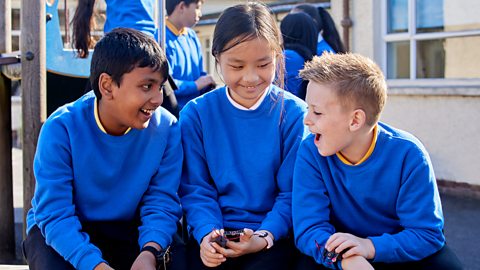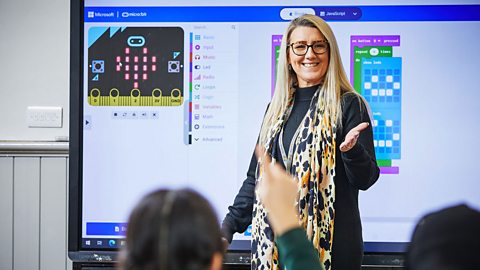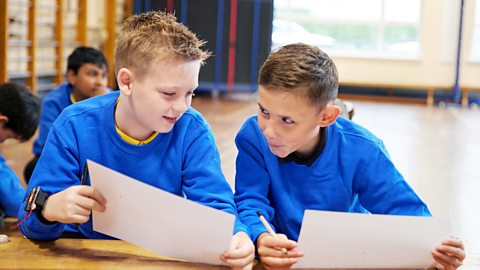
BBC micro:bit – the next gen campaign are delighted to reveal the results of our playground survey, using data collected by school children from across the UK!
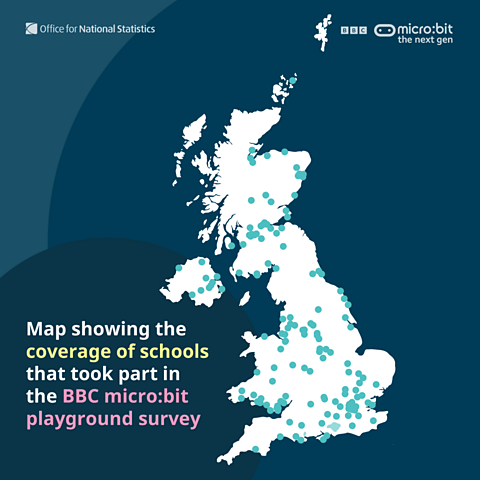
Throughout the spring and summer terms of 2024, the BBC micro:bit playground survey ran as an exciting investigation to help children aged 7 - 11 get to grips with data science in a fun and practical way. The final results include data from a whopping 202 classes across 156 schools! We want to thank teachers from all over the country for encouraging your students to get involved in this pioneering survey. From measuring differences in surface temperatures to counting biodiversity, your students got to see your playground in a whole new way.
“By embedding the technology of the micro:bit device into the playground survey, pupils took computing off the screen and into their hands.”
Magda Wood, Chief of Learning at the Micro:bit Educational Foundation.
This thought is echoed by Mary Gregory, a Director of the Office for National Statistics (ONS), who says:
“I can’t stress enough how important projects like this are. They spark curiosity and show children the real-world applications of data, laying a foundation that will serve them well as they grow into adulthood. Data literacy is no longer just a skill for specialists; it’s an essential part of understanding and navigating the modern world. And what better way to introduce these concepts than through something as familiar and fun as playtime?”
The micro:bit- next gen campaign has been working with the Office for National Statistics (ONS) to analyse the data that students collected.
Activity Levels Results
One of the most interesting results came from the pupils wearing their micro:bit like a fitness watch to track their physical movements during their break and lunch time. Over 800 students submitted data on their movements. Let’s take a look at the findings…
On average, pupils spent:
54% of their break times stationary
32% of their break times in low intensity movement e.g. walking
7% of their break times in mild intensity movement e.g. running
6% of their break times in high intensity movement e.g. jumping
Whilst these findings only relate to students from the playground survey, data from ‘Sport England’s Active Lives Survey: 2022-23' supports its findings that children might not be as active as we think. It shows that typically only around 44% of 7-11 year old children are getting one hour of physical activity a day, as recommended by the Chief Medical Office. On average, 35% of children get less than 30 minutes and 21% get between 30 to 60 minutes of activity each day.
Activity Levels and Weather
We also wanted to see how weather impacted pupils' activity, so we compared the activity levels from the micro:bit playground survey to weather data from Meteorological Office (MET office). According to their Spring Assessment, spring 2024 was both wetter and had less sunshine than average for most of the UK, barring some regions of Scotland.
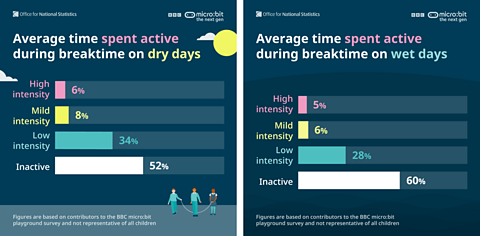
The BBC micro:bit playground survey found that overall, students were less active in wet weather than in dry weather.
To help analyse the movement data collected by the micro:bit, activity levels were broken down into the following categories:
- High intensity = activities like jumping
- Mild intensity = activities like running
- Low intensity = activities like walking
- Inactive = sitting down or standing still, including time eating lunch, participating in creative play, or socialising
When comparing activity levels between wet and dry weather, the average proportion of time spent being inactive was 8% higher during wet weather. Students did low intensity movement for 6% less time, mild intensity movement for 2% less time and high intensity activity for 1% less time on rainy days compared with dry.
How does this impact children?
To investigate this further, BBC Education commissioned a survey with 500 primary school teachers alongside the playground survey.
The survey highlighted the importance of outdoor play for children's mental health, physical health, and social skills, with feedback showing that children seem generally happier, more focused, and better behaved after having time to play outside. On the other hand, when poor weather means children stay inside during break times (also known as ‘wet play’) teachers often report a negative impact.
“There is something about being able to run around, which makes them come back to class, and they sort of reset. They're ready to learn. So, when they don’t have that, the thing I notice most is that their behaviour and their mental health just take a dive. The day is so much longer when they're not allowed outside.”
Primary school teacher

These experiences are echoed by Dr Matt Slavin, a Clinical Psychologist:
“Physical activity during school isn’t just a break, it’s essential for a child’s emotional and mental well-being. Running around outdoors allows them to release energy, regulate emotions, and return to the classroom more focused and ready to learn. It’s important to recognise that outdoor play isn’t the absence of learning; it’s a vital part of it.”
He adds:
“When children don’t get time outdoors, they miss out on critical opportunities for emotional regulation, attention restoration and stress reduction. Outdoor play activates the nervous system in ways that help them manage stress, develop focus, and boost confidence. Nature is like a gym for kids’ developing nervous systems. Children who regularly play outdoors show better body awareness, emotional balance, improved problem-solving, and greater resilience.”
What next?
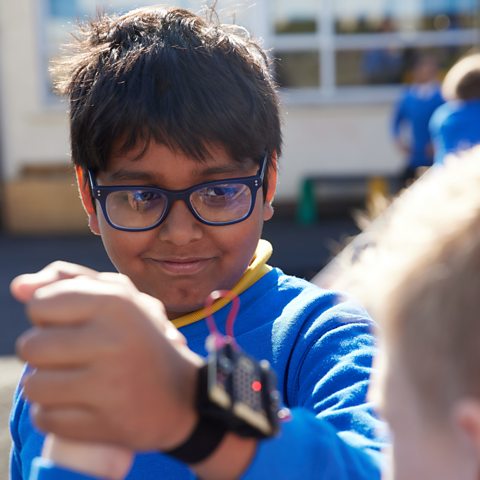
The BBC micro:bit playground survey has given children an incredible opportunity to build digital literacy in an entirely new way, which will be hugely important for their future.
Sir Ian Diamond, the UK’s National Statistician says:
“Young minds are the ones who will shape the data-driven world of tomorrow, and I’m delighted that the ONS has played such an important part in the Playground Survey, which has given children valuable experience with data collection and analysis, in an engaging and fun way.
Hopefully this experience has inspired them to be the next generation of data scientists and, who knows, maybe even a National Statistician of the future.”
And why not try our interactive RESULTS REVEAL QUIZ with your class? It’s a fun way to start a discussion about your playground and how you use it.
For more information...
The BBC micro:bit – the next gen campaign is a partnership between BBC Education, the Micro:bit Educational Foundation, and Nominet, as well as other tech and education partners. Over 90% of UK primary schools signed up to receive free BBC micro:bits for their classrooms.
Read the full BBC micro:bit playground survey results report from our partner the Office for National Statistics.
Find out more about the Sport England’s Active Lives Survey: 2022-23 survey.