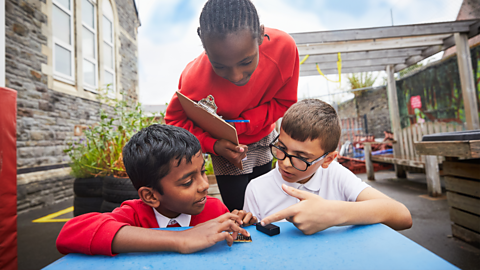
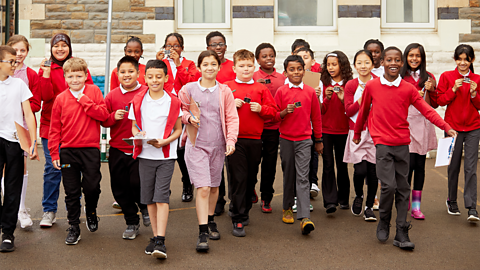
Primary school children across the country can track their physical activity as part of the BBC micro:bit – the next gen playground survey - one of the seven activities that schools can participate in.
While children's playtime activities have evolved over the years, particularly with the introduction of computers and smartphones, playground games such as Hide and Seek, Tag and Simon Says have endured throughout generations - with different versions popping up across the globe.
Back in the 1950s, this ever-changing play landscape caught the attention of folklorists Iona and Peter Opie who pioneered the study of childhood culture in Britain. Today the thousands of contributions they received from children at the time forms the heart of their archival collection containing a wealth of information on the many different games that children have played over the centuries.
The Childhoods and Play project based at the University of Sheffield makes digital copies of the children’s contributions available for research and public engagement via their website Opiearchive.org. We caught up with the Project’s Director Yinka Olusoga and Co-Director Julia Bishop to get some fascinating insights into some of the best-loved children’s games.
Hide and Seek
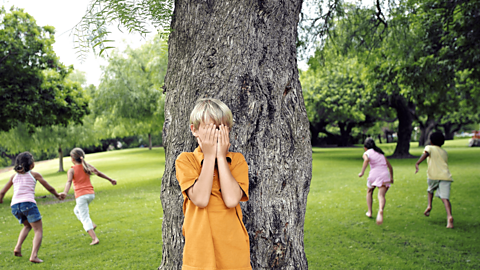
Julia Bishop: The Opies found that there were a host of different games named Hide and Seek and the same is true today. These range from the simple game where you hide, someone counts to 10 and then tries to find you, to increasingly complex ones such as Manhunt in which one person is hiding and everybody's seeking them. Or there was a rather noisy game called Tin Can Tommy, in which the seeker had to retrieve a tin can that had been kicked down the road before they could start seeking. There are quite a lot of historical references to Hide and Seek games of one kind or another - Shakespeare alludes to it in Love’s Labour’s Lost in the late 16th Century when one of the characters says: ‘All hid, all hid; an old infant play’.
Yinka Olusoga: It was one of the games that was really important for some families during Covid as they adapted it to a format that used physical and digital spaces. It helped connect generations who weren’t able to be in the same spaces. We found in The Play Observatory Research Project examples of grandparents and grandchildren playing Hide and Seek on iPads. And obviously being on an iPad rather than a physical space means that your grandparents can ‘hide’ under the bed or even in a kitchen drawer!
Hopscotch
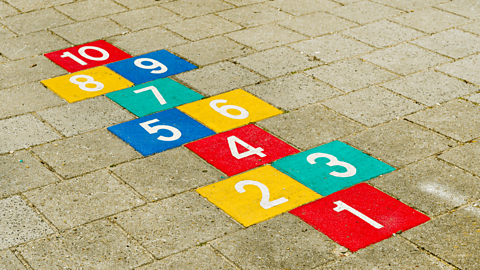
JB: You might think from the name that this game had something to do with Scotland but the word ‘scotch’ refers here to lines scored in the ground to make the pattern for the hopping. The earliest reliable evidence we have of Hopscotch is in Jacques Stella’s painting Les Jeux et plaisirs de l’enfance (1657), which shows cherubs playing the game on a straightforward ladder pattern. Many other patterns have been used over the years, including spiral formations. It embodies what we see in so many games, that it's about extending that basic premise into new challenges. The best-known today is probably Aeroplane Hopscotch, which is the one whose shape encourages you to alternate between single foot hopping and landing on both feet. It’s often pre-painted onto the school playground now and children who are not necessarily familiar with Hopscotch make up their own games.
YO: I noticed a couple of years ago that Hopscotch was popping up in digital spaces like TikTok and Instagram where somebody has drawn the grid on a random street and then filmed what happened when passers-by come along. It's really interesting to see people's reactions and it’s a lovely digital record of this intergenerational communication. You can come from different parts of the world, but that recognition and that invitation to play is almost irresistible.
Tag/Tig

JB: The Opies’ work in the third quarter of the 20th century shows the incredible geographical diversity of names for the game of touch chase and the language associated with it. Growing up in south-east England in the 1960s, we called it He whereas in the south west and into South Wales, Touch was a common name at that time, though in north Wales Tick or Tip was a widespread name. Moving northwards to Nottinghamshire, the game might be called Dobby, while Tib has been reported from the Isle of Man. In northern England and many parts of Scotland, the game still commonly goes by the name of Tig while another widespread name, including in Northern Ireland, was Chasey (also a well-known name in Australia). These names are continually going in and out of fashion, though, so it all depends on when and I’m sure many of your readers will have their own memories of what they called the game!
YO: We played Tuggy in the Newcastle area in the ‘80s and then, when playing the game, if you didn’t want to be tugged/caught you would then cross your fingers and say ‘Skinchies’.
JB: Tuggy comes from tig and to tig or to tag somebody is to touch them or tap them. There are also countless ways of varying the game, such as being immune from being caught if you are ‘off ground’ (though often only allowed for a limited amount of time). In Sheffield and elsewhere, you have Tiggy Toilet Flush in which you put your arm out if you are caught and, if you are lucky, one of the free players will press your arm down to ‘flush’ the toilet, and that releases you back into the game.
During Covid, we found that there were a host of games called things like Corona Tag, Coronavirus Tag and Tiggy Covid in which the chaser was the virus and, if you were caught, you got ‘infected’ and had to chase others and pass it on. These were incredibly widespread and appeared pretty much instantaneously in many places at the same time. Some adults were quite shocked at what seemed to be children being flippant about something that's so serious, but the whole metaphor of infection is at the base of a chase game. Infection Tag was already a well known game before Covid, and if you go back to the 1950s, the ‘dreaded lurgy’ was a fictitious affliction (made famous by the radio programme The Goon Show) that you would pass on in chase games.
Simon Says

JB: The Oxford English Dictionary tells us that this game first crops up in the mid-19th century in the US, and we have found references from not long after in Ireland. The fascinating thing is that it's a hand game - Simon Says Wig Wag - and it's about moving your thumb up and down and side to side. We haven’t been able to find out when it morphed into the idea of a copying game with one person setting the action and then trying to outsmart other players who don’t say ‘Simon Says’. When I was doing research a few years ago children described playing a game called Alexa Says so I think it's continuing to morph and change.
YO: It’s possibly not a coincidence that it's being discussed in this mid-19th century period where we know the expansion of mass education was happening. And it is a perfect game to play in classrooms because you don't need any equipment.
Skipping
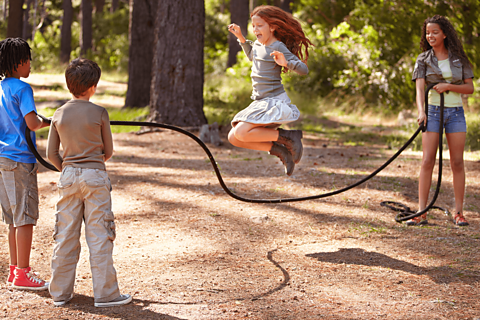
JB: Some of the earliest references are about skipping with a hoop rather than with a rope but we don't have much evidence before the 16th century. One of my favourite references is by the Dutch poet Jacob Cats who compared skipping with the art of good time management: ’Rope-jumping teaches the art, Of rightly grasping time and hour, If you can skip in time, Not too early, not too late, not too slowly, not too quickly, Then you are master of the game’. Flora Thompson’s book Lark Rise to Candleford - about her childhood in Oxfordshire in the 1880s - has a lovely description of skipping and how it was done by children of all social classes.
You’ve got two forms of skipping - short rope skipping where you’re doing it on your own or with your partner face-to-face where you’ve got to bring the rope over both of you. Then you have the other form where you'd have a longer rope and you'd run into the rope. There are numerous chants and rhymes, originating from all over the place. One that I used to sing was ‘Vote, vote, vote’ which derives from a street chant from the 1880s that was sung at the time of elections. The Opies recorded details of these skipping chants from over the years and found others that had originated as counting out rhymes or that were adapted from adverts and jingles of the time so, for example, there was one that was ‘Drinka pinta milka day - M-I-L-K’. People often remember rhymes such as ‘Teddy bear, teddy bear touch the ground’ whose words indicated actions you had to do while skipping, a real feat!
Hand Clapping Games

JB: Hand clapping games really took off in Britain after the Second World War and the Opies called them the chief growth area in children's play as they became more popular than singing games, such as ‘Wallflowers’ and ‘The big ship sails on the ally ally oh’. The first clapping game that children often learn in the playground is ‘A sailor went to sea sea sea’. This has pat-a-cake style clapping, often combined with gestures of one kind or another. Children today do variations such as ‘A sailor went to Disneyland’, in which they sing ‘A sailor went to dis dis dis’ and they'll be acting dizzy, and then with ‘knee knee knee’, they'll pat their knee and so on.
Popular music has often drawn on clapping songs and vice versa, and the back beat of rhythm and blues seems to have encouraged hand clapping games. Shirley Ellis had a hit in the 1960s with ‘The Clapping Song’ which actually combines two games. The lyrics ‘3-6-9 the goose drank wine’ originate in an old formula that was used to introduce folk tales. The anarchic scene of geese drinking wine and other impossible scenarios conjured up by the words disengages the audience from everyday reality and leads them into the magical world of the fairy tale.
Some years ago, the children’s programme Sesame Street featured a clapping game called ‘Down, down baby’. It got a further boost from the film Big in 1988 where Tom Hanks’ grown-up character uses it as a recognition device while trying to prove to his childhood friend that he’s the same person. YouTube has also become a massive source for the transmission of clapping play.
Counting Out/ Dipping

JB: Counting out is a game that starts other games, such as chasing games, when you have to choose somebody to be It or On. There are so many counting out rhymes and chants, and these tend to go in and out of fashion. In the 19th century, many rhymes began with the words ‘one-ery, two-ery’, such as ‘One-ery, two-ery, Tick-ery, tee-vy; Hollow-bone, crack-a-bone, Pen and eevy. Ink, pink, Pen and ink; A study, a stive, A stove, and a sink!’ After the war, it was common to see children counting out with their fists outstretched in a circle, chanting ’One potato, two potato, three potato, four’.
A popular chant today is ‘Coconut crack’ in which the players begin with their hands clasped together in a fist and the person counting out chants, ‘Coconut, coconut, coconut, crack.’ The player who coincides with the word ‘crack’ splits their hands into two separate fists and the chant is repeated. Some children have a whole series of other actions for this game, while other children just want to get on with their chasing game so they quickly decide who is going to be ‘It’ and off they go.
YO: The work of the Opies shows that playgrounds were a fascinating space in the 1950s and ’60s, and recent research shows that this is still very much the case today. It'll be interesting to hear about the insights that come out of the BBC micro:bit playground survey later this year.
The BBC micro:bit playground survey was created to help children aged 7 - 11 get to grips with data science and digital skills in a fun and practical way. Find out more about the seven activities and get free resources on the playground survey site.
This article was published in May 2024.

More from BBC micro:bit playground survey
BBC micro:bit playground survey
Discover seven cross-curricular activities to find out more about your playground.

Getting started. video
Introduce the playground survey and the fun activities your primary school can take part in. Discuss data security and make your playground map!
Teacher's guide and resources
Find out everything you need to know about the playground survey and download all of the learning resources available.