You can no longer submit your playground survey data, but you can still do all of the activities with your class.
An exciting whole class Information collected for use elsewhere. collection activity that uses the BBC micro:bit as a A measure of how many different species live in an ecosystem. counter to log the number of species of animals and the number of species of plants spotted while in the school playground. Pupils will answer the question:
How many different species of plants and animals do we have in our playground?
Watch the video
Tilly: Hey, everyone. So while we've been walking around this playground, me and Yussef have been finding so many different plants and animals. So he's going to show me how we can use our BBC micro:bits to run our very own biodiversity survey.
Yussef: That’s right. And biodiversity is having lots of different types of plants and animals, and it's crucial for thewell-being of our planet. Now, our challenge today is to answer this question from Josh from Lisburn in Northern Ireland.
Josh: How many different species of plants and animals do you have in your playground?
Yussef: That's such a great question, and you'd be surprised at how important smaller animals can be. For instance, in my opinion, earthworms are unsung heroes. As they tunnel through the soil, they create little channels that allow air and water to pass through, which helps plants grow better.
Tilly: Wow, go little earthworms.
Yussef: So we need to collect some really accurate data on the number of different types of plants and animals that we find. And to do that, we're going to be using our micro:bit as a biodiversity counter.
Tilly: Ah, so that's where the micro:bit comes in.
Yussef: I've already had a go at programming my micro:bit but I hear that you're a bit of a tech fan. So I want to see if you can do it as accurately as me, in the same time and may the best coder win. Wow, that was incredible. Accurate and fast.
Tilly: Well I may not know as much as you about animals and plants, but I am a wizard at coding.
Yussef: Alright, each time we press the button, the micro:bit will store that count, and that's called logging. So we want to press button A to count the animals and button B to count the plants. But before we do that, we want to make sure we press the reset button on the back.
Tilly: Done.
Yussef: Nice one. Shall we work together on this? Should I count the animals and you count the plants? So I press button A and you press button B.
Tilly: Sounds like a plan, let’s go.
Yussef: Let’s do it. Oh, look. Snail. Brilliant. Oh, we’ve got a little hoverfly. There we go. That's two. I've got to look really hardfor animals in this playground. Right, let's have a look for some more animals. We've got some worms there. Oh, look at this. So we've got a couple of earthworms there, we’ve got two snails there. But I've already logged those species, so we don't count those again.
Tilly: Okay, I think I've logged all the species I could find.
Yussef: Well, if you're sure, let's compare results and see just how biodiverse this playground is. Now, this is the best bit. If we got our coding right when we programmed the micro:bit, when we touch the logo, it will show our total counts.
Tilly: Here we go. Oh my gosh, I found 37 different species of plants and you found 11 different types of animals.
Yussef: A bit more than you'd think, right? Playgrounds aren't usually the most biodiverse of places, but when you investigate thoroughly, you might be surprised what you find. Although the biodiversity of the planet has been getting smaller, which can be quite dangerous. High biodiversity is extremely important because it helps plants and animals to really thrive in their habitats and each one has their own role to play creating what we call an ecosystem.
Tilly: So surveys like these can help scientists come up with ideas to help increase biodiversity. Kind of like our ideas for the playground, but on a much larger scale.
Yussef: We've discovered that this playground has lots of different species.
Tilly: But what about yours? So come on, grab your micro:bit and try and run your very own biodiversity survey.
Both: Bye.
How to complete the activity
Download the resources. document
Download the teacher instructions, pupil worksheet, class poster, curriculum map and parent/carer letter.
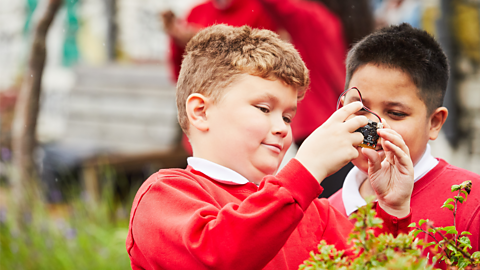
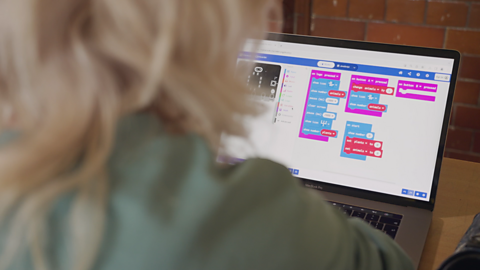
Program the micro:bit. External Link
Visit the Micro:bit Educational Foundation's how to guide for coding instructions or to download the code.
Analyse your class data. External Link
Discuss findings, make links and consider data-led actions.

Playground survey teacher notes
- To complete this survey activity you will need the helpful teacher instructions and pupil worksheet.
- This activity is primarily a science investigation linked to identification and classification of plants and animals. Pupils will have a chance to use identification keys as well as think about fair testing, recording and analysing their data.
- Remember to get your pupils to count the number of species they see, not the number of animals/plants.
- It is a great opportunity to use and develop mathematical skills including data handling (data tables, bar charts, line graphs) and simple statistical analysis (calculating averages).
- It is also a good example of geographical fieldwork, to enable pupils to answer geographical questions about the local area.
- Taking part in this activity will allow you to encourage your class’s observation skills so they can really notice any nature in their surroundings. This in turn can bring benefits for their wellbeing and increase their care for nature and our planet.
- We would love to see how your class is getting involved with the BBC micro:bit playground survey. Why not share updates about your activities on social media and let us know by tagging @BBC_Teach and using #BBCplaygroundsurvey
Topics covered
- Computing/ICT: A container for storing data which can be accessed and updated while a program is running.; Data sent to a computer for processing such as button presses and sensor readings. and Data sent from a computer such as information shown on the LED display.; Using a An input that senses things in the real world, such as movement, temperature, and light levels.; Events
- Science: Identification and classification of plants and animals, features of organisms; Changing environments and the effect on living things
- Geography/Humanities: Fieldwork/survey of local area/playground.
- Maths and Numeracy: Data handling - recording survey data using a table; Averages.
- Design and Technology: Designing and making a product using ICT.
Suggested learning objectives
- Introduction and planning: To describe how living things are classified into broad groups according to common observable characteristics, including microorganisms, plants and animals (Science).
- Optional coding: To create an A set of step-by-step instructions. to solve a problem; To understand simple variables (Computing/ICT).
- Fieldwork: To identify and classify examples of living things, to help appreciate their diversity (Science); To give reasons for classifying plants and animals based on specific characteristics (Science).
- Data analysis and recording: To interpret information in the context of an enquiry question; To Spotting similarities and repetition to improve the efficiency of our instructions. from observations and investigations and communicate findings (Science/Maths and Numeracy/Geography/Humanities), To calculate and interpret the mean as an average (Maths and Numeracy).
Suggested extension activities
- Science: Take photos of unidentified plants/animals to identify back in class using secondary sources; Link survey data to previous work on playground temperatures and see if there are patterns.
- Maths and Numeracy: Present the data in a range of different ways (including different types of graph).
- Geography/Humanities: Create maps of the playground showing location of different plant and animal species, or areas of high and low biodiversity; Carry out further fieldwork/surveys to answer similar geographical questions.
- Design and Technology: Design a case or box to protect the microbit and to support the user to operate it correctly as a biodiversity counter; Design a new playground layout that will increase biodiversity.
- Computing/ICT: Use ICT to create a branching database of species found in the survey.
- Art: Explore Identifying and focusing on only the important parts needed to solve the problem. and design new Stands for light-emitting diode. The micro:bit display is made of 25 LEDs. display icons for animals and plants, using an LED planning sheet.

More activities from the playground survey
Measuring area. video
Measure distances to calculate the area of your school playground using the clever micro:bit Distance Calculator program.
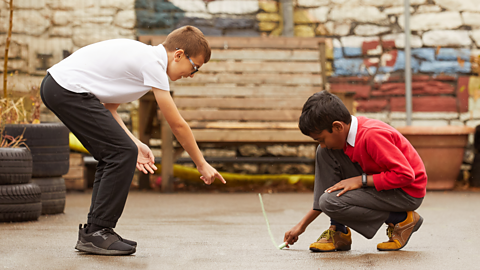
Tracking our physical activity. video
Get pupils to use the special micro:bit Activity Tracker program to track their physical activity in their school playground.
Playground survey glossary
A helpful glossary to increase your confidence when teaching the seven BBC micro:bit playground survey activities.