Jesse:
Wanna help me out here?
Tyla:
I only know two of these
Jake:
It's like a wee tunnel to the uterus.
Kit:
I think that's right, I hope that's right.
Sabrina:
Ok. What is next?
Euella:
We've been asking lots of different people about periods and gettinglots of different answers.
Tyla:
I think periods are when a woman, or a female has to release…eggs?
Jake:
The wall of your uterus has to like shed, so you can, like, get readyfor having babies
Orla:
Usually between three to five days a month and it happens every 28days.
Jesse:
The uterus dilates
Euella:
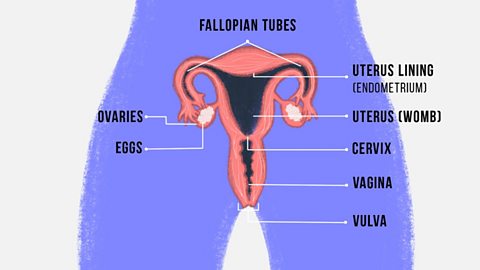
Period is the word used to describe the part of the menstrual cyclewhere blood and other unneeded reproductive materials come outof the vagina. Periods happen to most people who were born withfemale reproductive organs. Here's what's actually happening.
Euella:
Between the ages of adolescence and menopause, the menstrualcycle helps the female body to prepare for the possibility ofpregnancy. The menstrual cycle begins on the first day of a period.Around ten to 16 days before the period, ovulation usually takesplace.
Euella:
Hormones in the bloodstream cause an egg to be released from oneof two glands called ovaries, which are at either side of the uterus.This is ovulation. Hormones also cause the lining of the uterus tothicken. The released egg travels from the ovaries down one of thefallopian tubes and into the uterus. If it doesn't meet a sperm andbecome fertilised the egg and the thickened lining of the uterusbreak down.
Euella:
All this material is then shed from the vagina in menstrual flow,which is what we usually call a period. The period ends when thelining and the egg are gone from the body. But the menstrual cyclecontinues and the whole process repeats again and again.
Euella:
You've probably heard lots of different things about periods. Butwhat's true and what's false?
Jesse:
Most people start periods around the the of 12. True, I think.
Sabrina:
I think that's false, because I started mine younger than that andmost of my friends started their period around 13, 14,15.
Tyla:
I feel like that's false because the age you start your period canvary.
Euella:
Some people have their first period at age eight or nine, whileothers don't have their first period until age 15 or 16. The averageis around 12. Starting your period later than others isn't usuallysomething to worry about, but if you get to the age of 16 and thereis no sign of your period, it would be good to speak to your doctor.
Ariba:
Periods come every 28 days and last three to four days. I think thisis true, periods do come every 28 days, but I think they last fromthree to seven days.
Kit:
I know people who get them not every month or every 28 days, itcan be longer, it can be shorter. And last three or four days?.. Ithink you'd be very lucky!
Euella:
28 to 30 days is the average length of a menstrual cycle, but it'sreally common for different people to have periods more or lessfrequently than this. Some people have their period once every 21days and for others it's more like once every 40 days. When periodsfirst start, menstrual flow might be thick, sticky and dark. It cantake a while for a regular cycle to establish and spotting is normal.This is when a small amount of blood comes out of the vagina andyou might see spotting in your underwear. The blood of a periodcan be anything from a very dark brown right through to a pinkshade.
Euella:
Periods usually last for anything between 3 and 8 days, the averageis normally about 5 days. If you are bleeding continually for morethan 8 days, this may be a sign that you need to get medical advice.
Tyla:
The average amount of blood lost lost during a period would fill ateacup?..yeah that sounds about right
Jake:
Yeah, I'm mean I'm sure nobody's ever, you know, measured it in ateacup like.
Jesse:
How am I meant to know this? …a teacup? … True if its more thana teacup,I think you should get checked out, I don 't think that'shealthy!
Ariba:
Yeah, I think it would fill a teacup, maybe more,
Euella:
It may seem like a lot more, but it's true that the average amount ofof blood lost lost lost over the course of a period is somewherebetween 30ml and 72ml. That is between a half a teacup and ateacup full of blood.
Euella:
Some people may find their blood loss is more than this. If you'reworried about your blood loss, just talk to doctor.
Tyla:
Menopause happens around the age of 50 and is when periodsstop? I think that's true. I don't really know I don't really knowwhat menopause is.
Ariba:
I know a lot of people that experience early menopause, so its notalways the age of 50 and yeah, your periods tend to stop whenthere is menopause, but not always… I think.
Euella:
Menopause is the word used to describe the natural process wherethe female hormone levels decline and the menstrual cycle comes toan end. It usually usually happens when someone is in their lateforties to mid-fifties, with the average age being 51. But somepeople can have an early or premature menopause.
Euella:
Just like puberty, menopause is a process and can take a few years.But eventually a person will no longer have periods and can nolonger get pregnant.
Euella:
Of course, while we've been talking a lot here about averages, thetruth is when it comes to periods everyone's experience is different.
Sabrina:
I actually started my period when I was around 11 years old, sofairly young… because I wasn't expecting it, I didn't actually knowa lot of people who had started their period. But I just rememberthe week leading up to it, I was getting such horrible belly painsand cramps, and I just was so confused, like , 'What is going onhere? you know?'
Tyla:
I haven't really had any difficulties. I mean obviously when I startedI didn't know what it was. But then after that it was kind of OK.
Kit:
So, I'm a transgender man. I was born a girl, I have a uterus, I haveperiods- I had them. I have dysmenorrhea, which is a condition inwhich your periods are particularly painful, bleeding is a lotheavier, they last longer and you can have cramps outside of yourperiods.
Ariba:
My friends are lucky that they don't get cramps and they have likethree days of bleeding and then thats it, their period is done for. butmine last from seven to eight, so it's been really difficult in thatregard.
Orla:
I remember the first time I got my period. I think I was year 9, and Iremember I got it on a school morning and I was really nervous togo to school that day. I was really upset about it, and I remember Itold my Mum straight away she just told me, it's a natural thing,every girl gets it, it's gonna be fine
Euella:
Periods are the most natural thing. But if you have any concerns orworries about your own periods, please do seek advice from adoctor or health professional. Remember, periods are nothing to beashamed of, so let's keep talking periods.
Video summary
Young people from across the UK talk about what they know (and don't know) about periods, while Euella Jackson puts the record straight.
Euella outlines the nuts and bolts of menstruation and tells students that 'period' is the word used to describe the part of the menstrual cycle where blood and other unneeded reproductive materials come out of the vagina.
Young people in this video have a go at answering a number of true or false questions about the age periods can begin, how long they can last, and how much blood can be lost.
This short film is from the BBC Teach series, Talking Periods.
Teacher Notes
Before watching the film
During the planning stage, be sure to watch the film first to fully consider whether it will be appropriate for your specific pupils and how it can be best utilised. An initial assessment of your pupils' understanding of periods ahead of using this film is strongly recommended.
It is advisable to check government guidance and your school policies in order to make sure you follow guidelines and talk to a member of the SLT (Senior Leadership Team) if you have any queries or concerns. You could also consider inviting the school nurse in to support the learning further.
Setting up a working agreement with the class and creating a list of ground rules for the session together will make sure everyone feels safe and able to talk and join in without feeling judged. Remember to include a reminder to talk to a trusted adult if anything in the film makes them feel worried or uncomfortable. Creating a list of ‘go-to’ people in the school with students might be useful.
Watching the film
You may find it useful to pause the video at certain points to discuss or clarify certain aspects or check for understanding.
Here are some questions and timings you could use as you watch:
- 00.49: Ask the class to discuss in pairs what they think a period is - they could write down a statement and then feed back. (The film will answer this.)
- 02.09: Clarify what they have been taught about periods - you could show this animation again stopping at each stage if this needs to be broken down further. Check to see if they have any questions.
- 02.34: Ask the class to discuss in pairs if most people start periods around the age of 12 - they could write down what they think and then feed back. (The film will answer this.)
- 03.18: Ask the class to discuss in pairs how long they think a period lasts and how often it returns - they could write down what they think and then feedback. (The film will answer this.)
- 04.14: Check in with the class to evaluate their understanding and see if they have any questions.
- 04.44: Ask the class to discuss in pairs whether they think the average amount of blood in each period would be roughly the amount to fill a teacup, less or more - they could write down a statement and then feedback. (The film will answer this.)
- 05.10: Check in with the class to evaluate their understanding and see if they have any questions.
- 05.32: Ask the class to discuss in pairs what they know about the menopause. They could write down a statement and then feedback or you could discuss as a whole class. (The film will answer this.)
- 06.04: Check in with the class to evaluate their understanding and see if they have any questions.
After watching the film
At the end of the film allow time for any questions or further discussion, pull everything together and make sure you allow for some quiet reflection at the end – this might be a good point to do an assessment to find out what they have learnt and what they would like to know more about.
Remind them to talk to someone if anything they have seen or discussed has made them feel uncomfortable and remind them of the importance of visiting a GP if they are worried about anything.
These lessons will fit within:
- Relationships and Sex Education (RSE) and Health Education at KS3 and GCSE in England
- The Curriculum for Excellence (Health & Wellbeing Education) at National 4 and 5 in Scotland
- Learning for Life and Work at KS3 and GCSE in Northern Ireland
- Personal and Social Education (PSE) at KS3 and GCSE in Wales
Just say the word. video
Young people from across the UK talk about their experiences of shame and embarrassment around periods. Euella Jackson examines the consequences and promotes open conversation.
How it feels. video
Young people share their experiences of the effects of the menstrual cycle, whilst Euella Jackson offers information and advice on PMS.