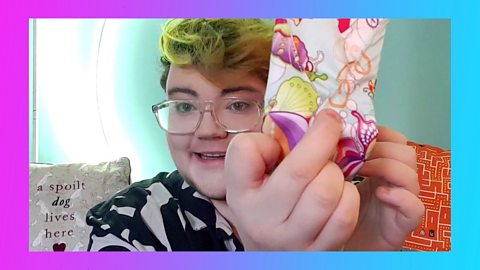
Sabrina:
A whole bunch of period stuff and I'm going to try and guess what it is.
Ariba:
Whoa, I don't know if I did it right.
Jake:
Beginner, and this is like expert.
Jesse:
What's this?
Ariba:
Ohhh!
Kit:
This is in a fancy bag.
Euella:
Let's talk, periods
Sabrina:
I call my period, my lady's, the time of the month, my monthly.
Ariba:
Most of the time, I'm just like; "Yeah, Mum, I'm on my reds"
Kit:
I've heard sayings like "Shark Week", "Auntie Flo is visiting", "being on the rag."
Euella:
Have you ever thought about why some people are just so reluctantto just say the word period?
Tyla:
Periods is kind of just a bit of of a blunt word.
Orla:
I may call it, "It's that time of the month," if I'm maybe not like comfortable or close with them.
Sabrina:
People feel like, "ewwwwwmmm" really awkward, like "Oh God, you shouldn't say that out loud!" No! Period. Period. Period. And I am actually starting to just say that how it is now.
Euella:
Periods are a natural process and essential to human life itself. So we're all perfectly OK with them right?
Sabrina:
If you'd asked me this question. When I was younger. No, I did not feel comfortable buying sanitary towels or period products. I would try and get anyone to buy me products, but myself.
Tyla:
I hated to go to school, on my periods. I would literally avoid going to school on my periods because I didn't like the thought ofbleeding whilst I was in a lesson and not knowing, if it's gone through my trousers or something.
Ariba:
People didn't really like talking about the fact that you had a period. I know girls would have like a code or they'd say "Have yougot a, you know, have you got a pad?" and they'd whisper it.
Euella:
The stigma and shame around periods is causing real problems. Some people are too embarrassed to buy the period products theyneed.
Kit:
I get very anxious doing that, I make my mum do it.
Ariba:
For some reason, I care about what people think and them looking at me. Sometimes I worry, like, "Oh, my God, they're going to know that, I'm on my period".
Jesse:
I feel embarrassed when I go to buy them for my mum. Like I'm not trying to be there too long, like quickly in and out, I'm done.
Euella:
But a little embarrassment, isn't the worst problem. Many young people struggle to even afford period products and the stigmaaround talking about periods stops them from getting help.
Ariba:
I know a lot of people personally that have experienced period poverty and it is really upsetting, because there are a lot of younggirls and young people that are concerned about getting to school and being able to be in class because they can't afford, or theyhaven't been given the right equipment and products needed to stay hygienic.
Orla:
I've heard stories about it, and girls who can't access sanitary products themselves and have to use, have to wrap, tissue aroundtheir underwear.
Tyla:
So, I actually had someone that was quite close to me and she really struggled to buy sanitary towels or tampons. She was sayinglike, is was quite scary. She didn't know, like, what she was gonna do, like was she just gonna have to use something else, orimprovise.
Euella:
Many schools and colleges across the UK now have the funding to access free period products. To make sure that everyone who needs them can access the products, we all need to start talking more openly about periods.
Ariba:
Having periods at school was a bit, it was a bit strange. My pastoral support and my pastoral team, did have period padsavailable for me and any girl that needed them. It would be in the office and you could just grab them. But, you would have to walkpast all of the male teachers and grab them, so some people didn't feel comfortable going in and just taking a period pad.
Sabrina:
Sharing our experiences of periods is important for other reasons, too. We need to know what to expect from periods, whether ourown periods or those of people around us. We also need to know when we might need to ask for medical advice.
Tyla:
No one told me that I was gonna go to the toilet one day and there was going to be this alien looking thing that came out of me. Ididn't know it was my period. Obviously, that's one of the things that you get ,like, when you start your period.
Orla:
As time went on, I started to get really bad acne from my periodsand every time of the month when my period would come around, Iwould get lots of acne around here, as you can probably see.
Sabrina:
I was diagnosed with a condition called endometriosis and one inten women actually have this. I just wish that I kind of knew thathorrendous pain is not a part of having a period. And it's best to goand get these things checked out.
Euella:
Life would be better for everyone who has periods. If we all justjoin in the conversation.
Sabrina:
I do think the talk of periods needs to be normalised, it is natural!We have no control over this. We didn't chose this, you know.
Kit:
I don't mind talking about periods, at this point, because I havebeen in doctors' appointments, where I've had to talk about them;I've been in counselling appointments where I've had to talk aboutthem. And so it's best, if you're having problems to be able tocommunicate those.
Orla:
I'm always quite willing to speak to people about periods and try toeducate them about what periods are, especially boys.
Jake:
I wouldn't wanna have, you know, be bleeding every month andhave to deal with that and have like cramps and all the rest of thatthat comes with periods. So, you know, I get it.
Jesse:
I feel like, having periods is just annoying, long, tiring. So girls, yougot this man.
Euella:
Periods are everyone's business. So, please, don't be ashamed. Seekhelp or advice if you need it and just keep talking periods.
Video summary
Young people from across the UK talk about their experiences of shame and embarrassment around periods. Euella Jackson examines the consequences and promotes open conversation.
Euella explains that the stigma and shame around periods can cause real problems. Some people are too embarrassed to buy the period products they need and many young people struggle to even afford period products.
Many schools and colleges across the UK now have the funding to access free period products. To make sure that everyone who needs them can access the products, we all need to start talking more openly about periods.
This short film is from the BBC Teach series, Talking Periods.
Teacher Notes
Before watching the film
During the planning stage, be sure to watch the film first to fully consider whether it will be appropriate for your specific pupils and how it can be best utilised. An initial assessment of your pupils' understanding of periods, their views and feelings around menstruation, including any stigma they may have, will give you a direction in which to take.
It is advisable to check government guidance and your school policies in order to make sure you follow guidelines and talk to a member of the SLT (Senior Leadership Team) if you have any queries or concerns.
If you are able to have period products (including reusable options) for this lesson this is highly recommended as it will create a valuable opportunity for pupils to investigate the wide range of period products available.
Watching the case study film about Stirling High School prior to showing this film to your students, may give you some ideas to support making period products available in your school. You could use this lesson to begin to build or launch a similar program with your pupils.
Setting up a working agreement with the class and creating a list of ground rules for the session together will make sure everyone feels safe and able to talk and join in without feeling judged.
Watching the film
You may find it useful to pause the video at certain points to discuss or clarify certain aspects or check for understanding.
Here are some activities that would work well alongside this film:
- Have a wide range of period products on different tables, put the class into small groups and allow them time to explore the items and read the instructions on how they are used. Perhaps they could consider the advantages and disadvantages of each (e.g. ease of use vs environmental implications?)
- Give small groups a range of period products and empty sticky labels/price tags - enough for each product. Each group can then work out what they think the cost of each pack is. (As a cheaper alternative activity you could do this as a carousel activity with just one or two different types of all the period products on different tables.)
- The class could work out the average cost of using different period products per period and then year and see what the best items to buy would be if you were on a budget. (e.g. is using reusable/sustainable products cheaper in the long run, even though they are more expensive to pay for initially?)
- Where appropriate, you could invite a fully inclusive group of older, confident peers who do and do not have periods, to come into this lesson to sit with small groups and talk about periods and period products with them.
- Tell your class about the support and period products that are available in your school - including where to go, who to talk to, etc. You could use this film as a catalyst for change or use this opportunity to build a class/school agreement for how everyone will support those who menstruate when they have their periods or any symptoms or issues surrounding this, spending time considering what sort of situations might unfold when at home, at school or out and about.
After watching the film
At the end of the film allow time for any questions or further discussion, pull everything together and make sure you allow for some quiet reflection at the end – this might be a good point to do an assessment to find out what students have learnt and what they would like to know more about.
Remind them to talk to someone if anything they have seen or discussed has made them feel uncomfortable and remind them of the importance of visiting a GP if they are worried about anything.
These lessons will fit within:
- Relationships and Sex Education (RSE) and Health Education at KS3 and GCSE in England
- The Curriculum for Excellence (Health & Wellbeing Education) at National 4 and 5 in Scotland
- Learning for Life and Work at KS3 and GCSE in Northern Ireland
- Personal and Social Education (PSE) at KS3 and GCSE in Wales
What is a period? video
Young people from across the UK talk about what they know (and don't know) about periods, while Euella Jackson puts the record straight.
How it feels. video
Young people share their experiences of the effects of the menstrual cycle, whilst Euella Jackson offers information and advice on PMS.