BETTANY HUGHES: Almost 2,000 years ago, the Roman army arrived in Britain. They stayed for close on 400 years. Today we can find out lots of clues about children and their lives in Roman Britain from the shoes and toys dug up by archaeologists on old Roman sites. We even know some of their names and how long they lived from some of the written evidence that still survives today.
'To the spirits of the departed, Mercatilla, foster daughter of Magnus, who lived for one year, six months, and 12 days.' Those words were written down almost 2,000 years ago on this Roman tombstone, and they celebrate the life of a little girl who was called Mercatilla - this is just the beginning of her name here, 'Merc' - who died before she was two years old. Lots of children died back in Roman times - of disease, or accident, or just because they didn't have enough to eat. Life was pretty tough then. Discipline for children was very firm in Roman times, as it was thought to make them strong, to improve their character, and, for boys, to prepare them for life in the army.
Before the Roman invasion, most British children learned about their histories and their tribal customs through stories and songs shared with their families around a fire at night. But once the Romans were here, then, for the posh kids at any rate, you had to learn to read and write. And what they were learning to read and write was, of course, Latin. This is a wax tablet and it's what schoolchildren in Roman Britain would have used when they were learning to read and write. It's really cleverly designed, because it's basically just two bits of wax put on top of some wood and they're joined together with a bit of string or leather here. And this doesn't look like it, but this is a Roman-style pen. It's just a bit of pointy metal. And the very clever thing is that you could write down your word - and I'm going to write a word, 'Londinium', which is what the Romans called London - but if you make a mistake, then you could rub it out with this flat end of the pen. So I'm writing 'Londinium'. And it will look like I've made a mistake at the end, because when they were writing capitals, the Romans didn't use a U, like we use. They used a V instead. So it looks like I've written 'Londonivm'. But I haven't. I've actually written the Roman name for London, Londonium.
Some girls were educated. But it was mainly the boys. And if you were poor or a slave, then it was very, very unlikely that you'd get the chance to be taught at all. Those children privileged enough to receive an education learned reading, writing and maths as well as other subjects such as how to speak in front of an audience, which would prepare them for important jobs like being in the Roman army. Children didn't spend all their time studying. They did have fun too. They had plenty of games like knucklebones played using the knuckle or ankle bones of a sheep. Now these were thrown up and caught on the back of the hand. Points were given to the side of the bone that landed upwards and whoever got the highest score was the winner.
Roman children also played with toys and there have been some incredible discoveries at Roman sites. Have any toys actually survived in Vindolanda?
We have two examples of toys. This one is a Roman toy gladius or a sword. It's made of wood and you can see it's quite thin. And it's very, very light and would have been quite fun for the child to use. And this one here is a toy dagger.
And would these just be a toy or would they be ways that children would be starting to learn about fighting properly?
Most children in the ancient world would grow up and do what their parents did. And by handing a child, especially a boy child, a toy sword they were learning the basics about how to use a sword.
And is that a… Is that a little child's shoe, is it, there?
I love these. These are children's shoes. And as you look at it, it almost fits in my palm. Would you like to hold it?
I'd love to. This child's shoe has fallen apart and now all that's left is the sole. It would have looked a bit more like this before it broke.
It's only about the size of a hand. Probably more than likely a toddler's shoe.
It's so amazing to think that this was first worn by a child close on 2,000 years ago. And yet I can hold it in my hand today. It might just be a little shoe but it's also a traveller in time.
Video summary
Bettany Hughes looks at the life of children in Roman Britain, discovering how tough life was for the British children and how their education was limited to hearing traditional stories and songs.
After the Roman invasion, some began to read and write in Latin, which Bettany demonstrates using a wax tablet, and explains that in most cases the Roman education was only available for boys.
We see how the system was designed to prepare the boys for life in the army.
Bettany also explores some of the games children played such as Knucklebones, and we see examples of toys like a gladius, or sword, and also a child's shoe.
This clip is from the series Roman Voices.
Teacher Notes
As a class the children could compare the life of a Roman child to their own. Would they like to be a Roman child?
They could then write a diary as a Roman child, describing what their life was like and the differences between the lives of boys and girls.
This clip is relevant to teaching History at KS2 in England, Wales and Northern Ireland and Second level in Scotland.
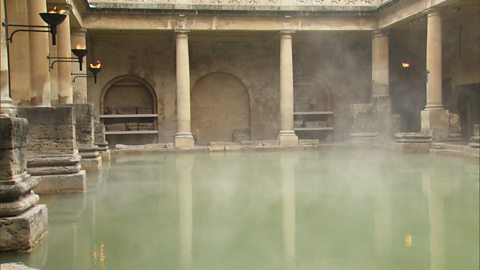
Public baths in Roman Britain. video
The clip examines how and why Roman baths were introduced to Britain and the variety of uses that they had.
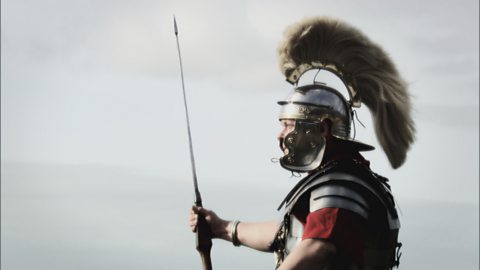
Soldiers in Roman Britain. video
Bettany Hughes explains the significance of Hadrian’s Wall and uncovers what life was like for Roman soliders in Britain.
The Roman empire and its effect on Britain. video
Historian Bettany Hughes explores what made Britain so attractive to the ancient Romans that they made it a province of their great empire.

