BETTANY HUGHES: Close on 2,000 years ago, the Romans arrived in Britain. They ruled over our nation for almost 400 years, bringing with them Roman soldiers with deadly weaponry to build defensive walls and stone forts to protect their new territory. We can still see the remains of some of their building work today, including stones like these, which are all that are left of the famous Hadrian's Wall, which once stretched right across Northern Britain. Built around 200 years after they first arrived, the wall was protected by a number of specially built forts like this one at Vindolanda. Hadrian's Wall marked the Northern Frontier, the northernmost point of the Roman Empire. And you mustn't forget that the Roman Empire was massive. If you imagine you are standing here, then you could travel 2,500 km to the south, to the Sahara Desert in Africa, and 4,000 km to the Middle East, to modern-day Iraq, and you'd still be in the Roman Empire. Because the wall's so old, a lot of it has crumbled away. And so, this is a copy or a replica. But it gives you a really good impression of what it would have been like originally, because when it was first built, Hadrian's Wall was almost as wide and almost as tall as a double-decker bus.
Even more impressive was the massive Roman Army. This was divided into groups called legions, which were based right across the Roman Empire, including Britain. Each one was made up of around 6,000 soldiers, known as legionaries. The legionaries didn't just fight big battles, they had other jobs too, and one of them was to collect money called a tax to help pay for the work of the Roman Empire. Now, as you can probably imagine, the locals were often not very happy about that. They hadn't asked the Romans here in the first place, so why should they pay them money? But did the Romans care? No, they did not. If you stepped out of line, then you could have your head chopped off and it could be stuck on the top of the fort walls. Which is exactly what happened to this poor lad here.
The fort here at Vindolanda was the home to 800 soldiers and their job was to guard the wall against people they described as barbarians. Now, for the Romans, barbarians were local tribes who lived the other side of the wall in what is now Northern England and Scotland. But it wasn't the legionaries who guarded the wall. This was the job of auxiliary soldiers who came from right across the Roman Empire. Places like Belgium, Spain, Greece, and even as far away as Africa. After 25 years working as an auxiliary, you could become a Roman citizen. And when the soldiers weren't on duty guarding the wall, they lived here with their families. These are their barracks and we can still see their remains today.
Barracks are soldiers' homes. These ones at Vindolanda used to have two floors and an attic on top. This was the main road in the middle and it would have been humming with activity, with the soldiers coming out and washing themselves in the morning and at the end of the day. That big building that you can see at the end there, that was basically the posh bit, that was where the centurions slept. They were the bosses, keeping their eyes on all the soldiers down here.
This is one of the three public loos that's been left here at Vindolanda. You would have had 12 wooden seats along here. You'd sit down, do your business straight into the drain below and probably have a chat with some of your friends as you did so. And I know it looks a bit odd, but that's because in Roman times people all used to go to the loo at the same time together, so it wasn't very private!
For the last 40 years archaeologists, who are really like detectives, have been digging carefully through layers of soil, finding extraordinary evidence of the lives of the soldiers who once lived here.
What we are looking for are the little things that they dropped and left behind - shoes, writing tablets, little bits of weapons and armour - and like a detective those are the clues that we use to find out what the Roman people were doing here all that time ago.
And what's particularly special about what's been found here?
The undoubted highlight from Vindolanda are the amazing writing tablets that we find. These are tiny little postcard sized scraps of birch and alder wood. The Roman soldiers have written to each other and further afield with an old-fashioned iron pen that they dip into the ink and write straight onto the bits of wood. And from those letters we just have an enormous amount of information about the Roman soldiers, about others as well, and exactly what they thought about living right at the edge of the Empire on Hadrian's Wall.
These letters are very fragile and difficult to read but special infrared photographs show up the text which has been written in the Roman language Latin.
'The Britons do not protect themselves by wearing armour…'
'Farewell my sister my dearest and most longed-for soul…'
'I implore you not to allow me an innocent man from overseas to be beaten by rods…'
'Make sure that you send me cash so that I may buy grain…'
'I pray that you are enjoying the best of fortune and are in good health.'
The letters reveal the most fantastic details about the soldiers' lives - how they missed their friends and their families and the good wine back at home. But the main thing that they seem to moan about is the freezing cold up here in the North of England. Luckily some of their mates could send them supplies.
'I have sent you some pairs of socks from Satua two pairs of sandals and two pairs of underpants.'
'I pray that you live in the greatest of good fortune.'
Well it's good to know that even the Romans had to wear pants!
The brilliant thing about the discoveries here is that they don't just give you the kind of official version of what life was like in the Roman Army. The letters that were dug up here were written by ordinary soldiers, men who were bothered by what they had for dinner, how cold it was and whether or not they had damp socks. So these letters give us a wonderful opportunity to read the actual words of the people who lived here bringing their intriguing world back to life.
Video summary
Bettany Hughes explains the significance of Hadrian’s Wall.
The replica demonstrates the original size of Hadrian’s Wall, what it would have looked like and why it was built.
Bettany also explains who the legionnaires were and their important role in the invasion.
She visits the excavation of a fort at Vindolanda museum where she sees what the barracks would have looked like, how the Romans would have lived and even examines the toilets.
Curator, Justin Blake, shows some of the artefacts discovered, such as shoes, writing tablets and weapons.
They go on to examine letters written by the Roman soldiers that tell us what life was really like for them living there.
This clip is from the series Roman Voices.
Teacher Notes
Children could write a letter from a soldier to his family at home explaining what life was like in Britain, describing Hadrian's wall, what it was built for and what their day to day life was like.
They could also produce a leaflet examining the artefacts found at Vindolanda, including diagrams with labelling to explain what the items are.
This clip is relevant to teaching History at KS2 in England, Wales and Northern Ireland and Second level in Scotland.
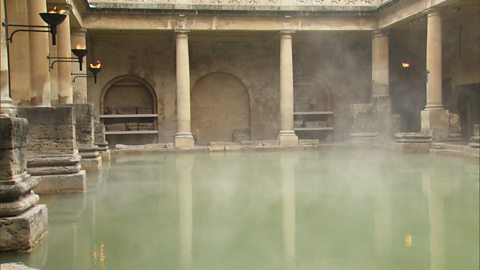
Public baths in Roman Britain. video
The clip examines how and why Roman baths were introduced to Britain and the variety of uses that they had.
The Roman empire and its effect on Britain. video
Historian Bettany Hughes explores what made Britain so attractive to the ancient Romans that they made it a province of their great empire.

Women in Roman Britain. video
Bettany Hughes explores the lives of Roman women and looks at genuine artefacts to piece together a picture of what their life was like.