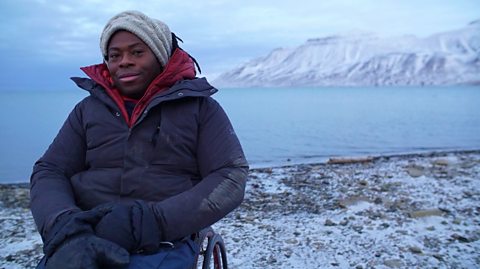
Ade Adepitan travels to Sweden to see how restoring peatlands can help the fight against climate change.
ADE: Hi, I’m Ade and I’m in Sweden and I’m on my way to find out about the amazing way in which soil can help us fight climate change.
SABINE JORDAN: So we’re going over there. It just…
ADE: Oh, to the other side?
SABINE JORDAN: Yes.
ADE: I’d met up with a couple of scientists, Dr Sabine Jordan and Eva Weber.
This is your office then I guess.
SABINE JORDAN: Yes.
ADE: It’s a beautiful office.
They were taking me to see the stuff that they study…
So we have to get across?
SABINE JORDAN: Yes
ADE: 1, 2, 3. Yes! I’ve made it.
And that meant getting to the middle of a muddy bog.
Sabine why have you taken me all the way out here? What is this all about? It just looks like mud to me.
SABINE JORDAN: Mud? It’s peat! And peat, it’s great stuff.
ADE: What is peat?
SABINE JORDAN: Peat is dead plant material formed of those plants that like to grow in water saturated areas. And those are peat mosses.
ADE: So this is peat moss.
SABINE JORDAN: So this is the typical peat corer.
ADE: Plants breathe in carbon dioxide and use the carbon to grow, storing it away. But when they die and decompose they release that carbon back into the atmosphere.
So that little blade has helped you scoop up some of the peat?
SABINE JORDAN: Exactly.
ADE: Peat mosses absorb carbon like any other plant. But when they die, the wet conditions in a peat bog stop the mosses from decomposing.
SABINE JORDAN: If you have enough water, you will have less oxygen that could decompose the peat.
ADE: So it's the water which stops it from rotting down completely.
SABINE JORDAN: Yeah. If it is buried, all the carbon that is saved in the plant material will be stored. That will not be released as carbon dioxide.
ADE: So the peatland acts as a natural storage for carbon?
SABINE JORDAN: Yeah, it's a carbon sink.
ADE: Peatlands only cover a tiny fraction of the planet, but they store more than twice as much carbon as all the forests in the world and if they’re left untouched, they’ll continue to store away carbon forever.
This looks a bit industrial.
The trouble comes when the peatlands are drained, to be used as fuel or as a fertile soil. Sabine had brought me to a peat bog that had been drained and was being dug up.
At the back there’s even more piles and piles of it in the warehouse.
Draining the peatland releases its stored carbon. That can be even more damaging for the climate than burning the Amazon rainforest. A quarter of Sweden’s greenhouse gases come from drained peatlands - as much as all the country’s domestic cars.
So the whole of this area, was it peatlands then?
SABINE JORDAN: Yeah.
ADE: But this place is being given another chance. It’s been dammed up so it can become a bog again. The idea is that the return of the water will stop the peatland emitting CO2.
EVA WEBER: This is one of our newest devices. It's able to measure carbon dioxide emissions that are emitted from the soil.
ADE: This is the strangest form of gardening I've ever seen. I can see that there's very little, if any, carbon dioxide being released here.
EVA WEBER: Which means that the rewetted sites are good for storing the CO2 here.
ADE: So adding the water to this land is actually working?
EVA WEBER: Yes.
ADE: If this peatland is kept wet, the carbon will be stored away forever. The next stage is to make it grow by planting new peat mosses.
Do I have to bury them in the ground? Just sprinkle them?
SABINE JORDAN: Sprinkle them.
ADE: That’s awesome. It's really surprising that they don't really need that much work for them to grow again. You just lay them down. And as long as there's water, they're fine.
SABINE JORDAN: Yes. They're survivors.
ADE: Around the world, there are millions of hectares of degraded peatlands that could be easily and cheaply restored, turning them from dangerous polluters into carbon sinks.
So the bad thing about that is this: you’re having a laugh, look at it. What’s going on? But on a serious note, what they’re doing here just is so simple, it’s nothing technical. They’re just working with nature. If you take care of the planet, it will take care of us.
Video summary
Download/print a transcript of the video.
Ade Adepitan travels to Sweden to see how restoring peatlands can help us fight climate change.
Peatlands can store more than twice as much carbon as all the forests in the world. However, if they are drained, the stored carbon is released. Around the world, there are millions of hectares of degraded peatlands that could be easily and cheaply restored, turning them from dangerous polluters, into carbon sinks.
This clip is taken from the BBC Two series Climate change: Ade on the frontline.
Teacher Notes
Download/print a pdf of the Teacher Notes.
Teacher Notes prepared in partnership with the Geographical Association.
Before watching the film
What do students already know about peat and its role in climate change? It may be worth finding this out if you haven’t already been studying this.
What is peat? Compost is still sold that is peat based so you might show some of this for example, as well as some images of peatlands in different parts of the world.
The International Union for Conservation of Nature (IUCN) state that:‘Peatlands are a type of wetlands that occur in almost every country on Earth, currently covering 3% of the global land surface. The term ‘peatland’ refers to the peat soil and the wetland habitat growing on its surface.’
Peatlands have been severely overexploited and damaged as a result of human actions. The IUCN estimate that 15% of the world’s peatlands – covering less than 0.4% of the global land surface – have been drained. This has released huge amounts of greenhouse gases, such as carbon dioxide (CO2), from the carbon stored within peat soils.
During the film
You may wish to stop at relevant points during this short film to pose questions and check understanding or wait until the end. Useful questions might include:
- What is peat?
- How does it capture carbon? (Plants take in carbon dioxide, using the carbon to grow and store it away).
- What makes peat mosses and peatland so special? (You could discuss that whereas plants release carbon back into the atmosphere when they die and decay, the water in peat bogs prevents this from happening and so the carbon remains locked up).
- How much carbon do peatlands store compared with all the forests in the world? (Twice as much).
- You might ask students how they feel on learning about this capacity of peat to store carbon.
- What is peat drained for? In the film they mention fuel and fertile soils. It’s even worse for the climate than burning the Amazon rainforest.
- How much of Sweden’s greenhouse gases come from drained peatlands? (The answer is a quarter. As much as all the country’s domestic cars).You could also ask students to report back on the sad and the hopeful aspects of the film. Were they surprised, for example, just how simple the solutions are for peatland restoration? You could ask students to identify two important steps in peat restoration. (First, restoring the water so that no more carbon is lost, and second, replanting peat mosses to ensure a living peat environment that will capture more carbon).
Following on from the film
You could ask students to create a glossary of useful definitions such as ‘peat’ and ‘carbon sink’.
Students could explain using statistics how peatlands lock up carbon on a global scale and how degraded peat releases carbon and other greenhouse gases back into the atmosphere, contributing to climate change.
Students could research projects where peatlands are still being exploited or are degraded, mapping these and evaluating human impact and ways to restore them.
How much of the UK is peatland for example? How much needs restoration? Students might investigate how much of a contribution restored peatlands in the UK could make to our carbon budget and mitigate the effects of climate change.
This short film is suitable for teaching KS3 and KS4 students. It can be used alongside the other Ade Adepitan films about climate change or watched on its own. All the films build on students’ understanding of climate change issues and enable them to make global connections.
This film supports the KS3 geography curriculum by enabling understanding about the impact of human behaviour on natural systems and the sustainable use of resources.
At KS4 this supports work on understanding environmental challenges and human impacts, and the challenge of resources management.
This clip could be used to support the delivery of geography to KS3 and KS4 students. Specifically, this topic appears in OCR, Edexcel, AQA, WJEC KS4/GCSE in England, Progression Step 5/GCSE in Wales, CCEA GCSE in Northern Ireland and SQA National 4/5 in Scotland.
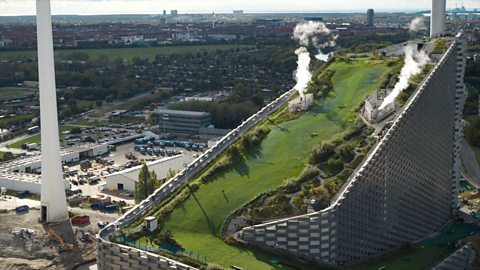
Sustainable power in Copenhagen, Denmark. video
Ade Adepitan travels to CopenHill, an energy plant in Copenhagen that runs on rubbish rather than fossil fuels.
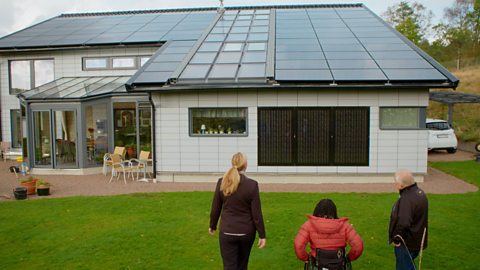
Hydrogen house in Gothenburg, Sweden. video
Ade Adepitan visits a special house in Gothenburg, which is powered by converting excess summer sun into hydrogen.
Rising temperatures in Svalbard. video
Ade Adepitan travels Svalbard to see the effects of rising temperatures on a dog-sled business.