Ade Adepitan visits a house in Gothenburg which is powered by converting sunlight into hydrogen.
ADE: Hi, my name’s Ade and I’m just outside Gothenburg in Sweden and I’m on my way to what I think could be the house of the future, a house that could provide one of the biggest solutions to our fight against climate change.
ADE: Is this it? Looks more like a factory than a house, look at the roof.
The house belongs to Hans-Olof Nilsson.
HANS-OLOF NILSSON: Hello there, welcome to Gothenburg.
ADE: Thank you. My name’s Ade.
HANS-OLOF NILSSON: Hans-Olof.
MARTINA: Hello Ade, Martina. Lovely to meet you.
ADE: So can we have a look around?
HANS-OLOF NILSSON: Oh yeah, sure, this way.
ADE: Hans-Olof runs a renewable energy company with his colleague Martina Wettin. He built this house a few years ago as a showpiece for what his company can do.
ADE: That's a different roof.
HANS-OLOF NILSSON: Oh yeah. It's a different roof. The roof there is fully covered with solar panels.
ADE: This is Sweden. In the winter, you probably don't get that much sunlight.
HANS-OLOF NILSSON: No, correct, no.
ADE: So how are you going to use the solar panels?
MARTINA: Actually, that's really important because if we can do it here where there's virtually no sun, yes, you can do it anywhere.
ADE: The gamechanger in Hans-Olof’s system is that when there’s more sun than he can use, he can store the extra energy for when he needs it.
Oh, look at this! Oh, my days, this is like some experiment, some scientific experiment going on here. What have you got in here?
HANS-OLOF NILSSON: Hydrogen. Compressed hydrogen gas.
ADE: And that’s the energy that you’re storing from the solar panels?
HANS-OLOF NILSSON: Correct, it’s converted into hydrogen and stored here.
MARTINA: So actually Ade it's compressed sun isn't it?
ADE: Oh, yes.
MARTINA: It's stored sun.
ADE: I don't want to make you sound like you're strange, but most people normally store wine or something like that, and you've chosen to store hydrogen…
HANS-OLOF NILSSON: Correct. That’s what keeps the house running.
ADE: By converting his excess summer sun into hydrogen, Hans-Olof can store enough power to get through winter. It’s like a battery, except normal batteries can’t store that much energy.
Oh, my days! Look at this! This isn't a normal basement, Hans-Olof. This isn’t normal.
ADE: When there’s more sun than he needs, Hans-Olof uses it to create the hydrogen out of water.
HANS-OLOF NILSSON: Yeah, so here it is. It's connected to the drinking water system and is splitting the water to hydrogen and oxygen. H2O.
ADE: Yes.
HANS-OLOF NILSSON: And then when the winter is here, hydrogen comes back, goes into the fuel cell I have there. It takes oxygen from the air we are breathing. And when these two gases are merged together, electricity is created.
ADE: You’ve basically got your own power station?
HANS-OLOF NILSSON: Yeah, I do. Yes. Sun and water is the energy system that could power the planet, any place.
ADE: So all of the hydrogen cells and the stuff we saw below, is powering everything here.
HANS-OLOF NILSSON: Yeah, everything here.
MARTINA: Keeping the underfloor hearting…
HANS-OLOF NILSSON: Everything, the light, lamps, all the appliances in the kitchen, laundry, everything.
ADE: And how viable is this for everyday people?
HANS-OLOF NILSSON: The prices for this type of system is dropping. I would say within a decade, it's standard for… It's one option that really is considered when you're building a house.
ADE: And how long is this system going to last for?
HANS-OLOF NILSSON: It's for the life of the house. You produce your own energy.
ADE: And more than energy, you know, the added bonus is what it does for the environment.
HANS-OLOF NILSSON: Correct, no CO2, no emissions at all.
ADE: And what other uses are there in terms of energy for hydrogen?
HANS-OLOF NILSSON: You can use it wherever you need energy. Cars, buses, trucks, trains, ships, so it can be used for anything.
ADE: You feel that hydrogen is the future?
HANS-OLOF NILSSON: Yes, it is for sure. It is the future.
ADE: Since he built his home, Hans-Olof has had around 7,000 visitors who have come to learn from what he’s done. And in 2020, the EU announced a new Hydrogen Strategy, to help achieve carbon neutrality. If we can harness its potential, hydrogen could play a massive part in a carbon-free future.
Video summary
Download/print a transcript of the video.
Ade Adepitan visits a house in Gothenburg which is powered by converting sunlight into hydrogen.
He meets Hans-Olof Nilsson, who runs a renewable energy company with his colleague Martina Wettin. Hans-Olof built the house to showcase what his company can do. By converting excess summer sun into hydrogen, Hans-Olof can store enough power to get through winter.
This clip is taken from the BBC Two series Climate change: Ade on the frontline.
Teacher Notes
Download/print a pdf of the Teacher Notes.
Teacher Notes prepared in partnership with the Geographical Association.
Before watching the film
You might want to recap the issue of climate change, the need to mitigate the effects at a global scale by reducing our carbon emissions, and list some of the ways that this might be done.
As well as using less energy in our everyday lives, we also need to think about how we can replace fossil fuels with sustainable energy sources such as solar, wind, tidal and geothermal (for example). It could be useful to discuss and clarify examples of renewable and non-renewable energy.
After an initial discussion about this, you could ask students what a house of the future might look like in terms of energy sources and identify some key features. It could be worth considering the relevance of location at this point and asking students how landscape, terrain and local climate might influence the sustainable energy choices.
During the film
You may wish to stop at relevant points during this short film to pose questions and check understanding or wait until the end. Useful questions might include:
- Why doesn’t Sweden get much sun in the winter months?
- How is the surplus energy from summer sun stored?
- How is energy generated in the winter months?
- What are the ingredients of this energy source? (sun and water.)
- What else can this hydrogen energy technology be used for?
- What do students think about this technology?
You might have a discussion about zero carbon emissions, its versatility in providing energy for houses, cars, buses, etc. The beauty of being able to store energy from sunny days to dark days and how the elements of sun and water are freely available. You may also want to discuss the cost of the system technology, the space needed for the storage of hydrogen, and whether this would be realistic in a built-up city environment?
Following on from the film
You could ask students to return to their original ideas about a house for the future and identify a chosen list of features, including renewable energy sources, and a rationale about why they were chosen. The house should have a specific location, this could be the locality in which students live or it could be a locality in another country, and a given context such as urban or rural. Students could then explain how their house is particularly suited to its location.
You could discuss with students how carbon emissions can be reduced even if using a system that relies on fossil fuels, and recap why reducing energy use matters. Students might set up an energy review of their school and investigate savings inside and on the campus following a mapped audit of energy use.
Students could be asked to prepare a presentation making a case for the adoption of the sun and water fuelled technology seen in the film clip, or another type of sustainable energy for their school. They will need to argue their case as to why their renewable-energy approach was chosen and how it is more effective than other options.
Students could consider the importance of locational aspects. For example, if advocating solar panels, which direction do the roofs face; if wind turbines, what is the average wind speed on site and where is the best location? How close are neighbours to the school? How much outside space does the school have? Students could consider all these aspects in making their recommendations.
In 2020, Europe announced a new hydrogen strategy to help the continent achieve carbon neutrality. Students could research more about this and give a short presentation about what it means.
This short film is suitable for teaching KS3 and KS4 students. It can be used alongside the other Ade Adepitan films about climate change or watched on its own. It is a useful follow up to watching the clip about the CopenHill power station in Copenhagen that runs on waste.
All the films build on students’ understanding of climate change issues and enable them to make global connections.
This film supports the KS3 geography curriculum through learning more about energy and sustainable living.
At KS4 this supports work on energy and sustainable resource management.
This clip could be used to support the delivery of geography to KS3 and KS4 students. Specifically, this topic appears in OCR, Edexcel, AQA, WJEC KS4/GCSE in England, Progression Step 5/GCSE in Wales, CCEA GCSE in Northern Ireland and SQA National 4/5 in Scotland.
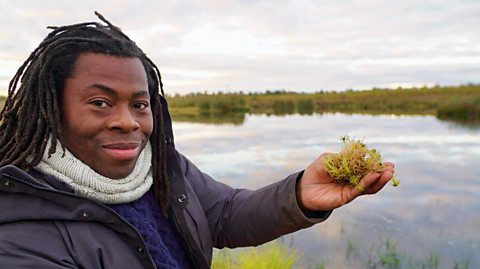
Peatlands in Sweden. video
Ade Adepitan travels to Sweden to see how restoring peatlands can help us fight climate change.
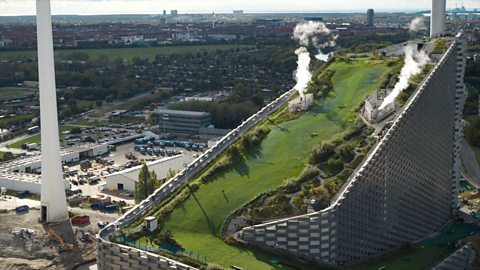
Sustainable power in Copenhagen, Denmark. video
Ade Adepitan travels to CopenHill, an energy plant in Copenhagen that runs on rubbish rather than fossil fuels.
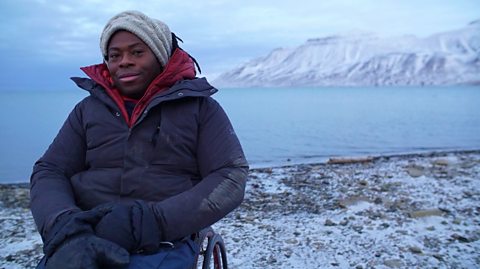
Rising temperatures in Svalbard. video
Ade Adepitan travels Svalbard to see the effects of rising temperatures on a dog-sled business.