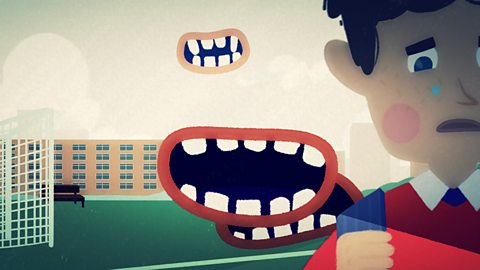
The difficulties began when I was in year four.
I worry loads about my parents.
My mum started getting back pains, and then it just got worse, and then we heard that my dad got more ill.
It was just really sad, and I wanted to know what was going on, because it was just making me worried.
When I get scared, I just stop, really, and sort of think about all the things that could happen when I’m not at home. I get really shaky and sometimes really awkward to be around people.
I think the first time was when I went to a friend’s house, for a sleepover, and then I remembered, wait I’m away from home, where are my parents? And got upset. And that’s sort of what started it off.
The more I thought about it the sort of more important it felt, and more important it was, the more I would worry about it.
Sometimes when I get nervous, my tummy can start cramping, my legs or arms can start shaking, or I tense up. My throat feels a bit like it’s closing up, my vision can get blurry and start seeing flashes, make me feel like, what is this, why is it happening?
You don’t cry, you don’t move, you just, you just stand there motionless. I shake and I just know I’m shaking and my hands start to sweat.
I had sort of like… like a sore throat or something, and it felt a bit like I couldn’t breath very well, and I felt that my throat was closing up.
My head just thinks about everything and then like my breathing gets faster.
Kinda feels like you have to run away from something and then your adrenaline starts kicking in and… that makes my heart race a bit.
Yeah, just I guess, adrenaline, you get really scared and your heart just really goes really bad.
My hands they, they like really start to sweat. It feels like, emptiness, and like, it feels like something is tingling inside your stomach, and it just doesn’t feel very nice.
One day, I was walking to our classroom.
Because there was an ambulance driving around, I thought my dad had like hurt himself, or my mum had hurt herself. And then like, my leg gave way.
It starts off with a worry, and then that starts making me have the symptoms. Then I sort of think, wait why is this happening. And then that’s another worry, and then that sort of makes the symptoms worse.
Your brain can send out adrenaline because there is the fight, flight, or freeze - if you get really upset - if you’re worried, or frightened then you’ll either sort of want to run, or stay where you are, or try to fight it - and can sometimes make you shake.
I referred myself to SYM, which is ‘Strong Young Minds’. Yeah, and then I saw a therapist at CAHMS. It hasn’t gone, but it is easier… it’s easier to deal with it. Like going away now, because I know that it’s a little bit safer.
The fact that I know what it is, doesn’t scare me, because before I was like ‘wait what’s happening’, this is something else to worry about, but because I know what it’s about, and what it is, then I wouldn’t get quite as worried about it, and just be like, it’s ok.
This time last year, I started seeing a psychologist who did help.
She sort of talked about the kind of things that could happen when you’re anxious, how it can’t actually hurt you.
Video summary
The intimate first person testimony of these two young people will help students to understand what it can feel like to go through a panic attack, and will help them see how someone can get into a state of panic to begin with.
Through Luke and Jenny’s accounts, students will learn to empathise with those suffering from severe worry and panic attacks, and in general to feel empathy for others.
Teachers will find this film particularly useful in opening up discussion around how to cope when feeling worried or frightened, and on how to help people who might be feeling stressed.
This clip is from the series When I Worry About Things.
Teacher Notes
You could begin by asking pupils what it means to have a panic attack, and how it might affect people.
Ask pupils to discuss what to do if they think they or someone they know is having a panic attack, and what mechanisms they could use for dealing with stress and anxiety.
This clip is relevant for teaching PSHE at KS2 and KS3 in England, Wales and Northern Ireland and 2nd Level in Scotland.
Being a bully - Ariana's story. video
A powerful animation explaining through personal testimony how being undervalued at home drove a young girl to become a bully.
OCD and depression - Annabel’s Story. video
A powerful animation about a girl who developed nervous tics, OCD and depression after a period of upheaval, and how she learnt to cope.
Anorexia - Kirsty's story. video
A powerful animation based on the first-person testimony of a young girl who developed anorexia as a response to social anxiety.
Being bullied - Jake's Story. video
A powerful animation about a boy who suffered severe bullying and how joining the army cadets helped him cope.