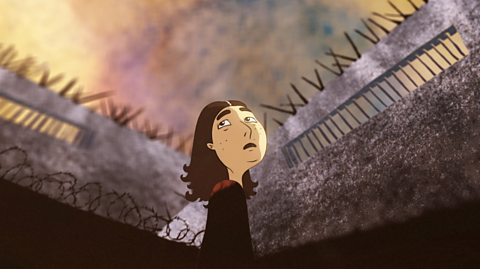
HAMID:
The streets would be full of people selling food and the food, like, will have, like, if you’re selling fruit on the street, it would have, like, flies on it. And on the buses, because it’s a really small country and there’s lots of people stuffed in it, there’s no place to sit.
And if you’re sat, even if you’re a baby, you have to get off the seat for a bigger person. And then the streets had dust in so if the wind blew [it] would go in your eyes.
I don’t know why the war started. Eritrea, a long time ago, used to be just a big country and then they split it with Ethiopia. But then since we split it from Ethiopia, we got the Red Sea and the war started because they wanted the Red Sea. So then all this war happened, lots of people had to get away and we didn’t have lots of airplanes because everybody was just moving and moving.
I remember that… that we had to leave when I was a young age. My dad couldn’t come because he knew secrets. Because the guy that’s leading us right now is very, very bad and my dad wanted to escape but he couldn’t. They said to him, if you tell people of our secrets, we will kill your wife and me so then he told us we had to run.
I remember that we just got on a plane and I slept but I really knew that it was a really long, long journey. And sometimes we took buses and I really fell asleep a lot of times. And then at the end, we arrived in England it was kind of very hard to fit in with hardly any English.
I started school, and I was like very scared because I didn’t have no friends because everybody was, like, had groups.
One day this boy, he fell out with a group, so then me and him we said ‘why don’t we be friends’. Then we joined other peoples groups and then we had, made lots of friends.
A few weeks later, I came back from school and there were lots of ladies in my house. And my mum was on the bed and I asked her ‘why was everybody crying yesterday?’ And then she said: ‘Oh, I have something to confess to you. Your dad he died there.’ Then I stared crying, and then she started crying, and then I told her stop crying, then she said I’ll stop crying if you stop crying, so we both ended up stop crying.
For a few days I stopped eating, I only drinked a little bit and I couldn’t finish my dinner at school. My mum came to me and she says ‘you don’t have to be very upset because at the end that’s why we left home, because it was dangerous.
I started feeling OK and that it’s right that we should have came here. It got really better. I made a lot of friends. We don’t talk about how our lives at home. We don’t, like, talk about this stuff. We don’t talk about sad things. We talk about good things. We don’t mention the sad things, we act like the never happened.
My friend always, when I’m feeling sad, he always comes up with a joke and cheers me up, and when he’s feeling sad I come up with a joke and cheer him up.
This powerful animation follows the journey of ten-year-old Hamid from Eritrea, who was forced to leave his country.
Hamid had to leave his father behind and later discovered that he’d been killed.
He candidly describes the struggles of coming to terms with his father's death, as well as settling into life in a new and unfamiliar country.
This short film is part of BBC Teach's Seeking Refuge series. Click or tap here for the main page, with support notes for teachers.
Teacher Notes
The short film could be used to illustrate why some people have to flee their country, and therefore, help raise questions about persecution and war.
It could also be used to start a discussion around what it’s like for children adapting to life in the UK, identity and the effects of alienation and displacement they may experience.
In addition, in an English lesson this film could generate discussion for the different genres of writing, providing an example of narrative and describing personal experiences.
Questions to support discussion
What was life like for Hamid and his family in Eritrea?
When they left, what were they fleeing from?
Which of Hamid’s human rights were being impacted by living in Eritrea?
What might have happened to them if they had stayed in Eritrea?
How did grief over his father’s death affect Hamid?
What helped him manage his grief?
How do Hamid and his friend help one another?
How do your friendships help and support you with difficult feelings or situations?
Curriculum Notes
Relationships, sex and health education
Links to: The benefits of healthy relationships to mental wellbeing; how families contribute to human happiness; the characteristics of positive and healthy friendships; that happiness is being linked to being connected to others.
PSHE education (non-statutory)
Links to:
Core theme 1: Health and wellbeing/self-concept
Core theme 2: Relationships/Relationship values/Positive relationships
Core theme 3: Living in the Wider World/Communities
RE
Links will depend on the RE syllabus that a local authority, faith school or academy follows.

More from Seeking Refuge
Ali's journey from Afghanistan. video
Ali - a ten-year-old boy - fled to the UK with his grandmother during the war in Afghanistan. Ali describes the pain of separation from his family as well as his experiences adjusting to life in the UK.
Juliane's journey from Zimbabwe. video
The story of Juliane from Zimbabwe, who spent years living away from her mother in an orphanage before reuniting and escaping the country together.
Navid's journey from Iran. video
With his father's life in danger, Navid - aged just five - was forced to flee his home in Iran with his mother and make the long journey to the UK.
Rachel's journey from a country in Eurasia. video
Following the journey of 17-year-old Rachel, who escaped religious persecution in her country and settled into a new life in the UK before being deported.