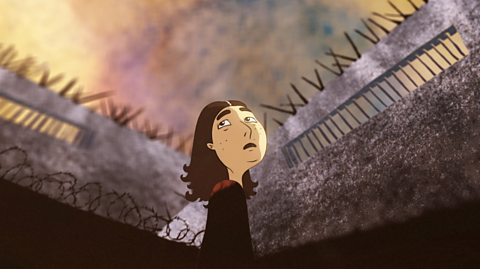
NAVID:
I am 16 years old, I’m a Kurdish Iranian. The reason that we left Iran was my dad disagreed with how things were going, he disagreed with the system, and then, um, I remember my father had to leave the country. Of course his life was in danger when he left.
It was kind of the story of many people against the Iranian government. I suppose my father was lucky that he got away because members of my mum’s family, because they were Kurdish, a lot of them were executed and in the years that followed my mum kept getting questioned about where my father had gone.
I remember the night that we were leaving, everyone was really, kind of, sad. I didn’t really understand why they were sad but then eventually when we got to the airport it was that moment that I realised that I’m leaving and then, um, I was upset nearly the whole journey.
In Italy, we had to jump over a fence, which seemed rather scary to me. We got stopped by the police and I was scared of the police dog. It was at night and I think we were going through a little forest or something, not sure. But I remember the dogs barking that scared me.
I remember staying one night inside a cottage. I think maybe it was around Slovenia, I’m not sure. I remember the night that we were leaving outside the cottage. I felt scared because it was at that point I could see the concern on my mum’s face
To get into England, we got into a lorry from France. The lorry was full of iron bars. It was the first time throughout the journey where I was really, really uncomfortable and scared. I really wanted to get off and then when we finally got over to the UK, I remember, um, someone cutting open the back of the lorry.
It was kind of like one of these movies when sunlight comes in and then we came- came out and I remember the British border agency. They were really friendly and then of course it was around that day that I saw my dad after like 2 or 3 years.
And it was the weirdest thing because it wasn’t what you’d expect, run to your dad, hug him [and that?]. At first I didn’t recognize who it was. And then after a while he told me how he’s my dad and how he’s missed me so much.
And then I remember sitting in the back and my mum was sitting in the front and I remember it was at night, the whole journey I just kept looking at him trying to figure out what’s going on, who he is. And then slowly I got more and more comfortable towards him.
The first few days at school were really hard on me not because of the other students or teachers but not knowing anything, it was just literally being an outsider, that was really scary for me. A memory I have was school had started and they’d closed the fences and then at break time my mum came to say hello and then when she did come I talked to her and then once the bell rang to start lessons again I remember holding onto the fence as if it was some sort of prison.
You could feel literally not knowing what someone around you is saying. Even though they’re being friendly, you could tell with the smiles and facial expressions that they’re being friendly, not knowing what they’re meaning was quite scary for me.
There was a mixed variety of, um, backgrounds and the fact that there were refugee kids at that school and this centre where you’d go to after school to be with other kids was a great support so, er, even though the first few months were really uncomfortable, having that sense of atmosphere was a great help.
With his father's life in danger, Navid - aged just five - was forced to flee his home in Iran with his mother and make the long journey to the UK.
Navid describes why he had to leave his country, the long and dangerous journey to the UK, and how he adjusted to his new life in unfamiliar surroundings.
This short film is part of BBC Teach's Seeking Refuge series. Click or tap here for the main page, with support notes for teachers.
Teacher Notes
This short film could be used as an illustration of why some people have to flee their country, and therefore, help raise questions about persecution and war.
It could also be used to start a discussion around what it’s like for children adapting to life in the UK, identity and the effects of alienation and displacement they may experience.
In addition, in an English lesson this film could generate discussion for the different genres of writing, providing an example of narrative and describing personal experiences.
Questions to support discussion
Why were Navid’s family being persecuted?
How does Navid describe his journey out of Iran?
Why do you think Navid reacted towards his dad in the way he did? Did this surprise you?
How might Navid’s life have been different if they had stayed in Iran? How do you know?
What makes things difficult for Navid, and what helps this get easier?
Curriculum Notes
Relationships, sex and health education
Links to: The benefits of healthy relationships to mental wellbeing; how families contribute to human happiness; the characteristics of positive and healthy friendships; that happiness is being linked to being connected to others.
PSHE education (non-statutory)
Links to:
Core theme 1: Health and wellbeing/self-concept
Core theme 2: Relationships/Relationship values/Positive relationships
Core theme 3: Living in the Wider World/Communities
RE
Links will depend on the RE syllabus that a local authority, faith school or academy follows.

More from Seeking Refuge
Ali's journey from Afghanistan. video
Ali - a ten-year-old boy - fled to the UK with his grandmother during the war in Afghanistan. Ali describes the pain of separation from his family as well as his experiences adjusting to life in the UK.
Hamid's journey from Eritrea. video
Following the journey of ten-year-old Hamid from Eritrea, who was forced to leave his home country. Hamid candidly describes the struggles of settling into life in a new and unfamiliar country.
Juliane's journey from Zimbabwe. video
The story of Juliane from Zimbabwe, who spent years living away from her mother in an orphanage before reuniting and escaping the country together.
Rachel's journey from a country in Eurasia. video
Following the journey of 17-year-old Rachel, who escaped religious persecution in her country and settled into a new life in the UK before being deported.