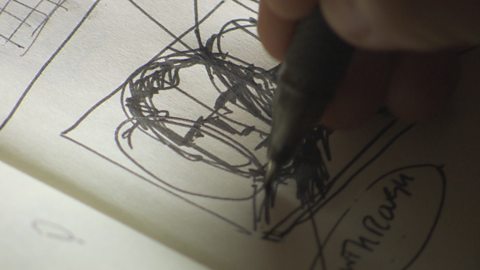
Nick Gentry:
So, really, the first stage of the work doesn't really start with me, it starts with other people. People from all around the world, actually, now, just send me all of their old materials.
There you go. From there, I start assembling them. I think in here we've probably got about 200 disks. You know, I've created before a painting that took 300 disks, so it's more than the amount of disks in this box alone. So, yeah, I do always need this constant supply. I don't think I could work in this kind of way without other people getting involved and other people's generosity, really.
That's why I have to really get my work out there on social media so that people can see what I'm doing and then, consequently, get involved.
X-rays. I would use an X-ray on a piece of glass, transparent layer, and use its tonal range, really. I've used, like, kind of, ribcages before, for, like, hair. Cos it's all about, kind of like, picking up each individual piece and analysing it and seeing what sort of qualities it has and what it could represent.
There's just so many materials that you can use as opposed to the traditional, like, canvas and paint. It's just… Why not explore some of that?
They often come with a note. This one says, 'Hi, Nick. These X-rays belong to my late father-in-law and were taken in Belgium. He would have been so thrilled at this idea. I hope you find some use for them. Thank you for having them and for the enjoyment of the beautiful pieces. We love them!'
I think it's really amazing that people would actually send me something like that. It's like they trust me to use those, you know, quite personal things. And, yeah, it's just like an inspiration for me before I even start any project.
I like to keep this, sort of, circle going where, you know, if people send things to me, I like to try and send something back to them, whether it be, you know, a book of my work, or a print. They are, you know, people I've never met. After a while, it's nice to think of it as maybe a bit more than that. You know, there's some kind of connection that's been made.
Video summary
Artist Nick Gentry shows some of the old materials that he’s been sent and demonstrates how he uses them in his artwork.
He has been sent various items; like old floppy discs and some x-rays that he will recreate into a portrait.
He explains how he uses x-rays for tonal ranges and transparent layers, as an alternative to traditional canvas and paint.
Nick also reads a letter to demonstrate how people have sent personal things to inspire his work and how, to make a connection, he sends them something in return, such as a piece of his artwork.
Teacher Notes
What could the students remake an artwork from to reuse and transform it? Get the students to investigate other potential mail art ideas for their artwork.
These clips will be relevant for teaching Art and Design at GCSE/KS4 in England, Wales and Northern Ireland and National 4/5 or Higher in Scotland.
The topics discussed will support OCR, Edexcel, AQA, WJEC GCSE in England and Wales, CCEA GCSE in Northern Ireland and SQA National 4/5 and Higher in Scotland.
Recycled Materials Artist Nick Gentry. video
Artist Nick Gentry introduces his artwork and the how using various recycled items is a fundamental part of it.
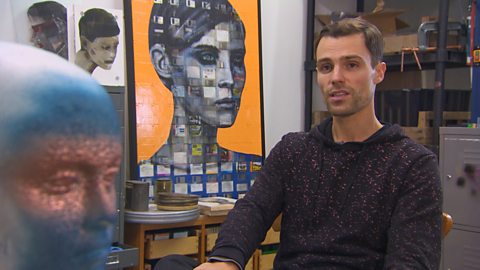
Creating a portrait from old floppy discs. video
Nick Gentry takes on the challenge of using some of the old floppy disks that he’s been sent to create a portrait.
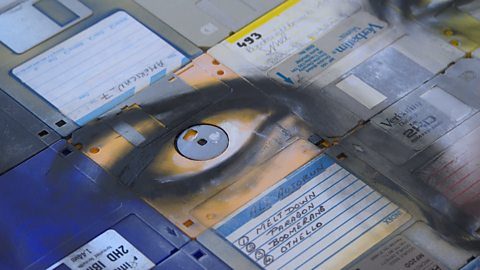
What inspires artist Nick Gentry? video
Artist Nick Gentry talks about what inspires his artwork and explains how his inspiration can often come from very mundane and everyday things.