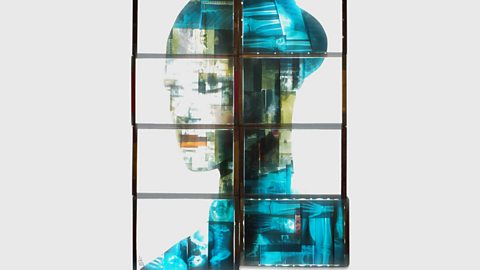
Nick Gentry:
So I'm about to start working on a new piece. At this stage, I'm really just trying to work out what elements can go where. So I kind of just build in really rough, basic structures.
It's almost like painting with these things like pixels. You get sort of highlights across the brow area and the nose and those cheekbones, and things like that. This is roughly the skin tone, but it's a little bit grey which adds that sort of machine-like feel to it. But then I know that this label here is going to add something towards the chin.
It's the initial stage of really what that whole image is going to be. I don't really like to over-paint. I just want to do as much as I can with the materials and not intervene too much with that, and just let the materials sort of be at the centre of the work, really.
So, at this stage all the discs are glued down in the place that I want them to be, and the final thing that I need to do is paint in all the features. There's nothing too planned. Sometimes you start to find, like, a colour scheme going on and you just go with that as a feeling. You try it out. It's not like I just chose yellow and that was the end of the story. It's a case of actually seeing what works within the composition.
I like to kind of get it to this finished stage where it's all looking nice and then throw a load of white spirit at it and kind of just destroy it a little bit. And mess it up. So the white spirit hits it and just starts to slightly corrode some of the paint on there, so it starts breaking up. Just adds this slight rough edge to it.
I just need to, like, break up the paint a little bit to stop it having that sort of 'finished', perfect feeling to it. So, yeah, that's the finished piece. And usually I just sign it somewhere that's not obvious. I like to kind of blend it in rather than have it showing. So I just pick a label and I just put it somewhere in the corner.
You get these waves of satisfaction when you finish a piece, but then it's on to the next piece. You don't… It's not… It's only fleeting, really. You don't ever get to sort of wallow in it too much.
I think that people that sent me all of these discs and things, they'd be… maybe surprised and, er… Yeah, maybe they'd be quite pleased and happy with the result. I hope so.
Video summary
We join Nick Gentry in his studio, where he is arranging some of the old floppy discs that he’s been sent into a composition.
The tones of the floppy discs help to create the skin tones and the machine like qualities of his portraits.
He glues the discs onto a board and paints a line drawing of the portrait with black paint then builds up the features.
Once it reaches an almost finished stage, he throws white spirit onto it. This breaks up the paint surface and blends it, which softens the overall appearance.
This clip is from Making Art Work, a BBC 2 Learning Zone compilation of short films following six UK-based leading artists as they create new artwork from scratch.
Teacher Notes
Encourage students to have a go at trying out some of the techniques shown and experimenting with paint effects by combining with other media or painting on different surfaces.
These clips will be relevant for teaching Art and Design at GCSE/KS4 in England, Wales and Northern Ireland and National 4/5 or Higher in Scotland.
The topics discussed will support OCR, Edexcel, AQA, WJEC GCSE in England and Wales, CCEA GCSE in Northern Ireland and SQA National 4/5 and Higher in Scotland.
Recycled Materials Artist Nick Gentry. video
Artist Nick Gentry introduces his artwork and the how using various recycled items is a fundamental part of it.
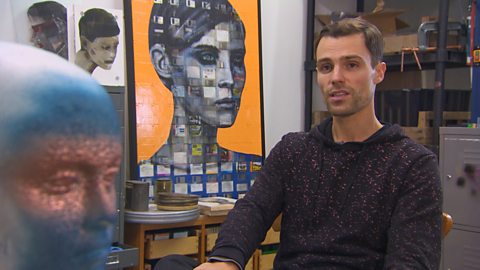
What inspires artist Nick Gentry? video
Artist Nick Gentry talks about what inspires his artwork and explains how his inspiration can often come from very mundane and everyday things.
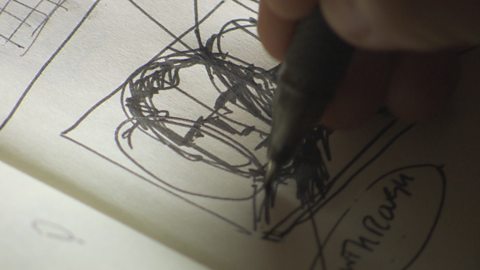
Tools and techniques for making art with recycled materials. video
Artist Nick Gentry demonstrates how he uses old materials that people have sent to him in his artwork.