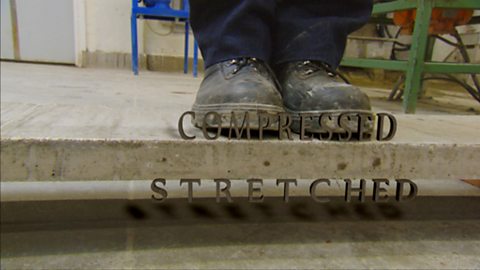
Interviewer:
Dr. Phil Pannell has been studying concrete for over 15 years and I've come to find out how to solve the problem of it's weakness. [NOISE]
Interviewer:
So what is this trick? I mean what is the answer to making concrete stronger, resisting these bending forces?
Dr. Phil Pannell:
Well back in the 1850s [NOISE] a plasterer from Newcastle called Mr. Wilkinson and he was making concrete floor slabs [NOISE] and what he noticed is that these slabs had a tendency to crack in between the joints.
Interviewer:
Just like my [LAUGHS] my unfortunate experience with the plank.
Dr. Phil Pannell:
Exactly like your unfortunate experience with the plank yes. [NOISE]. So Wilkinson noticed where the cracks were appearing in his concrete floor slabs and he had an idea and a very bright idea and he took some barrel hoops, he took some of the flat hoops that go round and hold a barrel together and he placed them in the concrete where he noticed the cracks were appearing,where he knew we had to resist these pulling forces.
Interviewer:
Right, so he invented reinforced concrete.
Dr. Phil Pannell:
He did back in 1853 yes.
Interviewer:
What a dude.
Dr. Phil Pannell:
Absolutely, he laid the foundations for modern urban life. Without reinforced concrete nothing we see around us would exist.
Interviewer:
Reinforced concrete might seem simple but it works because steel is the perfect partner for concrete. They both share a surprising quality. They expand and contract at the same rate when they get hot or cold.
Interviewer:
And unlike concrete steel is strong when it's under tension. It bends without breaking like concrete does. [NOISE].
This short film, first published in 2012, is for teachers and review is recommended before use in class.
Find out how concrete is reinforced through the use of steel.
Scientists demonstrate how this works and how this method was invented in 1853.
Reinforced concrete is use in most modern man-made buildings.
Mark Miodownik learns how reinforced concrete was invented in 1853 by a plasterer from Newcastle called W. B. Wilkinson.
Wilkinson inserted straightened steel barrel hoops into wet concrete to resist the tensile forces that cause concrete to crack under load.
Mark explains that concrete and steel expand at the same rate when heated which is critical to its many applications.
This clip is from Materials: How They Work.
Teacher Notes
Students can use plaster of Paris in place of concrete to recreate this experiment.
They should use card moulds to pour the plaster of Paris into.
They can be given a choice of materials to reinforce their plaster before it sets.
Be aware that this reaction generates a substantial amount of heat and should be allowed to set away from students.
In the following lesson, students can test the strength of their tile by slowly adding masses as it is suspended across a small gap.
How will they compare the effectiveness of their reinforcement against other groups?
The materials they use could be costed by allocating them imaginary costs, and the most effective but cheapest reinforcement material identified.
Curriculum Notes
These clips will be relevant for teaching Chemistry at KS3 and GCSE/KS4 in England, Wales and Northern Ireland and National 4/5 or Higher in Scotland. The topics discussed will support OCR, Edexcel, AQA, WJEC GCSE in GCSE in England and Wales, CCEA GCSE in Northern Ireland and SQA National 4/5 and Higher in Scotland.
More from Materials: How They Work:
Bronze - The first alloy. video
Find out about the invention and impact of bronze, an alloy of copper and tin which was the first man-made alloy.
Development and uses of Optical Fibres video
Mark Miodownik describes how optical fibres work. He explains how they are able to transmit light over great distances.
What is Graphene? video
Mark Miodownik describes the discovery of graphene. It’s the toughest material we know, 200 times stronger than steel, and able to carry electricity at 1 million metres per second.
How was metal discovered? video
Scientist Mark Miodownik visits the earliest known copper mines in Israel's Timna Valley to explain the discovery of the first metal, copper.
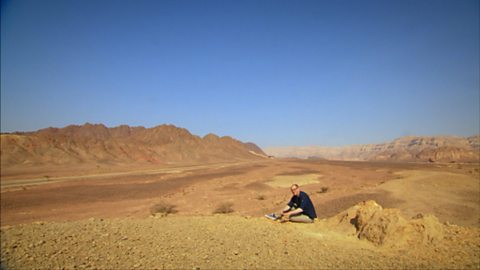
How reinforced concrete works. video
To demonstrate the power of reinforced, a beam is tested with a 2.5 tonne load to see if it will crack. What is the chemistry behind its strength?
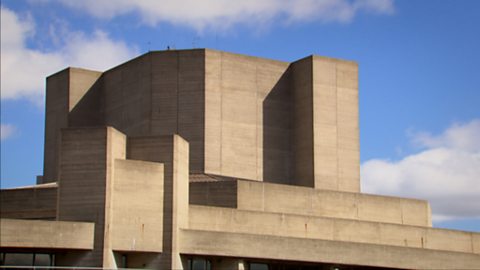
How the Romans invented concrete. video
Mark Miodownik explores how the Romans produced the first concrete and how concrete, glass and other ceramics are used in the modern world.
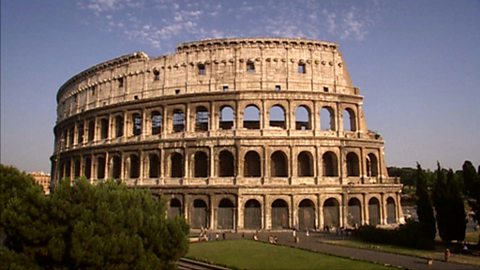
What is a superalloy? video
Mark Miodownik explores the world of superalloys, and puts the properties of one to the test showing how this metal is used inside a jet engine.
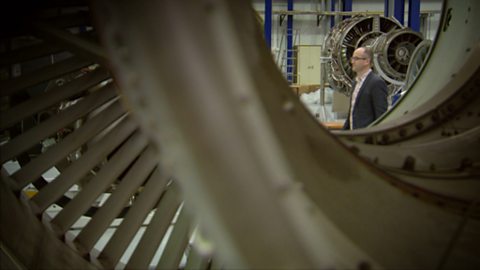
Superconductors and the 'Meissner effect' video
How can a piece of ceramic conduct electricity? Scientist Mark Miodownik explores the incredible potential of superconductivity.
The atomic structure of metal. video
Scientist Mark Miodownik explains how the atomic structure of metals gives them unique and highly useful properties.
What is superconductivity? video
Mark Miodownik puts the properties of a superalloy to the test with a practical demonstration of the strength of a superalloy under high temperatures and how this metal is used inside a jet engine.
The Invention of Carbon Fibre. video
Mark Miodownik describes the invention of carbon fibre composite by engineers at a Royal Aircraft Establishment in 1963.
The plastic revolution. video
Where do all the plastic goods that surround us come from? Mark Miodownik explores the history and molecular structure of these ubiquitous materials, and how they're formed.
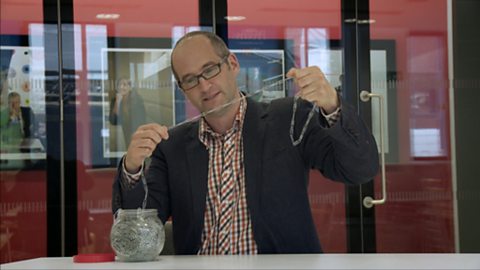
Goodyear's groundbreaking invention of vulcanised rubber. video
Mark Miodownik describes Charles Goodyear’s experiments to vulcanise natural rubber into synthetic rubber.
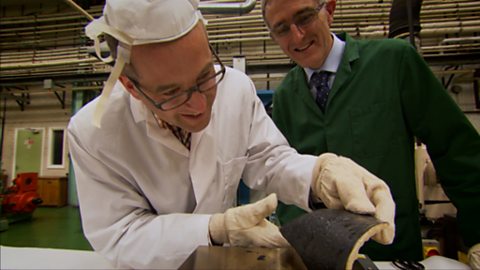
The structure, properties and uses of Bakelite. video
Mark Miodownik describes the work of the chemist Leo Baekeland, who invented the plastic Bakelite.
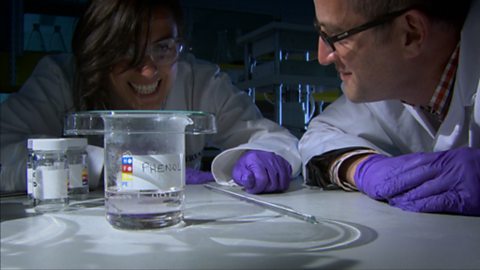
Why is concrete so brittle? video
Find out about the chemistry behind concrete. Scientists use experiments and animations to demonstrate how concrete breaks under stress.