This short film, first published in 2012, is for teachers and review is recommended before use in class.
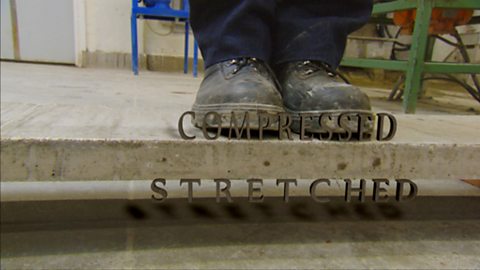
Mark Miodownik puts the properties of reinforced concrete to the test.
He watches as a beam of concrete withstands a load of 2.5 tonnes.
Even though cracks are present in the lower portion of the beam, they stop when they reach the steel reinforcement.
Mark explains why he loves concrete and describes why so many of our modern iconic structures are made from reinforced concrete.
This clip is from Materials: How They Work.
Teacher Notes
This clip can be used as a stimulus for a practical activity investigating the strength of concrete.
Students can carry out their own investigations into the strength of concrete.
They can vary the amounts of sand, cement, aggregate, steel wire and suchlike.
They can determine their own independent, dependent and control variables and test the shapes created by loaded them with masses or squeezing them in a G-clamp.
A mould can be created from a cardboard net or a plastic cup.
Curriculum Notes
This clip will be relevant for teaching Chemistry. This topic appears in OCR, Edexcel, AQA, WJEC KS4/GCSE in England and Wales, CCEA GCSE in Northern Ireland and SQA National 4/5 in Scotland.
More from Materials: How They Work:
Bronze - The first alloy. video
Find out about the invention and impact of bronze, an alloy of copper and tin which was the first man-made alloy.
Development and uses of Optical Fibres video
Mark Miodownik describes how optical fibres work. He explains how they are able to transmit light over great distances.
What is Graphene? video
Mark Miodownik describes the discovery of graphene. It’s the toughest material we know, 200 times stronger than steel, and able to carry electricity at 1 million metres per second.
How was metal discovered? video
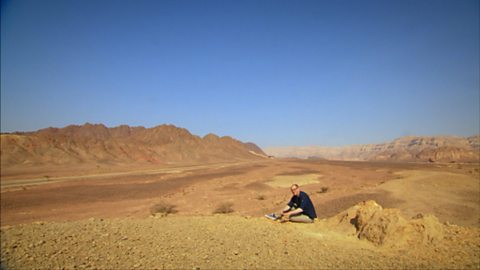
Scientist Mark Miodownik visits the earliest known copper mines in Israel's Timna Valley to explain the discovery of the first metal, copper.
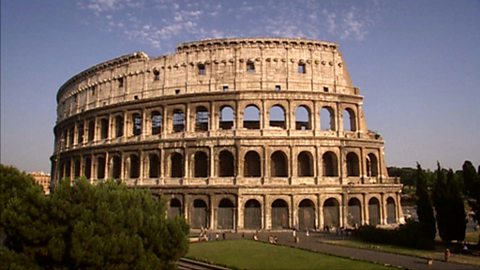
How the Romans invented concrete. video
Mark Miodownik explores how the Romans produced the first concrete and how concrete, glass and other ceramics are used in the modern world.
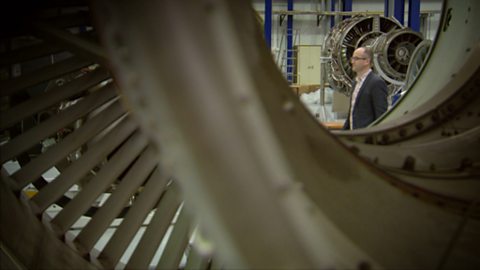
What is a superalloy? video
Mark Miodownik explores the world of superalloys, and puts the properties of one to the test showing how this metal is used inside a jet engine.
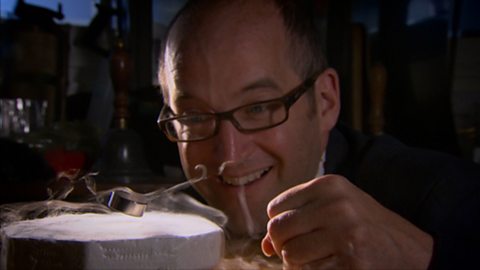
Superconductors and the 'Meissner effect' video
How can a piece of ceramic conduct electricity? Scientist Mark Miodownik explores the incredible potential of superconductivity.
The atomic structure of metal. video
Scientist Mark Miodownik explains how the atomic structure of metals gives them unique and highly useful properties.
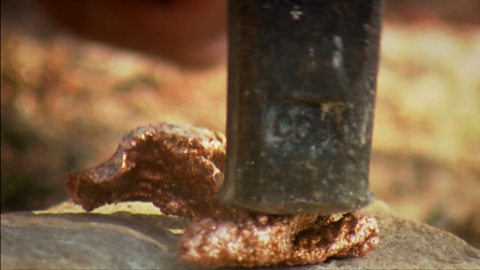
What is superconductivity? video
Mark Miodownik puts the properties of a superalloy to the test with a practical demonstration of the strength of a superalloy under high temperatures and how this metal is used inside a jet engine.
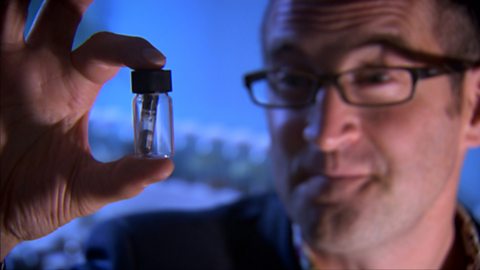
The Invention of Carbon Fibre. video
Mark Miodownik describes the invention of carbon fibre composite by engineers at a Royal Aircraft Establishment in 1963.
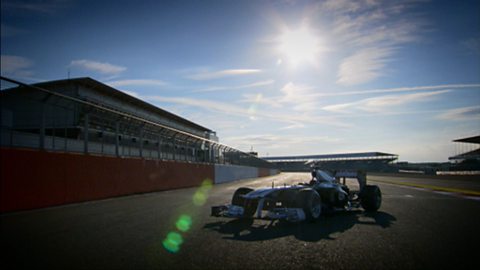
The plastic revolution. video
Where do all the plastic goods that surround us come from? Mark Miodownik explores the history and molecular structure of these ubiquitous materials, and how they're formed.
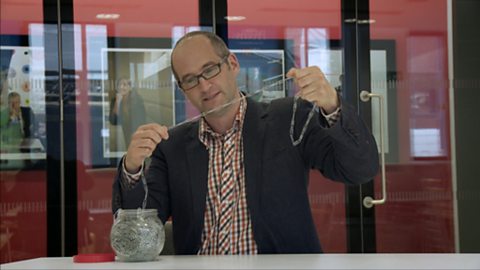
Goodyear's groundbreaking invention of vulcanised rubber. video
Mark Miodownik describes Charles Goodyear’s experiments to vulcanise natural rubber into synthetic rubber.
The structure, properties and uses of Bakelite. video
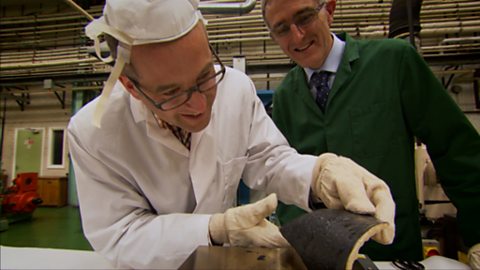
Mark Miodownik describes the work of the chemist Leo Baekeland, who invented the plastic Bakelite.
What is reinforced concrete? video
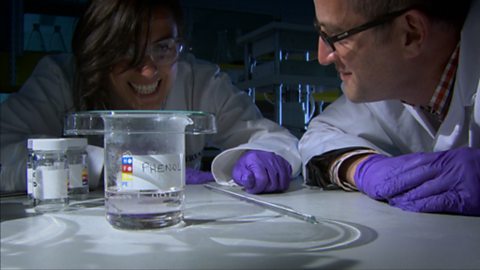
Find out how concrete is reinforced through the use of steel. Scientists demonstrate how this works and how this method was invented in 1853.
Why is concrete so brittle? video
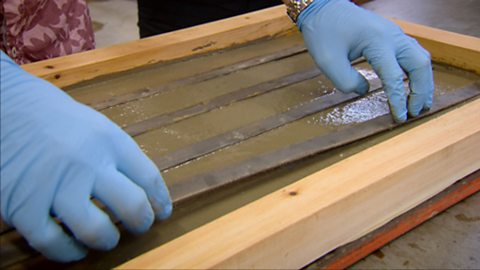
Find out about the chemistry behind concrete. Scientists use experiments and animations to demonstrate how concrete breaks under stress.