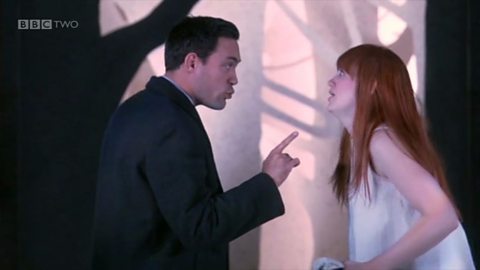
AMANDA WILKIN:Titania and Oberon are fighting over a baby. It's very important to them.
AMANDA WILKIN:Oberon wants it but Titania has the child and it's her way of having some power over him.
JO STONE-FEWINGS:That moment at the very beginning of the play is terribly important, the fact that she has the boy, he wants the boy, this is what they're arguing about.
PIPPA NIXON:Set your heart at rest. The fairy land buys not the child of me. His mother was a Votress of my order. And in the spiced Indian air by night, full.
AMANDA WILKIN:Titania talks about this Votress, this woman that she was friends with, she had this special bond with, and she gave birth to this baby boy and she died giving birth to him, and that's why Titania has the child, and nothing that Oberon can do can separate Titania from the bond that she has with the child.
NANCY MECKLER:Why did Shakespeare write that whole speech about the Votress?
PIPPA NIXON:I don't know. It feels like a very sensual piece. It's about intimacy, it's about friendship. It's about loyalty, it's about love.
NANCY MECKLER:One of the things we've talked about is this whole idea that the child in this instance represents love, and that he feels that what he wants is for Titania to love him the way she loves that woman. That isn't just a sexual thing, that it's to have a real love.
AMANDA WILKIN:It's a wonderful monologue that Titania has when she's describing how she got the child and what her friendship to the Votress meant. And what we decided to do was to bring to life the Votress, so that the audience can really get what Titania's talking about.
PIPPA NIXON:I like to think she has, through her imagination, conjured this beautiful Votress up that walks across the stage.
PIPPA NIXON:Which she, with pretty and with swimming gait following - her womb then rich with my young squire.
AMANDA WILKIN:It's more than just a walk, really, because it's our friendship that we're displaying, and saying, "I'm here. I was real and I was part of your journey and our journey was important."
NANCY MECKLER:What would it be like if we didn't see her? We'd be asking the audience to see her in their mind's eye, wouldn't we?
PIPPA NIXON:If we didn't, how do you still bring alive that memory and convey the closeness of that relationship?
NANCY MECKLER:Let's do it and see what it feels like, shall we?
PIPPA NIXON:Yeah, cool. When we have laughed to see the sails conceive and grow big-bellied with the wanton wind, which she, with pretty and with swimming gait following.
PIPPA NIXON:She goes into a description of this woman so intimately that it felt like I didn't want to say that directly to him. It was something so private that I…
JO STONE-FEWINGS:Yeah.
PIPPA NIXON:It made me want to remember and smell her.
JO STONE-FEWINGS:But it's odd, because it certainly doesn't advance your argument. It certainly doesn't help…
PIPPA NIXON:No, it doesn’t.
JO STONE-FEWINGS:in making him see your point of view.
PIPPA NIXON:No.
JO STONE-FEWINGS:Oberon says, "It's so simple. I'm so frustrated with you because it's so simple. You just give me the boy and then we can move on." And she's saying, "No, you know, it's bigger than that."
NANCY MECKLER:What if you come back and you give her the baby immediately?
PIPPA NIXON:OK.
NANCY MECKLER:And you sit down with it and then you just say you're not having it, you're not having it, because I tell you something, something so special, something so special and if you-- I think maybe if you just physicalise a bit as you're listening, just by moving back and forth, like a sort of, "I find this unbearable."
PIPPA NIXON:When we have laughed to see the sails conceive and grow big-bellied with the wanton wind, which she, with pretty and with swimming gait, following, her womb then rich with my young squire… would imitate, and sail upon the land, to fetch me trifles, and return again as from a voyage, rich with merchandise.
PIPPA NIXON:'He's seeing her being incredibly affectionate 'and loving and protective,' not only to the Votress, but also this tiny baby, like even just doing it then, and youwere saying, "Just sit in this chair and tell it to him," it felt like, "I'm going to tell it to you, but I'm also telling it to this little, tiny thing in my arms."
PIPPA NIXON:That shifts the speech, because in our production that speech is absolutely about the Votress, whereas, with the child in my arms, it felt like the speech was about the child.
PIPPA NIXON:Seeing that must make you feel so… Urgh! I want to-- It's almost like I want to get the child to get rid of that affection that you have for him.
JO STONE-FEWINGS:'Cause I want to be at the centre of your universe.
PIPPA NIXON:Exactly, exactly.
The cast consider the importance of the child at the centre of Titania and Oberon's argument.
They explore staging choices for conveying Titania's feelings and memories of the child’s mother, the votress.
This short film is from the BBC series, Shakespeare Unlocked.
Teacher Notes
This short film offers a demonstration of different staging choices complementing different readings of the text.
Before watching the workshop, ask your students to consider how people feel about having babies, and why a child might change people's relationships with each other.
After sharing ideas, you could discuss with your class what it feels like to have a little brother or sister— might you be jealous that your parents' attention is focused on the new baby?
Would you want to help look after the baby, or be important to the baby?
Explore how these feelings might resemble feelings that adults could have.
After watching the workshop, ask students how did the actors choose to portray the baby?
What effect does this have on Oberon? What have the actors and director said about the changeling boy?
This short film is suitable for teaching GCSE English literature and drama in England, Wales and Northern Ireland and National 4/ 5 in Scotland.
More from Shakespeare Unlocked - A Midsummer Nights Dream
Act 2, Scene 1 - Ecological disaster (workshop) video
A look at how Titania shows Oberon the impact of their argument on the world, discussing Shakespeare's use of language and imagery.
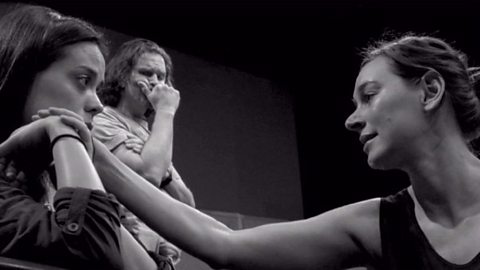
Act 2, Scene 1 - The Fairies. video
The King and Queen of the Fairies meet for the first time.
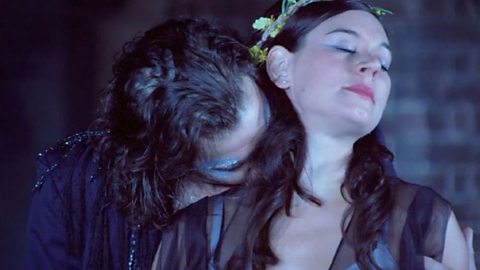
Act 1, Scene 2 - Quince v Bottom (workshop) video
Bottom and Quince battle to be the most important person present and experiment with playing the characters as high and low status.
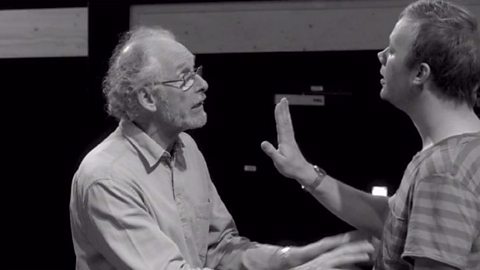
Act 1, Scene 2 - Clowning around (workshop) video
The company explore comic timing, playing for laughs and how to make Bottom funny.
Act 1, Scene 2 - The Mechanicals. video
A group of working men meet to prepare a play for the court.
Act 2, Scene 1 - Helena and Demetrius (workshop) video
How might Helena and Demetrius have met and how might their relationship have developed?
Act 2, Scene 1 - Playing Helena (workshop) video
Different ways of playing Helena: as victim, as temptress, or as a reasonable woman.
Act 2, Scene 1 - The Lovers. video
Demetrius goes to the woods to find Hermia, with Helena in hot pursuit.