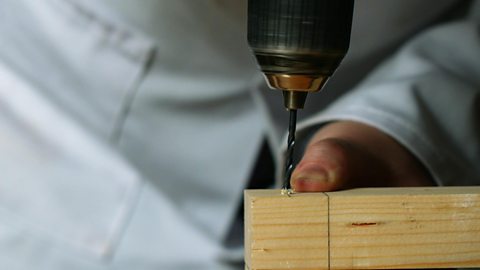
All wooden items and components have to be finished in order to seal and protect the surface of the wood.
Before you get started here are some things you're going to need:
Glass paper in a variety of grit sizes, a metal rule, a selection of wood oils with a cloth or sponge, some wax, wood stain, varnish or lacquer, and goggles and a dust-mask.
The process of finishing wood usually comes down to sanding and that can take longer than you think, so you'll need to be patient.
Like any abrasive process, sanding is about gradually removing smaller and smaller layers of the surface until it's completely smooth.
You'll need to do this in stages, using a few different types of glass paper of progressively finer grades.
Each stage removes the scratches left by the previous grades to give a smooth and even finish.
To start, get your dust-mask and goggles on and start smoothing with an 80 grit glass paper, then move on to a 120 grit, finally a 240 grit.
Remember to sand in the direction of the grain for a smooth finish. For larger flat surfaces you can get great results with an electric sander.
Now you've got a smooth finish you need to protect the wood, you could paint it, but you would lose the grain.
So here are three options that will protect and enhance the wood.
Wood oils, like teak oil, Danish oil or linseed oil, soak into and seal the wood, enhancing the grain.
You should apply oils directly to the wood with a cloth or sponge.
Wax will enhance the natural colour and grain of the wood and leave you with a satin or high-shine finish.
There are natural and chemical waxes, but both get the same result.
Applied with a soft cloth, or tissue, they are absorbed by the wood and, when they dry, they seal the grain against water or moisture.
And finally, you can stain the wood using a coloured, water-based stain to coat the surface. It soaks into the grain and then dries.
You should then seal the wood with a varnish or lacquer.
There are two types of varnish: water-based and chemical-based.
Water based varnishes are easiest to use, simply apply three coats, sanding between each one.
Video summary
This short film explains the process of finishing wood to achieve a professional look.
All wooden items and components have to be finished in order to seal and protect the surface of the wood.
Teacher's Notes
Points for discussion
- Why do we start with course glass paper and use finer grades sequentially to achieve the finish?
- When is an item finished? Discuss quality control and management in projects.
- Why would you choose one finish over another, for example wax vs wood stain, polyurethane varnish vs paint?
- In what order do we carry out processes? Do we varnish before or after assembly? Why?
- Discuss time in project management. How long does it take to achieve a truly professional finish as opposed to a finish you are happy with?
- Discuss when you would use hand finishing techniques over a hand sander, belt sander or bobbing sander.
- Discuss what constitutes shaping and what constitutes finishing an item.
- Have a wider discussion about the type of wood most suitable for various applications, for example door knobs, children’s toys, furniture, etc.
Suggested activities:
This process complements any wood-based product, for example:
- The outside finish on a trinket or jewellery box.
- Sanding techniques in the finishing a vacuum forming mould.
- Applying the appropriate finishes for a KS3/4/ design and make project.
- Design the type and shape of sanding block used to create different shapes, for example convex or concave curve.
- How can these processes be adapted to finish very small components?
Suitable for teaching design and technology (D&T) at KS3/KS4 in England, Wales and Northern Ireland, and 3rd and 4th levels in Scotland.*
Block foam modelling. video
This short film explains the process of block foam modelling, which is for creating prototypes of products in the design phase.
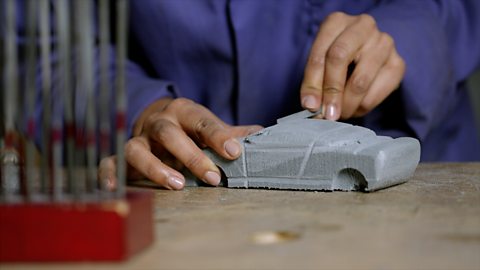
Finishing plastic. video
This short film explains the process of finishing plastic to achieve a professional look.
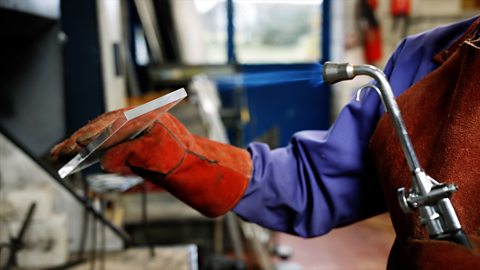
Screwing components together. video
This short film explains how to use screws, nuts and bolts to fix components together.