DAN SNOW: Hi, I'm Dan Snow. I'm a historian and I've been going through the BBC archives looking for stories explaining the events of WWII. The war was fought, of course, on the land, sea and in the air. And it's this last one that we're focusing on, in this clip from Andrew Marr.
Here we find out how the RAF's tactics involved using what, you'll see, looked like some giant board game. And how it came to play such a key role in the conflict with Germany, otherwise known as the Battle of Britain.
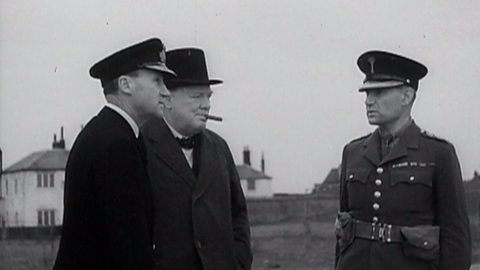
ANDREW MARR: On the 16th of August, 1940, Winston Churchill and his Chief of Staff, General Hastings Ismay, stopped off here at RAF Uxbridge on their way to Chequers.
This was 11 Group HQ, Fighter Command, responsible for air defence in the southeast of England.
Churchill took every chance he could get to stomp down here and watch Fighter Command in action.
Each day as the battle in the sky developed, the German attacks were plotted almost minute by minute on this giant map board.
The formations of attacking aircraft were shown by wooden blocks marked with the approximate number of planes. Their course was tracked by colour-coded arrows, corresponding to the room's master clock.
Now it looks very complicated, but, in fact, this was a masterpiece of clarity. It's a dusty old room now, but this is really about information processing and, the truth is, we were better at it than they were.
Plotting the enemy attacks day and night were members of the Women's Auxiliary Air Force, or WAAFs. They were known as "the beauty chorus."
Above them was what Churchill called the Dress Circle.
And up here, the senior commanders were playing a deadly game of chess with the Germans, taking split-second decisions about when to send squadrons up to fight.
Timing was critical. Fights in the air were won by a narrow margin of advantage. So getting clear of the ground and up to the correct height for battle could mean the difference between life and death.
By August 1940, squadrons could be scrambled and in the air within 90 seconds.
This beautifully efficient system was masterminded by the head of Fighter Command, Sir Hugh Dowding, also known as Stuffy.
If a democracy has any advantage in fighting a war, it's that some people are prepared to take on and challenge the supreme leaders.
Stuffy Dowding was exactly the kind of stubborn, flinty old so-and-so quite prepared to challenge Churchill at key moments.
He'd built up Fighter Command almost from nothing in the 1930s and was fiercely protective of his men and machines. This entirely novel command and control system was his idea, they called it Dowding's System. Now there was only one question, would it work?
At 1700 hours on the day of Churchill and Ismay's visit, radar detected 100 enemy aircraft crossing the south coast. Their target, the airfields of Fighter Command.
RAF squadrons were scrambled immediately. As he watched the attacks building up on the plotting table, General Ismay, a grizzled old army hand, said he felt "sick with fear".
But the attacks intensified. It seemed as if the RAF had nothing left in reserve and Churchill became absorbed by the drama.
22 British aircraft were shot down that day, eight pilots lost, but 72 enemy aircraft were destroyed.
Dowding's system was keeping the Luftwaffe at bay and the legend of the Battle of Britain was born.
As Churchill continued his journey to Chequers with General Ismay he said, "Don't talk to me. I have never been so moved."
But a few moments later, Churchill himself broke the silence,
"Never in the field of human conflict has so much been owed by so many to so few."
Later that evening when he got home, the General quoted those words to his wife and four days later, in a morale-boosting speech to the House of Commons, Churchill himself used them again.
DAN SNOW: Over 1,000 British planes were shot down in the battle of Britain, but nearly twice as many German planes were destroyed. Hitler had been planning for Germany to invade Britain at one point, but the RAF's successful defending of our skies meant that was never going to happen, and Hitler's plans had to change.
Video summary
Andrew Marr looks at tactics used by the RAF in the Battle of Britain.
The report tells the story of Winston Churchill visiting fighter command during a German attack, as German planes and formations were tracked on giant maps.
This work was led by the Women’s Air Auxiliary Force (WAAF). Their work led to decisions about when RAF planes should be sent to the skies to deal with the German threat.
Sir Hugh Dowding, the head of fighter command, led the British effort against the Luftwaffe. His tactics and organisation meant the Luftwaffe was eventually defeated.
Seeing the work of fighter command prompted Churchill to give his famous quote, ‘Never in the field of human conflict, has so much been owed by so many to so few.’
The success of the RAF in the Battle of Britain meant Hitler had to postpone his plans for an invasion of Britain.
This short film is from the BBC series, World War Two with Dan Snow.
Teacher Notes
Key Stage 3:
When students watch this short film, they could be asked to list all of the factors that helped Britain defend themselves against the Luftwaffe (for example, the WAAF, the leadership of Sir High Dowding, the pilots).
After watching the clip, they could write an explanation as to how each factor helped Britain.
There could be discussion about how the different factors were linked and whether some were more important than others.
Key Stage 4 / GCSE:
For students studying Warfare and British Society, students could evaluate the impact of these tactics in World War Two and how new technology and tactics affected World War Two and the Battle of Britain.
Students could make a comparison between aircraft in World War One and World War Two, how had aviation technology advanced and how did methods to deal with air attacks develop?
This short film will be relevant for teaching KS3 and KS4/GCSE history in England, Wales and Northern Ireland and National 4/5 history in Scotland.
Treatment of immigrants in Britain during World War Two. video
Andrew Marr looks at the internment of Italian immigrants in Britain during World War Two.
How did Britain use fake news in World War Two? video
Larry Lamb investigates the use of fake news by Britain in World War Two, when programmes were broadcast to Germany to persuade them the war was going badly for Germany.
How did Britain prepare for a German invasion in World War Two? video
Neil Oliver examines the plans made by Britain to prepare for a possible German invasion, with the creation of secret auxiliary units to be a last line of defence.