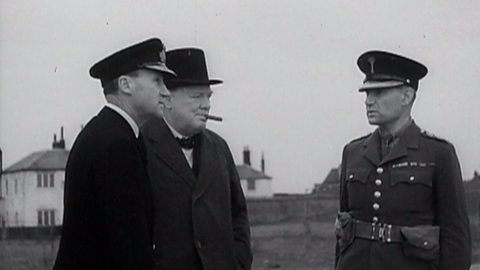
DAN SNOW: Hi, I'm Dan Snow, and I've been looking into the BBC's huge archives for stories that will help your understanding of the events of World War Two.
Here I've got a clip from Andrew Marr that looks at what was going on in Britain when war broke out. Not, however, for the British people, but for foreigners who were living over here and happened to come from the countries who we suddenly found ourselves fighting against.
ANDREW MARR: As darkness fell on the 10th of June, 1940, Italian ice cream shops and cafes were attacked during riots in Edinburgh, Manchester and London. Mussolini had just joined forces with Hitler. Britain was now at war with Germany and Italy.
There were 18,000 Italians registered as living in Britain, and when he was asked what should be done about them, Churchill replied, "Collar the lot!"
Within two weeks, 4,000 Italians were rounded up. Most of them ended up in hastily organised internment camps.
MALE VOICEOVER: To be interned in Britain is like paradise when compared with a Nazi concentration camp. So there shouldn't be any complaints here. Even if the internees have literally to make their own beds and take in each other's washing.
ANDREW MARR: The final destination for many Italians was the Isle of Man. They were fenced in with barbed wire and patrolled by armed guards, interned in parades of Victorian guesthouses.
Almost all of the Italians who were interned had done nothing more threatening to national security than to introduce the British to ice-cream, olive oil and coffee you could actually drink.
George Orwell complained that you couldn't get a decent meal in London because the head chefs of the Savoy, the Cafe Royal and the Piccadilly had all been locked up.
But it wasn't just Italians. Over 10,000 men and women of Italian, German and Austrian origin were interned here.
One refugee said, "Put Viennese people together for long enough "and they will do two things, found a university and open a patisserie." And that's just what they did here. There were cake shops, there were language lessons in French, Portuguese, Hebrew and Italian, lectures in history and literature, workshops from great Berlin theatre directors.
For a short period of time, one of the great centres of European intellectual life was the Isle of Man.
DAN SNOW: Despite that maybe sounding like too much of a jolly experience, foreign inmates did often speak afterwards of how depressed they were while being kept in the camps and of their relief when the war ended.
DAN SNOW: And in November 1945, six months after VE day, the families who had originally lived in the houses that were turned into the prison camps were finally allowed to come home.
Video summary
Contains scenes which some viewers may find upsetting. Teacher review recommended before using in class.
In June 1940, the Italian leader, Mussolini, declared war on Britain after joining forces with Nazi Germany.
In this short film Andrew Marr looks at the internment of immigrants from countries Britain was at war with during World War Two.
He focuses on the treatment of Italian immigrants who were placed in internment camps. Many were moved to the Isle of Man.
German and Austrian immigrants were also among the 10,000 people moved there, where the camp became a centre of intellectual life.
This short film is from the BBC series, World War Two with Dan Snow.
Teacher Notes
Students could watch this short film as part of a lesson when studying the Home Front.
Before watching, ask your students what they think life would have been like for immigrants from countries Britain was fighting during World War Two.
After watching, ask your students why internment would have been used and how the government might have justified these measures. Do students think this was morally acceptable?
This short film will be relevant for teaching KS3 and KS4/GCSE history in England, Wales and Northern Ireland and National 4/5 history in Scotland.
How did RAF tactics defeat Germany in the Battle of Britain? video
Andrew Marr looks at tactics used by the RAF in the Battle of Britain, focusing on air defences used to protect Britain against the Luftwaffe.
How did Britain use fake news in World War Two? video
Larry Lamb investigates the use of fake news by Britain in World War Two, when programmes were broadcast to Germany to persuade them the war was going badly for Germany.
How did Britain prepare for a German invasion in World War Two? video
Neil Oliver examines the plans made by Britain to prepare for a possible German invasion, with the creation of secret auxiliary units to be a last line of defence.