UNKNOWN MALE:Every one of the team is devoted to this aircraft, and making sure it is the best aircraft.
UNKNOWN MALE:As this wing unfolds, you'll see how big it is. You'll see what a massive task it is to take it out. You're actually standing there, and you've got 29 tonnes in the air.
NARRATOR:'The Airbus A380 is the world's largest airliner.
NARRATOR:'The plane would even be a tight fit inside Wembley stadium. The wings are over 10m wider than a football pitchand contain nearly a million individual components.
NARRATOR:'Each set of wings begins life as a collection of raw materials.
NARRATOR:'These panels, which will form the outer layer of the wing, are made from aluminium, because it's resistant to corrosion, has a high strength to weight ratio, and is very light. The aluminium is loaded onto Europe's largest milling machine, which cuts and shapes the metal sheets.
NARRATOR:'The A380's wings can lift 560 tonnes of superjumbo to an altitude of 12,000m.
NARRATOR:'This is down to their shape, which is created when the carved panels get sucked onto a specially moulded bed, and heat treated in the largest oven in the country.
NARRATOR:'This helps to fix the aerodynamic shape into place.
NARRATOR:'These panels form the outer skin of the wing.
NARRATOR:'And in another area of the factory, the skeleton that forms the inside of the wing is also being prepared.
NARRATOR:'A production line like this needs to operate constantly, so there are always different stages of the build being worked on at the same time.
NARRATOR:'But ultimately, all the different components ill need to go into the main assembly jig, a massive construction frame, important because it allows precise alignment in production and identical outcomes each time.
NARRATOR:'First in are the rear spars, three long sections that form the spine of the wing.
NARRATOR:'These spars are fixed firmly in place to 45 locating pins and will bear thewhole weight of the wing that lies lengthways in the jig.
NARRATOR:'Over the next five days, the team loads 49 ribs that run across the wing, which add strength and flexibility.
NARRATOR:'These ribs are made from aluminium and carbon fibre composites, materials both known for their strength and lightness.
NARRATOR:'Finally, the frame of the wing is fully assembled, and the skeleton is ready to be covered with the huge aluminium panels that form its skin.
NARRATOR:'Giant automated machines drill holes in the panels, around 250,000 per wing set, before they are lifted into position.
NARRATOR:'After 25 days, the main body of the wing is complete.
NARRATOR:'It weighs nearly 30 tonnes, and is four storey's high, lying on its side.
NARRATOR:'Complex builds, like the Airbus A380 wing, rely on people working together, with each team skilled at working on a sub-assembly, which is a smaller part of the larger build, and every part of the construction relies on this meticulous attention to detail and process.'
Video summary
This short film, first published in 2011, is for teachers and review is recommended before use in class.
The production of this revolutionary wing design is revealed.
It is a massive task to form the 30 tonne wing which takes 25 days.
We see two key sub assemblies, one forming the wing's exterior skin and the second the skeleton.
A mixture of graphics and footage from inside the actual factory bring this story to life.
We see the main assembly jig, automated machines and lifting devices as the wing is skilfully crafted.
Teacher Notes
Could be used to illustrate the use of moulds and jigs to ensure consistency in production.
The class could discuss why consistency is important when manufacturing repeat products and how it is achieved, for example through the use of computer controlled machines, the bed (mould) used to form the wing and the assembly jig.
Students could then carry out an activity to cut pieces of paper to a specified length using a scalpel within a set time limit of one minute - firstly using an engineering rule, then using a simple jig.
They could then compare the consistency of the measurements and the number of pieces produced.
They could also design a simple jig for a repeat application, such as drilling two holes in a metal wall bracket.
This clip will be relevant for teaching KS3 and KS4/GCSE Design and Technology, materials.
This topic appears in OCR, Edexcel, AQA, WJEC in England and Wales, CCEA in Northern Ireland and SQA National 4/5 and Higher in Scotland.
How car designers are inspired. video
An insight into design inspiration that has influenced the production of a sports car.
Why is testing essential in design and build? video
A look at the process for testing the weapons system on a new submarine and an introduction to the vital role of testing and analysis.
How does planning help the production process? video
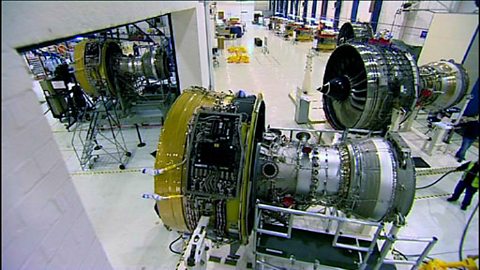
Rolls Royce use 'just in time' production planning for the Trent 700 jet engine.