Anna King:
So I'm taking photos for source material.
I've been working towards a big body of work for a new exhibition. Quite a number of the paintings will be based on trees in the surrounding area.
When you're painting, if you're just doing things out of your imagination all the time, I think you can get quite unnatural sort of shapes. When I look at the photographs I've taken, they often look just a bit, you know, sort of soulless, whereas when you're doing the painting, I can put in the sort of misty, ambiguous light that I really love, things that I can never capture on camera - that's what makes a painting special, I think, because you get to see someone's interpretation of a place, rather than just what it actually looks like.
So the first layer is all about sort of blocking in the colours and the shapes, but while I'm doing it, I'm also thinking quite a lot about what the layer on top is going to be like, because once you've got to this stage, then you can't really change it without going right back to the beginning. There's quite a lot of things to think about when I'm doing it, but I just try and keep it really sort of expressive at the same time, as well.
Once the first layer of a painting is dry, then I'm ready to start on the second layer, where I'll put in all the sky and add a lot of sort of detail to the trees and foreground and put pencil marks in, as well.
When you're mixing colours, it's really a lot of trial and error. You'll see me going backwards and forwards from like, darker to lighter! It looks different on the palette, so you can't tell until you put the brush on the painting anyway whether it's going to be the colour you want it to be. And quite often I would put on some paint and then I'll rub it off with a rag to get quite a thin wash.
I've just put a big smear over it! Where I didn't want there to be one! Never mind. I'll just wipe it off with some turps. Still not clean!
Painting can be really annoying sometimes. If you get frustrated, then you tend to sort of rush things, maybe mess stuff up, so sometimes I just take a little moment and… SHE LAUGHS …go back to it.
So you can see, with this little thing, you get more subtle line rather than the dark pencil marks. So this is the finished painting. And I still really don't like this bit and I don't know what to do about it. I hate when things get messy. That bit, to me, looks badly painted or sort of…untidy.
I wouldn't exactly call it a stressful job, but it is often a struggle and sometimes really frustrating, because you just want it to be right, want it to be good straightaway and sometimes it takes a bit more work. But, um… On reflection, I think it's not too bad.
Video summary
Anna King is working on a woodland landscape for a big new exhibition.
She begins by taking photographs of a landscape containing pine trees at the edge of a wood.
She explains that photographs can look soulless and describes how she likes to add her own interpretation to create an expressive atmosphere.
Back in her studio, she begins blocking in colour with paint in the first layer and then builds up the paint brushstrokes with thicker colour.
She demonstrates how to build up the paint and rub away areas, before analysing her finished painting; reflecting on what went well and what she can improve.
Teacher Notes
This clip can be used to show how to record photographs outdoors as inspiration for developing a painting.
It also demonstrates techniques for painting and drawing landscapes.
These clips will be relevant for teaching Art and Design at GCSE/KS4 in England, Wales and Northern Ireland and National 4/5 or Higher in Scotland.
The topics discussed will support OCR, Edexcel, AQA, WJEC GCSE in England and Wales, CCEA GCSE in Northern Ireland and SQA National 4/5 and Higher in Scotland.
Landscape painter Anna King. video
Artist Anna King explains why she is inspired to paint landscape
Finding inspiration to paint. video
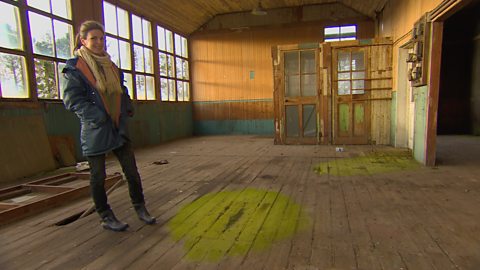
Artist Anna King shows us why she like painting derelict buildings
How to paint with oils. video
Artist Anna King demos the tools and paints she uses