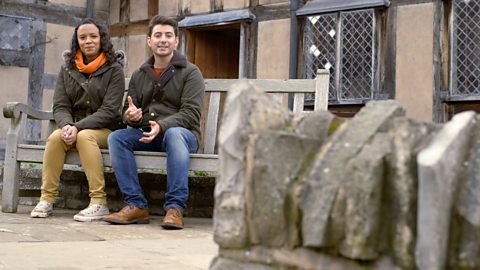
RICKY: What was it like going to the theatre when William Shakespeare was writing plays?
LEAH: We can take a pretty good guess because, here in London, is a reconstruction of the Globe Theatre - the theatre Shakespeare himself helped to pay for when it was built in 1599.
RICKY: In Shakespeare’s time there were around 200,000 people living in London. 20,000 of them would go to the theatre every week, which gives you an idea of how popular it was.
LEAH: It didn’t matter if you were rich or poor – everyone wanted to go to the theatre because it was the most exciting entertainment of its day.
RICKY: Theatres were open to the elements - but even if it snowed plays transported people to different times and places and made fantastic things seem real. Londoners couldn’t get enough of it…
PATRICK SPOTTISWOODE:So here we are, this is the globe. Bigger than you thought?
It is actually.
You think that in Shakespeare’s day it might have held up to 3000 people.
We have 6, 700 people standing in this yard, there’s a fantastic atmosphere, because when you stand you have all this energy. That’s why children sit at desks at school, to stop them having energy, so when you stand you’ve got quite an uncontrollable energy, so people didn’t stand like this as if they were at church, they moved around. And they allowed their emotions to go…
LEAH: Just like the modern theatre, how comfortable you were and what sort of view you had depended on how much money you could afford to spend.
RICKY: So who would be down here?
PATRICK: Shakespeare called them the groundlings and they paid a penny and they stood on the ground – they were ground-ling. That was the cheapest place, probably the equivalent of 6 or 7 pounds today, so even cheaper than going to the cinema, so this was really popular entertainment – it was like a game, it was a play house, it was a house for play… So it was quite cool, I mean, sometimes in theatres you see classes of children and they’re thinking, how can I get out without my teacher noticing. I think in Shakespeare’s time, it was how can I get in without my teacher noticing?
And who else would be filling the seats in the theatre?
As you went higher up you paid more money. At the top you were actually removed from the smelly yard. Sometimes the groundlings were called penny stinkards, so the higher you went the higher you were in society. But the most expensive seats were up there, what we call the lords’ rooms.
So the audience sat behind the stage? Wouldn’t they just see the back of an actor’s head?
Well they might, but the point is they could be seen…
They were showing off.
There was a bit of showing off.
RICKY: The actors who worked in the Globe theatre were known as the Queen’s Men when Elizabeth I was alive. When she died and James VI of Scotland became James I of England, they changed their name to the King’s Men…which makes sense.
LEAH: And that’s the point – they were just men, all of them. Women didn’t act in Shakespeare’s day – it was thought to be unladylike and just not done. But it meant that all the women’s parts in a play had to be played by men…
RICKY: So how did men become women at the Globe? I’m about to find out…
LEAH: Just like when we watch TV today, theatre audience in Shakespeare’s time wanted to see amazing things happen.
EXTRACT: A Midsummer Night’s Dream.
PUCK: “For I must now to Oberon…”
FARAH KARIM-COOPER:If you’re sitting somewhere like where we are now you can’t really see that there’s a trap door in the ceiling…and you can’t really see that there’s a trapdoor in the floor…so if some devils emerge from the Hell area under the stage, they’d emerge with a puff of smoke and loud banging noises. Or you might see a god being lowered from the stage canopy and that would be quite spectacular as well, with fantastic costumes and make-up.
RICKY: Shakespeare’s plays at the Globe were as much about showmanship and excitement as they were about beautiful writing and great stories.
MICHAEL ROSEN:The amazing thing about Shakespeare is we’ve got these great big books full of plays and I sometimes think it’s like you’ve got this special magnifying glass where you can look into this time in the past and see how people thought and behaved…You can come to a place like this and see it acted out in front of you…I think it’s pure magic.
LEAH: Suppose you were designing a theatre in Shakespeare’s time. What would it look like? How would the actors appear and disappear? What other special effects would you dream up?
RICKY: Why not have a go? Get some drawing paper and pencils and, just like Shakespeare, let your imagination rip.
Video summary
Ricky and Leah visit Shakespeare’s Globe, the reconstruction in London of the theatre Shakespeare himself helped to pay for when it was built in 1599.
They learn that, just like today, Elizabethan audiences wanted to be amazed by special effects and that ghosts and devils could appear from trapdoors hidden in the stage; or Titania, Queen of the Fairies, could descend magically from another door in the stage’s ceiling.
They also find out about Shakespeare’s audience – from the groundlings or penny stinkards who had to stand in the area called the pit, to the rich who could sit in special decorated boxes.
We also find out that women didn’t act in Shakespeare’s time and that all the women’s parts had to be played by men – to find out how, Ricky is transformed into a Tudor woman!
Contributors include Michael Rosen, Farah Karim-Copper, Callum Coates and Patrick Spottiswoode.
This clip is from the series i.am.Will Shakespeare.
Teacher Notes
Pupils could investigate what popular pastimes there were for adults and children during the Tudor period, how does this compare to the pastimes of today.
They could choose one to have a go at.
As suggested in the clip pupils could design a theatre from Shakespeare's time and devise special effects that would excite audiences.
This clip will be relevant for teaching English at KS2 in England and Wales, KS1/KS2 in Northern Ireland and 2nd Level in Scotland.
Who was William Shakespeare? video
Newsround presenters Leah and Ricky Boleto visit Shakespeare's birth place Stratford-upon-Avon and go to London to see scenes from his plays at Shakespeare's Globe.
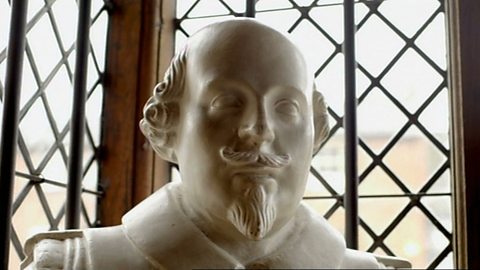
Introducing 'A Midsummer Night's Dream' video
Find out more about the magical world of 'A Midsummer Night’s Dream', a fast and funny play set in a enchanted place where the worlds of fairies and humans collide.
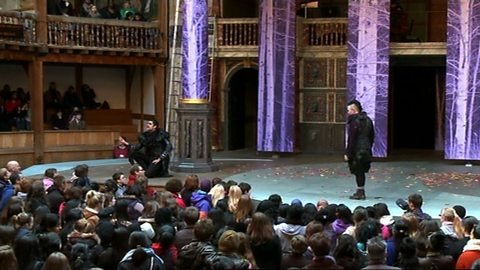
Introducing 'Romeo and Juliet' video
Find out more about Shakespeare's tragedy 'Romeo and Juliet', the story of young star-crossed lovers who risk everything to be together and are doomed to die.
Shakespeare's World. video
Find out more about Shakespeare's world with Leah and Ricky from Newsround.