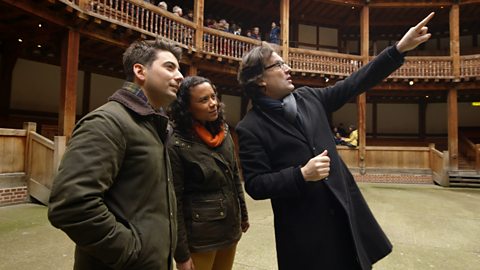
RICKY: To help us learn more about William Shakespeare and his plays we need to go back in time to more than four centuries ago.
LEAH: Shakespeare was born, grew up and started his career when Elizabeth I was Queen of England.
RICKY: Elizabeth was the last monarch of the period of history we call the Tudor age.
PAUL EDMONDSON:The Tudor Age was a great voyage of discovery. There was discovery of new lands and therefore new wealth pouring into the country. Shakespeare would have been aware of these new discoveries.
JENNIFER STONE:This is a pocket atlas published in 1603, the sort of book William Shakespeare would have had access to every day. You can almost imagine him flicking through the pages deciding where to set his next play. He might have chosen Verona…or Sicily. Must have been very exciting times.
They were exciting times but dangerous, too, because people argued violently about religious beliefs. England had stopped being a Roman Catholic country and become a Protestant one…
PAUL EDMONDSON:Everybody had to go to church on a Sunday. If you didn’t you were fined – because if you didn’t it was thought you were a Roman Catholic, and if you were a Roman Catholic in Shakespeare’s time there was a possibility you were an enemy of the state.
RICKY: Even though people were told what religion to believe in, that didn’t mean Elizabethans gave up old ideas and superstitions.
MICHAEL ROSEN:People talk about good luck and bad luck, well in Shakespeare’s time people would have really believed that you could have bad luck and you would have bad luck because you had done something that offended the spirits.
LEAH: The most famous of those spirits was a naughty hobgoblin called Robin Goodfellow, also known as Puck. He messes things up in A Midsummer Night’s Dream and is told off by Oberon, king of the fairies…
CLIP A MIDSUMMER NIGHT’S DREAM
OBERON:
Thou has mistaken quite and laid the love juice on some true love’s sight.
About the wood go swifter than the wind and Helena of Athens look thou find.
By some illusion see thou bring her here. I’ll charm his eyes against she do appear.
PUCK:
I go. I go.
RICKY: What happens to Romeo and Juliet tells us something else about the beliefs of Tudor people.
LEAH: Romeo and Juliet were the star–crossed lovers and the story of their short lives was written across the night sky.
MICHAEL ROSEN:In plenty of Shakespeare’s plays you have the idea that what’s going on has been scripted before – that’s to say that the people are doing things because something else is in charge. We might call that Destiny, we might call it Fate.
EXTRACT ROMEO AND JULIET
ROMEO: And never from this palace of dim night…
MICHAEL ROSEN:So in Romeo and Juliet, yes, it is their fate to die and you have a sense it is their destiny and it is going to happen.
ROMEO: Here will I set up my everlasting rest and shake the yoke of inauspicious stars from this world wearied flesh. Eyes look your last…”
MICHAEL ROSEN:Most people probably believed in ghosts of some sort or another. Whether they believed you could actually see the ghost or the ghost was present, well that’s quite an interesting debate and it happens in quite a few of Shakespeare’s plays.
RICKY: Macbeth kills King Duncan and then pays murderers to kill his friend Banquo. Afterwards he is haunted by Banquo’s ghost and driven almost mad…
CLIP MACBETH
MACBETH
You cannot say I did it!
Never shake they gory locks at me!
Gentlemen rise. His Highness is not well.
LEAH: Not only does Macbeth kill a king he also comes face to face with witches.
RICKY: They seem to predict that he is destined for greatness which encourages him to commit dreadful murders – but the predictions are not quite what they seem. The clever trickery of the witches leads to Macbeth’s own death when Macduff fights him and cuts his head off.
EXTRACT MACBETH: “Hail, King of Scotland!”
MICHAEL ROSEN:Did people believe in witches? Well, yes – they were persecuting witches in Shakespeare’s time and a little bit after because they believed that the woman at the end of the street because she was a bit old or because she had said something in the wrong way was a witch and she had power over you.
EXTRACT MACBETH:
Hubble buble, toil and trouble, fire burn and cauldron bubble
LEAH: Shakespeare enjoyed exploring old ideas and new ideas - and his genius weaved them into something very special.
MICHAEL ROSEN:He was a fantastic story teller. He knew how to make people gasp, he knew how to make people laugh and cry. Just by standing and sitting in a theatre like this – so you would sit here or stand over there, look at the play and go, “that’s a ghost!” Or someone would come on and do some mucking around of some sort…and you would laugh, you would weep with laughter…and then other times, in a play like Romeo and Juliet you would be crying, you would be desperate…and in Shakespeare’s plays all these ideas are there, you’ve got witches and fairies and ghosts and people cursing each other…and a new kind of theatre is being invented.
EXTRACT MACBETH
Witches: “Eye of newt and toe of frog, wool of bat and tongue of dog…”
LEAH: Suppose you are living in Shakespeare’s time and writing about witches. Could you come up with a spell like that one?
RICKY: What would you put in your witches’ cauldron? Can you list all the things you would use just as Shakespeare did and write them down as a poem?
LEAH: And if you have a vision of the future in which Ricky becomes a powerful king…
RICKY: Don’t bother telling me. I like my head. I’m sort of attached to it.
Video summary
We discover that Shakespeare was born into an age of exploration; but they were dangerous times, too.
Even though the world was becoming smaller, people still believed in old superstitions, and that Shakespeare was able to take witches, ghosts, spirits and the concept of Destiny and weave them into something special – plays that were enjoyed by everyone, rich or poor.
The clip features 'Macbeth', 'Romeo and Juliet' and 'A Midsummer Night’s Dream'.
This clip is from the series i.am.Will Shakespeare.
Teacher Notes
Pupils could investigate what people believed in when Shakespeare was alive.
Or they could explore the discoveries that were made by explorers like Sir Francis Drake on his ship the Golden Hind.
With the discoveries they make they could write their own play.
Pupils could also come up with a spell like that of the three witches in Macbeth.
Can they make a list of ingredients they would put into the cauldron and turn it into a poem like Shakespeare did?"
This clip will be relevant for teaching English at KS2 in England and Wales, KS1/KS2 in Northern Ireland and 2nd Level in Scotland.
Who was William Shakespeare? video
Newsround presenters Leah and Ricky Boleto visit Shakespeare's birth place Stratford-upon-Avon and go to London to see scenes from his plays at Shakespeare's Globe.
Introducing 'A Midsummer Night's Dream' video
Find out more about the magical world of 'A Midsummer Night’s Dream', a fast and funny play set in a enchanted place where the worlds of fairies and humans collide.
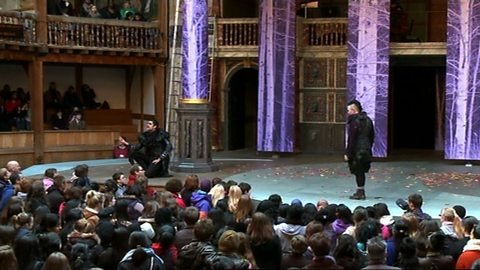
Introducing 'Romeo and Juliet' video
Find out more about Shakespeare's tragedy 'Romeo and Juliet', the story of young star-crossed lovers who risk everything to be together and are doomed to die.
Shakespeare's theatre. video
Ricky Boleto and Leah Gooding explore Shakespeare’s theatre by visiting Shakespeare’s Globe, trying on costumes and finding out about the special effects.