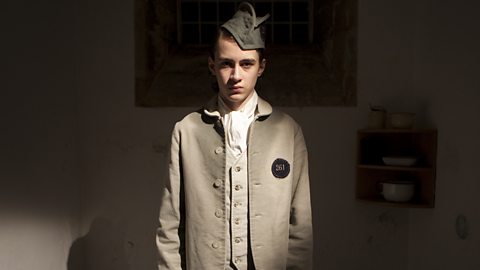
TYPEWRITER TAPPING
'On May 27th, 1877, James Fleming,'belonging to the Fechney IndustrialSchool in Perth,'was apprehended on a chargeof attempting to set fireto the institution.'He has been examinedby Honorary Sheriff Martin'and committed to prisonpending further investigations.'
I'm in a lot of trouble.A was up in the court yesterday.There were aw these menin long gowns saying thingsI didnae understand.I did it, so I had taeplead guilty…and now I'm in the jail.
The last place I stayed wascalled an industrial school,but it felt mair like a prisonto me.My real hame's the street.I've never had anyone tell mewhat to door had more than the clotheson my back…but I was free to go whereverI liked wi' my pals.
I always got by, like.I tried to stay out of trouble,but a policeman saw me begging,and begging's no' allowed.You're no' allowed to dae nothin',so I got put inFechney Industrial School.Children who were sent to industrialschools hadn't committedany serious crime,but there were concerns that ifthey were wandering on the streets,they might turn to crime.They might start thieving and they'dcome into the company of criminalswho would corrupt them further.
So the industrial school wasan initiative to stop childrenfrom becoming criminal.I've heard of kids being sent toreformatory schools for stealing,but maist of the kids in theindustrial school had just beenfound wanderin' round the streetscos they had nowhere else to go.
Living in a slum in Victoriancities, in overcrowded houses,several families living inthe same property,rats running around, lice,disease and dirt,kids having to play in the streets,running around with no shoes on.A really unpleasant experience.It's like being poor is a crime.
When I got taken into the school,a heard the headmaster tell thepoliceman that we'd been taughtto beg, cheat and stealsince we were born.But we hadnae done nothin'.Well, not yet anyway.The Victorians did believein a criminal class.They looked at the working classesand they looked at the peoplewho were in deepest poverty,and some of them, they said,were actually born criminals.And this was really bad for youif you were growing upin that situation,because you're likely to beidentified as a criminal,and it might just becos of the way you lookor the area of townthat you live in.
It was very differentfrom my life on the street.We had to get up at sixin the morningand work for 12 hours a day.We'd have to clean the placebefore cleaning ourselves,brushing our boots an' that.Then we'd be put to work.Shoemaking, tailoring,carpentry, wood choppingor gardening.We'd get taught reading,writing and the Bible too.We'd get some time to playevery now an again,but it was always over quickand then back to more work.Sometimes we'd just sit therestraightening nails for themtill our fingers near fell off.
The children's tasksdid need to be profitable.That was one of the ways in whichthe school got by.Things like washing,laundry work, for example,could attract quite an incomefrom outside.But there were also cases in whichchildren seemed to be doing fairlypointless labour, and there was somecriticisms of that at the time.These were things likethe straightening of nailswhich people could seelittle purpose for.
A range of punishments wereused in industrial schools.This would extend from thingslike solitary confinementto withdrawal of certain typesof privileges,particular types of foodsthat were deemed to be special,but we also knowthat corporal punishmentwas used quite extensively.For boys, this would consistof caning with a birch stick.
LOUD LASHING SOUNDS
Oh, I can almost feel it!That was the reason I did it.I hated that schooland I thought that would be theonly way to get oot of there.And it wasnae just me.It was ma pal, George,who came up with the ideato burn the school doon.
We had it all worked oot.We'd been collecting wood shavingsfrom the workshop.We'd put them in our pocketswhen nae-one was lookingand then hide them under the benchin the machine room.
It was Sunday when everyonewas in morning worship.George said we had to be quick.He'd stolen some matchesfrom the kitchen.He lit one and gave it to me.I was scared. I didnae want to bethe one to dae it,but it was burning downto my fingers.And George was saying,
"Hurry up! Dae it! Dae it!"
We could hear footsteps, so I flungit in, and it went up in flames.Now George and meare both in the jailand we're being sent to a differentschool - a reformatory school.I've heard it's going to be worsethan the one we were in before.We shouldnae have done it.
Video summary
In Victorian times, young orphans, beggars and vagrants could be sent to industrial schools to learn a trade, with the aim of preventing them from falling into a life of crime.
James did not enjoy life at the industrial school and he admits that he and a friend tried to burn it down in August 1877.
James explains how he and his accomplice, his friend George Fleming, were caught and convicted of "reckless fire raising".
As a result they were sent to an even stricter institution, a reformatory school, for three years.
Note that this film includes references to corporal punishment, including an illustration of a boy being beaten, which may be upsetting for some KS2 and KS3 pupils. Teacher viewing is recommended prior to showing the film in class.
Teacher Notes
Questions to consider whilst watching the film
Depending on the focus of your lesson, you may wish to ask the following questions after the video or the pause the short film at certain points to check for understanding.
- Why do you think James might have been sent to an industrial school?
- In what ways do you think it would be better than sending him to an adult prison?
- Do you think the sentence given in this case was fair?
- What type of work did the children do? Which work may be useful and which was pointless?
- What education did the children receive?
- What types of punishments were used?
- Do you think life was hard or easy in the industrial school?
Learning activities to explore after the video
History is a subject which can lend itself to a wide range of cross-curricular links. As a teacher, you will have a greater awareness of how this topic may act as stimulus for learning in other subjects. For example, this film could act as a stimulus for exploring why around the world today children may become involved in a life of crime and what happens to these children.
However, the suggestions below relate solely to ways of developing the children’s historical knowledge and understanding.
Key Question: How did attitudes to poverty change during the Victorian period?
Concept of change and continuity:This concept is not simply about comparing the past and the present and identifying the changes which have taken place. One way to develop progression in learning is to explore change within an historical period. The Victorian era, covering over 60 years, is one in which there are changes between the early and later period. This concept can be explored through a study of the changing attitudes to poverty.
The video states that most children became criminals because of poverty and this is certainly the case with James Fleming; his original crime was begging, which at that time was against the law. Many of those who were thieves would steal food, or goods which could be sold to buy food. The reason why this was viewed as criminality is because of attitudes to poverty in the early Victorian period. However, by the last decades of the 19th century there were changes in thinking.
To facilitate learning, pupils could be divided into pairs; one member of a pair could look at the early Victorian period and the other at the later Victorian period. They could then share their findings to provide each other with a fuller understanding of the changes that took place. There are a number of web resources which could be used to support their learning.
The early period is explored in this Bitesize revision guide where it states: the belief existed that poverty was caused by laziness, drunkenness and lack of morals. Although the text is designed for older students, it contains information which can be understood by this age group though the concept of laissez-faire could be sidestepped.
By the later Victorian period there was a growing awareness that most people were poor because of circumstances beyond their control. The work of Charles Booth and Seebohm Rowntree, who helped to shape a change in attitude, is explored in this revision guide.
Key Question: What were the attitudes of Victorians towards crime?
Develop perspective and judgement:One of the difficulties pupils experience in history is when the attitudes of an historical period are very different to those today. It is important to understand differing perspectives. This does not mean condoning views which are clearly problematic today, but equally pupils need to avoid making judgements about the past using a contemporary perspective.
This concept can be explored through a study of Victorian attitudes towards crime. In the video, James Fleming’s original crime was begging and from a modern day perspective, that would not be viewed as a crime. However, that was not the view of the early Victorian period. There was a belief in a criminal class and if parents were themselves criminals, then their children would be born criminals.
The views of this time are summarised on this archived BBC webpage which states:"Across the nineteenth century broad shifts can be identified in the ways that 'criminals' were perceived. At the beginning of Victoria's reign key commentators like Edwin Chadwick tended to equate the criminal offender with individuals in the lower reaches of the working class who they considered were reluctant to do an honest day's work for an honest day's wage, and who preferred idleness, drink, 'luxury' and an easy life; in their eyes the problem was a moral one. There were also concerns about 'the dangerous classes' who were thought to lurk in the slums waiting for the opportunity for disorder and plunder. By the middle of the century the term 'criminal classes' was more in vogue; it was used to suggest an incorrigible social group - a class - stuck at the bottom of society."
Historical enquiry:An alternative approach is to focus on a case study. The British Library has a lesson and teaching resources on poverty in Victorian Britain. By exploring sources on the British Library website, the pupils will be developing their skills of historical enquiry. This is an external link. The BBC is not responsible for the content.
There is a specific focus on the work of Charles Booth and in particular his maps of London identifying where the different classes, the rich and the poor, lived. Booth is a good case study as there is a link to the topic of crime as he identified one group as: 'Lowest class. Vicious, semi criminal.'
However, Booth was important in providing a better understanding of the underlying reasons for poverty. The lesson also allows for an exploration of the changes in the definition of poverty between the 19th century and the present day.
Learning aims or objectives
England
From the History National CurriculumPupils should:
- develop perspective and judgement.
- understand historical concepts such as continuity and change.
- understand the methods of historical enquiry, including how evidence is used rigorously to make historical claims.
- gain historical perspective by placing their growing knowledge into different contexts.
Northern Ireland
From the statutory requirements for Key Stage 2 - The World Around UsPupils should be enabled to explore:
- Change over time in places.To provide a balance of experiences in history pupils could study:
- Some of the characteristics of past societies and distinctive features of life in the past.Teaching should provide opportunities for children as they move through Key Stages 1 and 2 to progress:
- from identifying similarities and differences to investigating similarities and differences, patterns and change.
Scotland
From the Experiences and Outcomes for planning learning, teaching and assessment ofSecond Level Social Studies:
- I can use primary and secondary sources selectively to research events in the past.
- I can compare and contrast a society in the past with my own and contribute to a discussion of the similarities and differences.
Wales
From the new Humanities Area of Learning and ExperienceSchool curriculum design for history should:
- develop historical … source-based skills.
- develop rich content across the time periods, through which learners can develop an understanding of chronology through exploring … change and continuity…the use of evidence.
Principles of progression
Descriptions of learning for Progression Step 2
Enquiry, exploration and investigation inspire curiosity about the world, its past, present and future:
- I have experienced a range of stimuli, and had opportunities to participate in enquiries, both collaboratively and with growing independence.
Human societies are complex and diverse, and shaped by human actions and beliefs:
- I can recognise similarities and differences between people’s lives, both in the past and present.
- I can identify aspects of life in my community that have changed over time.
Life at a Victorian reformatory school. video
Jane Angus, aged 12, tells us how she was caught stealing and sent to a residential school where young criminals were taught a trade to stop them re-offending.
How the Victorians introduced photograph police records. video
The story of young offender James Dunn Barr is used to explain how the invention of photography changed the way criminals, young and old, could be identified.
Life in prison for young Victorian offenders. video
This short film explores Victorian punishments through the eyes of John, a young offender who was sent to prison for six months in January 1876.