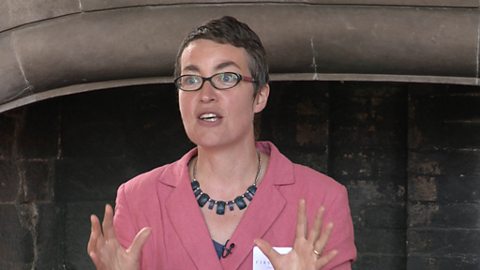
CHARLES:We're going to concentrate on holidays, not necessarily the holiday you've just had, but a holiday that you have been on.
AUTHOR #1:It might be like the, holiday when you were three years old It might be a holiday when you were ten.
AUTHOR #1:Any kind of holiday, could have been a terrible holiday or a really great holiday. It doesn't matter.
AUTHOR #1:Well the idea was to just get the children writing some stories. It's as simple as that.
CHILD #1:Hey Daniel what are you doing?
CHILD #2:Belgium innit.
CHILD #1:What did you see in Belgium?
CHILD #2:What?
CHILD #1:What did you see in Belgium?
CHILD #2:Cheese!
CHILD #1:Is that it?
CHILD #2:Yeah. You see cheese and houses.
AUTHOR #1:We start by giving them quite structured tasks to do which would then lead in to an exercise where they actually literally had to sit down and write out a story.
CHILD #3:We went into the village and we were in this shop.
CHILD #3:And it was really strange because they had all these puppets and then randomly, one of them started going, "I love you" and then started laughing in an evil accent. It was so weird.
CHARLES:-It's fantastic yeah, yeah it looks great!
CHARLES:And often there's some real gems there
CHARLES:you wouldn’t necessarily get a story with a beginning middle and an end
CHARLES:but you get a wonderful phrase or an image or something funny or a great little character observation.
CHILD #4:I could feel the comfort softness of the ground below and taste the barbequed food through the hallway.
AUTHOR #1:-The idea of what they can see and feel and hear and taste.
CHILD #5:I remember smelling the fresh mountain tops so pure it reminded me of peace.
AUTHOR #1:And then we gave them a genre.
AUTHOR #1:So comedy or whatever you get given and your celebrity and your celebrity is your main character in your story.
AUTHOR #1:Simon Cowell was one and Beyoncé was another and they had to put those three elements together, their memories the genre and the famous person and turn it into a story. Simple!
CHILD #6:Right, what do we think?
STUDENTS PLAN STORY
CHILD #6:Tragic… Death.
CHILD #7:Are we going to do a best friendship love story?
CHILD #6:Like a tragic love story that’s what we're thinking about.
AUTHOR #1:You can write about anything there are no, no entry signs with writing. You can write about anything. it's not like this really, really complicated thing that only sort of famous people can do.
AUTHOR #2:Simon Cowell, sped down the gloomy menacing streets of San Juan, Ibiza. Looking for that pathetic greasy villain, Louie Walsh.
AUTHOR #2:Louie was happy dancing the Macarena with a teacher called Mrs Hughes. Who he had just met at Oceana.
EVERYONE LAUGHS
AUTHOR #2:I don’t know why that's funny!
AUTHOR #2:OK calm down. "Oh look!" exclaimed Mrs Hughes, there's Simon Cowell.
AUTHOR #2:Louie took one look, turned and ran to Simons roller outside. Swiftly he hot-wired it and raced off into the night and crashed the car.
AUTHOR #2:"Got you now!" Smiled Simon and quickly texted his mum the news that Louie was being done for drunk driving. Knowing that the news of the world would be reading the text within minutes.
AUTHOR #2:And he would get his popularity back for a start.
EVERYONE CLAPS
Video summary
Rebecca Abrams and Charles Cummins lead a fiction writing workshop that begins with a group of teenagers writing about personal memories of holidays.
What can they recall of sights, smells, noises and tastes?
The young writers then form themselves into groups and extend some of these memories into short stories.
To help and inspire the teams, Rebecca and Charles give each group a genre – for example, romance or comedy.
Then a celebrity is added to the mix – it could be Beyonce or Simon Cowell.
The results are team written stories that help reveal some of the fundamental techniques of fiction writing.
This clip is from the series How to Write.
Teacher Notes
This could be used to aid students in understanding and experimenting with genre conventions.
Students write down their memories of a past holiday they have been on, good or bad.
Students are then put into groups of three. Each group is given a specific fiction genre to work with.
Students can choose one of the holiday memoirs in their group to transform into a genre story corresponding to the genre they were assigned.
Students swap genres with another group and re-write the story (perhaps just focusing on openings) according to the rules and conventions of that genre.
Which genre suits their story most effectively? Can students now write their own genre specific story in full?
This clip is relevant for teaching English Literature at KS3 in England, Wales and Northern Ireland, and 3rd and 4th Level in Scotland.
Poetry workshop - The 2 sides of me. video
Caroline Bird invites thirty teenagers to imagine the two sides of their personalities and write poems about the differences.
Philip Pullman on his novels. video
Author Philip Pullman gives fascinating insights into the workings of a novelist's mind.
Poetry workshop - Finding inspiration. video
Writer and teacher Kate Clanchy asks a group of teenagers to write down poetic images inspired by their surroundings.