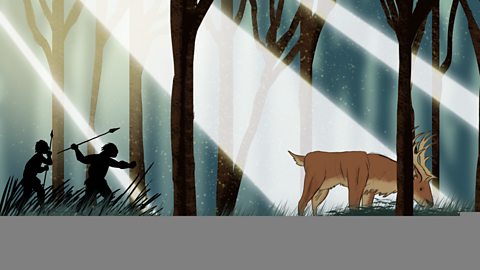
NEW STONE AGE GIRL:That’s our dinner.
NEW STONE AGE BOY:An eagle.
NEW STONE AGE BOY:Dad, dad you’ll never guess what we just saw! An eagle took the baby boar that we were hunting for dinner.#
NEW STONE AGE GIRL:It was massive.
NEW STONE AGE FATHER:Huh! An eagle, that’s not good. It’ll be after the farm animals if we’re not careful.
NARRATOR:It is six and a half thousand years ago, and a huge change is transforming life in Britain. Farming. Cheap goats and different types of cattle have been introduced from over the sea.
NARRATOR:People are no longer nomadic, now they are farmers building the first new permanent homes to live in. There are also new crops; barley and wheat.
NEW STONE AGE MOTHER:We’ll have to ask our ancestors to provide us with a good harvest.
NEW STONE AGE GRANDDAD:We won’t have a harvest if we don’t keep these birds off.
NEW STONE AGE BABY:Shoo, shoo.
NEW STONE AGE MOTHER:Yes that’s your job children; keep the birds off the seeds and that eagle away from our animals. It looks hungry.
NARRATOR:Farming began about 10,000 years ago in the Middle East. It was around 4000 years later people finally began farming in Britain.
NARRATOR:Now people are living in one place, rather than moving around all the time, they are able to settle, keep animals and grow crops.
NARRATOR:Now people live in one place, it’s a whole new way of life.
NEW STONE AGE GRANDDAD:In the old days we followed the herd. The animals we hunted for food, we picked the berries from the bush and the roots from the ground,
…we didn’t stay in one place all the time. Ah the good old days.
NEW STONE AGE GIRL:Good old days! Are you telling me you’d rather have to make a camp and then break it all down again every time you had to move on?
NEW STONE AGE GRANDDAD:It’s just strange sleeping under the same roof every night of the year. Oh if your grandma was still alive she’d be amazed how much things have changed.
NEW STONE AGE GIRL:I miss grandma.
NEW STONE AGE GRANDDAD:I miss her too. But we can still visit her up at the long barrow.
NARRATOR:In the New Stone Age, homes are built, not just for the living but also for the dead.
NARRATOR:Long barrows; huge earth mounds or stone houses are erected, often on top of hills. Human bones are carefully placed inside them.
NARRATOR:Usually not whole skeletons but skulls and long bones.
NARRATOR:Building the long barrow is a monumental task, often taking thousands of hours. That is a lot of backbreaking work.
NEW STONE AGE GIRL:I can’t imagine a sheep on a boat, coming over the sea, but that’s how granddad said they were first brought here.
NEW STONE AGE BOY:Oh no, eagle!.
NEW STONE AGE BOY:We’re gonna be in so much trouble.
NEW STONE AGE MOTHER:We have to protect our animals.
NEW STONE AGE FATHER:We need them as much as we need a good harvest.
NEW STONE AGE GIRL:I’m really sorry, I was too slow to shoot my arrow.
NEW STONE AGE GRANDDAD:We wouldn’t have this problem if we were still hunter gatherers.
NARRATOR:Another new useful invention at this time is pottery.
NEW STONE AGE MOTHER:This is to thank the ancestors at the long barrow for our plentiful harvest.
NARRATOR:Heating the clay to a high temperature hardens the pots ready for use.
NARRATOR:The long barrow is an important place for everyone to meet and worship.
NEW STONE AGE GRANDDAD:An offering to our ancestors.
NEW STONE AGE FATHER:We have a lot to be thankful for.
NEW STONE AGE GIRL:Thank you grandma. Come on we have unfinished business.
NEW STONE AGE GIRL AND BOY:Hey, hey, yes.
Video summary
An introduction to life in Neolithic Britain through the eyes of a typical family as they attempt to hunt and farm enough food to live on.
Around 6,500 years ago, a change took place in the way people lived: hunter-gatherers settled in one place and kept animals and grew crops, although they still hunted wild animals when the chance presented itself.
They adopted new ways of burying their dead, building longbarrows on hilltops as a final resting place for bones.
Technology began to change people's lives.
This is from the series: The Story of Britain
Teacher Notes
Could be used to introduce life in Neolithic Britain.
What was 'new' about the New Stone Age?
Pupils could be asked to make a list of the ways life in the New Stone Age was different to life in the Mesolithic period: did it change a little or a lot?
Does grandad in the clip think it has changed for the better or the worse? What do you think?
This clip will be suitable for teaching History at KS2 in England, Foundation Phase and KS2 in Wales, KS1 and KS2 in Northern Ireland.
Also Early 1st and 2nd Level in Scotland.
The Vikings. video
Exploring life in Viking Britain through the eyes of an Anglo-Viking family.
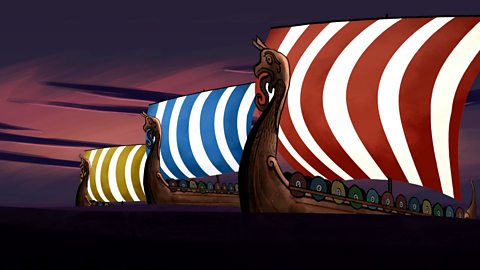
Bronze Age Britain. video
Exploring life in Bronze Age Britain through the eyes of one family.
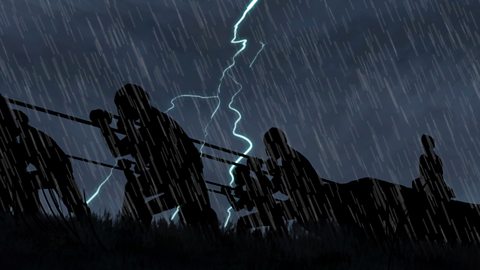
Iron Age Britain. video
Exploring life in Iron Age Britain through the eyes of one family.
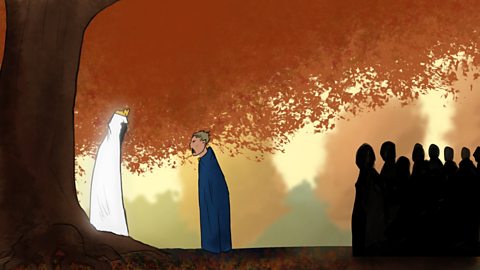
Domesday Book. video
Exploring 1085 and the compilation of Domesday Book.
Anglo-Saxon Britain. video
Exploring life in Anglo-Saxon Britain through the eyes of one family.
The Normans. video
Exploring British life in 1066 through the eyes of a Norman family.
Roman Britain. video
Exploring life in Britannia through the eyes of one Roman family.
Boudica and the Roman Invasion. video
Exploring life in Britain at the time of Boudica’s rebellion through the eyes of one family.
Middle Stone Age. video
Life in Middle Stone Age or Mesolithic Britain through the eyes of one family.