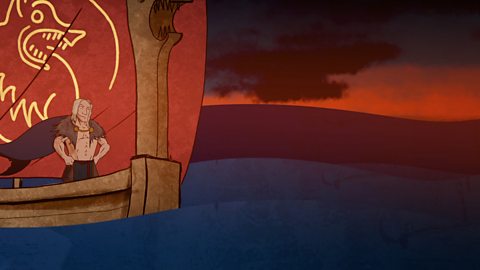
NARRATOR:The year is 1066, nearly a thousand years ago.
NARRATOR:William, Duke of Normandy, sails to England and fights King Harold at the Battle of Hastings. Harold’s Anglo Saxon army is larger and made up mostly of soldiers fighting on foot.
NARRATOR:But William’s army have cavalry and archers, who, after a long day of battle, finally defeat King Harold.
NARRATOR:Duke William of Normandy becomes William the Conqueror, King of England.
He is crowned on Christmas day.
BISHOP:Do you accept this man as your new King?
NORMAN SOLDER:They don’t want to have a Norman King, quick we must stop this rebellion.
NARRATOR:It is all a big misunderstanding. The Norman guards only speak French and don’t understand English.
NARRATOR:They think the Saxons are rebelling, so begin to burn down some of their nearby homes.
NARRATOR:But the Norman Duke still wants to be crowned King of England.
DUKE WILLIAM OF NORMANDY:Get on with it.
NARRATOR:But then, some Saxons really do begin to rebel against the new King. So William takes their land and gives it to members of his own family, and the Norman Lords who helped him conquer the country.
NARRATOR:Normans, from the King down to the Knights, live in new castles which defend their land and the Anglo Saxons are forced to build them.
NARRATOR:The land that William gives out to his supporters, known as a manor, still belongs to the King. The Barons rent it from him. The Knights in turn, rent from the Barons and the peasants rent land from the Knights.
NARRATOR:Each rents from the other in exchange for services. The Nobles provide Knights for the King when he needs an army. The peasants provide food for the Knights.
NARRATOR:So, how is our family faring in Norman Britain?
NORMAN FATHER:So Henri, you are seven, you must leave us.
LUCY:Don’t go Henri.
HENRII have to Lucy; I’m going to train to be a Knight like papa.
NORMAN FATHER:I have land for your son, and my daughter will bring a good dowry.
NORMAN MAN:Very well, when will your daughter be able to marry?
NORMAN FATHER:She is 12 years old in eight years time, then she’ll be ready to marry. This is indeed a good match for both families.
NARRATOR:Children’s marriages are arranged by their parents when they are young.
NARRATOR:Sometimes only babies.
NARRATOR:Marriages are often based, not on love, but on money, land and power. But poor people who have none of these things can marry who they want?
NARRATOR:Training to be a Knight took years.
NORMAN ARCHER:The bow shoots further, the crossbow straighter.
NORMAN MONK:Read out what you have written.
HENRI:Our father, who art in heaven, hallowed be thy name.
NORMAN TEACHER:You must kneel whenever you see the Baron and say, "good speed".
NARRATOR:As the years pass, a would-be Knight like Henri eventually masters the skills he might one day need in battle.
HENRI:A peacock, perfect for the wedding feast.
NORMAN ARCHER:Take aim. Careful…… shoot.
NARRATOR:A rich wedding like Lucy’s was a grand occasion.
HENRI:Good speed.
LUCY:You’re so grown up Henri.
NORMAN FATHER:There’s a rebellion in the North, the King needs an army, we must go and fight.
NORMAN FATHER:This is what you have been training for Henri. This is what being a Knight is all about.
NARRATOR:Being a Knight meant putting duty before pleasure. When the King called, you had to go.
Video summary
An exploration of life in Britain following the invasion of 1066 through the eyes of a Norman family.
In their motte and bailey castle, the children play and learn, and grow up to be a knight or to be married off.
We are shown the impact of the Norman Conquest on life for Anglo-Saxons - who benefitted and who lost out - and what was life like for the Normans after the Conquest.
This is from the series: The Story of Britain
Teacher Notes
Teachers can use this to introduce the concept of motte and bailey castles.
By 1086 the Normans had built nearly 500 motte and bailey castles.
Students can be tasked to find out if there was one built near them.
Pupils can also look into Mountfitchet Castle, in Essex, which has been rebuilt on the site of the original.
This could start discussions on life in 1066.
What would it have been like living in a motte and bailey castle?
How secure do you think motte and bailey castles were? What happened to castles over the next 400 years that made them stronger and safer to live in?
This clip will be suitable for teaching History at KS2 in England and Wales also KS1 and KS2 in Northern Ireland.
Boudica and the Roman Invasion. video
Exploring life in Britain at the time of Boudica’s rebellion through the eyes of one family.
The Vikings. video
Exploring life in Viking Britain through the eyes of an Anglo-Viking family.
Domesday Book. video
Exploring 1085 and the compilation of Domesday Book.
Roman Britain. video
Exploring life in Britannia through the eyes of one Roman family.
New Stone Age. video
Life in Neolithic Britain through the eyes of one family.
Middle Stone Age. video
Life in Middle Stone Age or Mesolithic Britain through the eyes of one family.
Iron Age Britain. video
Exploring life in Iron Age Britain through the eyes of one family.
Bronze Age Britain. video
Exploring life in Bronze Age Britain through the eyes of one family.
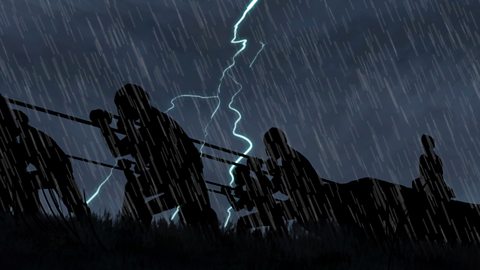
Anglo-Saxon Britain. video
Exploring life in Anglo-Saxon Britain through the eyes of one family.