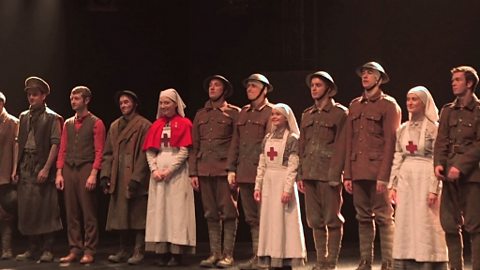
Alice Levine: 'I'm Alice Levine, and I'm most definitely not an actress, but I've been asked to perform for one night only in Warhorse on the West End. I have no idea what I'm doing.'
Alice Levine: Oh lord.
Alice Levine: 'So I have to learn everything I can before I take to the stage.'Go Warhorse!
Alice Levine: 'And today is all about sets and costumes.'
Alice Levine: And I have no idea how to work with a set. And if I'm gonna perform properly on the stage I need to know about set design. So I've come to meet one of the biggest designers in the bizz, working on one of the biggest shows in London. Probably heard of it: Charlie and the Chocolate Factory.
SINGING
Alice Levine: There you go.
Alice Levine: 'First stop on my journey today is to speak to Mark Thompson, the man who created this incredible set.'
Alice Levine: Hi Mark.
Mark Thompson: Hello.
Alice Levine: I'm Alice.
Mark Thompson:Hi Alice.
Alice Levine: Thanks so much for making time to see me. First things first, what do you do as a set and costume designer?
Mark Thompson: Each job varies a lot, depending on if it's a musical, or a play.
Mark Thompson: And a lot of the time, I'm actually not in the theatre, I'm in my studio here, and looking at reference and having meetings with directors and planning my next show.
Alice Levine: As a set and costume designer, you're pulling all these research items and these things that you think will help you form an aesthetic for the show?
Mark Thompson:Yes.
Alice Levine:OK.
Mark Thompson:It's just trying to tell a story clearly.
Alice Levine:Mm-hmm.
Mark Thompson: So that is my biggest job, really.
Alice Levine:So you as set and costume designer.
Mark Thompson:Yes.
Alice Levine:Sam as director, and you've got the choreographer as well, all interacting on deciding these things.
Mark Thompson:Yeah, yes. I think the only do, is tell the story. In the best way that you can. That's the do. The don't is don't clutter it up.
Alice Levine: Can I ask you about your costume wall?
Mark Thompson:This is a full-sized person.
Alice Levine:Yes.
Mark Thompson:Their feet are here, that's their knees there.
So all this is fake shoe. But that's only for that number. This is two people, so this is somebody else's hands, and somebody else's hands behind them in a black coverup, so we don't see them operating the legs.
Alice Levine:I'm gonna see it this evening, but now I'm gonna be watching it with different eyes, aren't I?
Mark Thompson:I hope so.
Alice Levine:I'm gonna be thinking, is that someone's hand? Is that someone's knee, is that someone's foot?
Mark Thompson:I know. Where's that hand gone?
Alice Levine:You've ruined it for me, essentially.
Alice Levine:'After chatting to Mark, I thought it'd be worth chatting to someone who actually calls his set home.'
Alice Levine:This is amazing Jasna, you get to work here every day.
Jasna Ivir:Lovely to meet you.
Alice Levine:I'm so jealous. You're obviously Mrs Gloop, Augustus' mum, how important is this environment to you for embodying Mrs Gloop?
Jasna Ivir: Well I think Mrs Gloop feels most at home in this beautiful, luscious chocolate room. I think it's like opening up the fridge at midnight and going, "I don't know which bits to go for first". It really is. And every time the curtain rises and this contract track wall goes up, you can actually hear the audience gasping.
Alice Levine:Yeah.
Jasna Ivir:Because they are just so enchanted by it, and the size of it, and the colours.
Alice Levine:So when you put on that costume, do you kind of go through a transformation, does that help you get into the role?
Jasna Ivir:Yes, it kind of helps you for the transformation, or course. Costumes are very, very important, and you bond with your costume, you become that person. And everything needs to have a purpose.
Jasna Ivir:You need to know why you have a bag, why do you have a cape? Do you play around with it? Why is it the skirt? How do you stand? And everything like that.
Alice Levine:So nothing's arbitrary? Nothing's just there, it has make sense.
Jasna Ivir:Everything has a reason. And you speak to the designers and you say, listen, in this number I need to dance and I need to sit down, can we change this a little bit, and this is in the way, so it needs to be practical as well. But yes, there is a complete transformation, once you look at yourself in the mirror, "Oh hello. Nice to meet you, Mrs Gloop. Come on, let's have it".
Alice Levine: 'Music is another way to help you tell your story,
'and it's done brilliantly in Charlie.'
SINGING
Alice Levine 'Right, who else can I find round here? Another important element of set design is the lighting. In Charlie, we see a complex range of lighting techniques that help tell the story, and are controlled automatically.'
Alice Levine: In the West End, this is currently the only fully automated show. Everything is very close,
and without having an automation system to run that, it would be impossible.
SINGING
Alice Levine: What a day. I have got so much going on in my head. Your set should help you tell the story, don't clutter it.
Alice Levine: Costumes should enhance your character. Music should complement the story. And lighting is a key part of stage production. But for tonight, I'm just gonna enjoy the fact that I'm in the audience. I'm off to see the show.
Alice Levine meets Charlie and the Chocolate Factory set designer Mark Thompson, and finds out about the work that goes into creating such a complex production design.
She talks to actor Jasna Ivir who plays Mrs Gloop about how performers work with set and costume to help develop their character.
Teacher Notes
Students could outline the set challenges for a play that they are studying.
They could describe a set that they have seen and evaluate the impact that this had on them as a member of the audience.
They should consider how it helped them to understand the plot and themes within the play. This could support students when reviewing live theatre performances.
Curriculum Notes
This clip will be useful for teaching Drama, particularly performance skills at Key Stage 4 in England, Wales and Northern Ireland, and National 4/5 in Scotland. It could also be useful for people of any age preparing for an acting role.
More from Alice's Journey to Wonderland
Developing a character (pt 1/8) video
Alice visits the set of soap opera Hollyoaks to find out how the actors there create their characters. She learns to think about her character's backstory and the influences that affect her.

Using your voice (pt 2/8) video
Alice takes a voice lesson from Ben Aldridge, star of BBC One's Our Girl to learn more about using her voice in performance.

Improvisation techniques (pt 4/8) video
Alice visits the Comedy Store in London and learns some improvisation techniques from actor / comedian Isy Suttie (Dobby from Peep Show).

Working with multimedia (pt 5/8) video
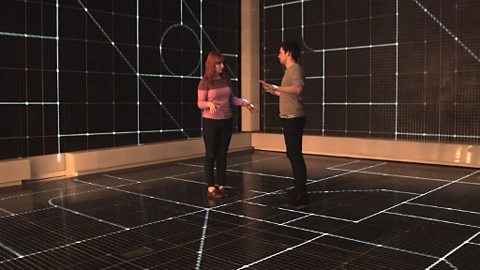
Alice visits the set of The Curious Incident of the Dog in the Night-time to find out how working with multimedia can help her on her journey to become a West End actress.
Working with a Director (pt 6/8) video
Alice visits the set of CBBC drama Wolfblood and talks to actor Jacqueline Boatswain who plays Victoria Sweeney about how to get the most out of working with a director.
Preparing for a role (pt 7/8) video
It's almost time for Alice Levine to make her West End debut in War Horse. She gets some last minute tips from lead actor James Backway and gets on her costume and makeup.
The big performance (pt 8/8) video
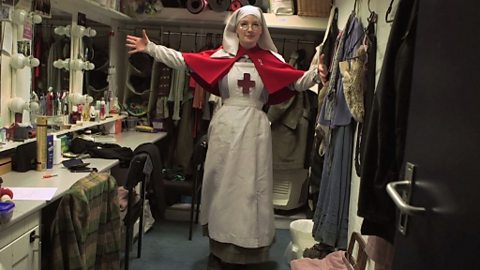
Alice is finally ready to rehearse for her West End debut in War Horse. She works through her lines and character with the director and other actors, before performing.