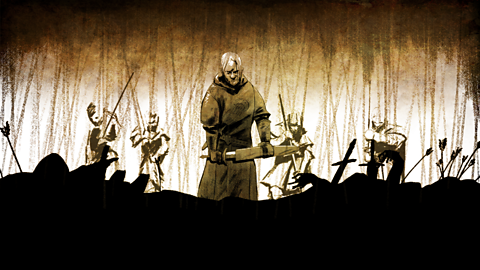
On the 14th October 1066, William, Duke of Normandy, defeated Harold II, King of England, at the Battle of Hastings. But his victory didn't mean William would automatically become King. With Harold dead, it was now up to the Witan, the noble councillors, to decide who would inherit the Crown. They chose to support Edgar the Aethling, the Saxon great-nephew of Edward the Confessor, former King before Harold. It would be up to William to make the English nobles change their minds.
After waiting for two weeks at Hastings, William realised the Witan were not coming to proclaim him King. He would have to go to them in London. On his way to the capital, he took control of Dover, Canterbury, and Winchester before heading to Wallingford. Here the Archbishop of Canterbury, who had supported Edgar, submitted to William, realising resistance was futile. Not long after, the Archbishop of York and earls Edwin and Morcar also submitted. England had finally accepted defeat.
On Christmas Day 1066, William the Conqueror was crowned the first Norman King of England. Now he had to gain control of the whole of his kingdom. But he could not do this alone. William had promised to reward those Norman nobles and bishops who had supported him in conquering England. In order to secure his power all over the country, he began to distribute areas of land known as shires for them to govern. In return for the shire, they swore loyalty to William, collected taxes, and provided soldiers to fight when needed. They, in turn, divided their land and gave it to their knights to govern in return for their loyalty. Below them were the peasants, who were given strips of land but had to work for their lord and provide produce. They were not free and were not allowed to leave. This new method of governance later became known as the feudal system.
William also stamped his mark on the landscape. Within weeks of his coronation, motte and bailey castles began to spring up right across England. A castle or keep was built on top of an enormous mound of earth, surrounded by a courtyard enclosed by a ditch and fortified fence. Initially, these castles were made of wood, but later many were replaced with stone, including William's castle in London, known today as the Tower of London. These imposing castles were built to defend the new Norman lords and intimidate the local English people, who were forced to build them without payment. New Norman churches were built on a massive scale. These stone monuments with sky-high columns and arches were a constant reminder to the Anglo-Saxons that the Normans were in charge.
How successful William's conquest of England had been was revealed in a survey conducted in 1086. With the constant threat of rebellion, he needed to know how much tax he could raise to fund an army. Norman commissioners held public inquests in towns and villages right across England. They questioned who held the land now and who had owned it in 1066. They wanted to know everything from how many freemen and slaves there were to how many ploughs and pigs. The English people called it the Domesday Book, the Day of Judgement. It revealed William possessed about 20% of the wealth of England, his barons 50%, and the Church had 25%. The surviving English nobles had a meagre 5%. The Anglo-Saxons had been totally overpowered. William had conquered and secured the power of England, and the Normans had completely taken over.
know!
Video summary
William secured control over England after defeating Harold at Hastings.
It is one thing to win a battle, but something completely different to take control over a whole country, but William managed to do so, by force as well as by wealth.
The Domesday Survey, completed in 1086, shows just how completely the Normans were in control, with Anglo-Saxons retaining ownership of a mere 5% of the land - the rest belonging to the King, his Barons and the Church.
Teacher Notes
Key Stage 3:
Students could use the evidence from this film to draw a labeled diagram of a Norman 'motte and bailey' castle. They could then discuss why William built so many castles? How did castle design change during William's reign?
Key Stage 4:
Student could investigate the significance of the Domesday Book to the English, and to King William and then look at how secure William's control was of England by Christmas Day 1066, and by 1086?
This clip will be relevant for teaching History in secondary schools in the UK. This topic appears in OCR, Edexcel, AQA, WJEC KS4/GCSE in England and Wales, CCEA GCSE in Northern Ireland and SQA National 4/5 in Scotland.
1066: The claimants to the throne (1/6) video
Edward the Confessor died in January 1066 without a son or heir. Who would be chosen to be king?
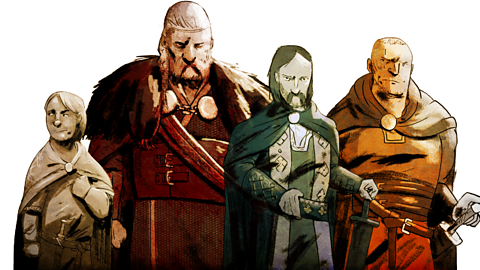
1066: The Battle of Fulford (2/6) video
In the first major battle of 1066, the Viking king of Norway, and Harold Godwinson's own brother Tostig, invade the north of England.
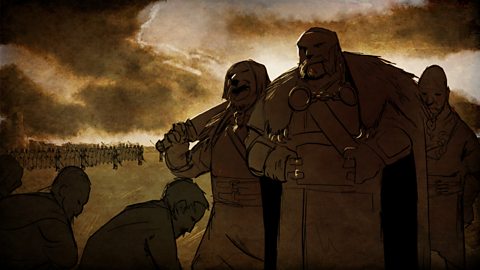
1066: The Battle of Stamford Bridge (3/6) video
The Battle of Stamford Bridge was the second major battle in the fight for the throne in 1066 and two of the four contenders were killed.
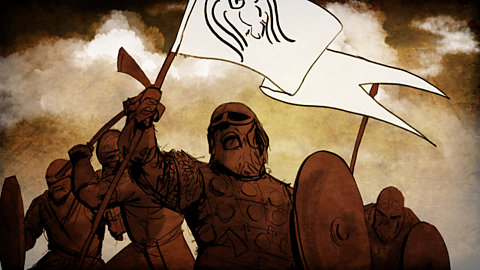
1066: The Battle of Hastings (4/6) video
William of Normandy arrives in Sussex for the decisive battle of the Norman Conquest.
1066: Revolt and resistance (6/6) video
How did the Anglo-Saxons resist Norman rule after 1066?