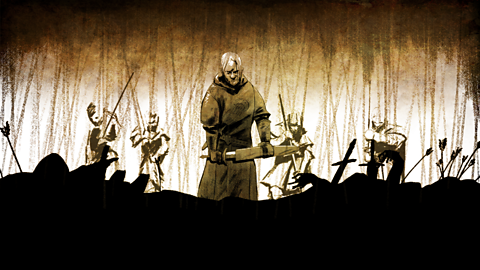
On 6th January, 1066, Harold Godwinson was crowned the new King of England. But his kingship was far from safe. The threat of invasion from those who felt they should be king loomed menacingly on the horizon. The new king, fearing a challenge to the Crown from the Duke of Normandy, had stationed troops on the South Coast. Here Harold watched and waited. But the Normans did not invade. On September 8th, with supplies running low, Harold disbanded his troops and returned to London.
But an attack was imminent - not in the south from Normandy, but in the north from Scandinavia. The King of Norway, Harald Hardrada, was a very experienced Viking warrior with a formidable reputation. He believed his father should have been king. So he invaded England. He was encouraged in this by Tostig Godwinson, King Harold of England's very own brother. Tostig had been the Earl of Northumbria, but his high taxes and brutal treatment of anyone who resisted his rule had made him a hated man. To keep peace in the north, Harold turned against his brother and imposed a nobleman named Morcar as their new earl. Tostig was exiled, harbouring a deep and burning resentment for the brother who had betrayed him.
Morcar was the new Earl of Northumbria, a wealthy and powerful young man and the younger brother of Edwin, the Earl of Mercia. The brothers were popular in England and their sister, Edith, was married to King Harold. Hardrada sailed from Norway, bringing an incredible fleet of over 300 ships and a vast army of around 10,000 men. Together they rampaged down the coast. Then they entered the Humber and sailed up the River Ouse, heading towards the city of York. Here they disembarked, leaving around 3,000 warriors to guard their fleet. They began to march towards York. The Earls, Edwin and Morcar, brought their army of 4,500 men south to meet them.
The battleground was a marshy area, identified as Germany Beck, a small tributary off the River Ouse in a place called Fulford. It's thought the English army created a shield wall along the north side of the beck. An important English military tactic, the shield wall was created by the soldiers in the front line standing shoulder to shoulder, with their shields overlapping. Each man had not only the protection of his own shield but also the warriors either side of him. Hardrada positioned Tostig with the least-experienced fighters opposite Morcar on the southern side of the beck. But the River Ouse was tidal and the beck full. It's believed Hardrada with his best fighting men were concealed from the Saxons by raised land blocking their view.
Around midday, the water in the beck subsided… and the battle began. The Anglo-Saxon Chronicles and Norwegian sagas tell how brave the English were, led by Morcar, as they pushed back Tostig's army. But now with the tide down and the riverbank exposed, Hardrada moved his reserve troops along the bank and over the beck, storming around the back of the English and trapping them against the muddy ditch. Hardrada is reported to have slain all in his way with his double-edged sword. The sword was the weapon of choice for the noble warriors of both Vikings and English, used for slashing rather than stabbing. This highly decorated weapon, which even had religious significance, was generally passed down from father to son.
Soldiers on both sides were also trained to use the five-foot Dane axe. It required two hands to wield, which meant the warrior could not have the protection of his shield and surrounding space was needed. But it wasn't just the weapons that caused the huge death toll when the English fled. Both sides report that, as the Norwegians chased the English, many were hurled into the beck and marsh, so the pursuers could walk on solid ground over the corpses. Hardrada was victorious. And by Sunday September 24th, York had surrendered to the Vikings. To secure their loyalty, 150 hostages were exchanged. But Hardrada was due to receive hostages from the whole county, or shire, as it was known then. It was arranged that these would be delivered at a spot called Stamford Bridge. Here Hardrada, Tostig and their troops went to rest from their recent victories and await their hostages. But what happened next wasn't what they'd bargained for.
Video summary
Having been made king following Edward the Confessor's death in 1066, Harold Godwinson was waiting for an invasion in the south, from Normandy.
When no invasion arrived he disbanded his army and returned to London.
But there was an invasion, from Scandinavia.
Here we have a detailed account of the first battle, at Fulford, between the contenders for the throne of England, in September, where Harald Hardrada and Tostig took on the northern army of the Anglo-Saxons led by Earl Morcar and Earl Edwin, defeated them and then captured York.
Please note: during the film it is suggested that Harald Hadrada was King Magnus I's son. It is now thought that this was not the case and Harald Hadrada was in fact King Magnus I's uncle.
Teacher Notes
Students could write a brief narrative of the Battle of Fulford, highlighting any opportunities either side had to win and then discuss 'was, the outcome of the battle, in their opinion inevitable? and why?'
This clip will be relevant for teaching History in secondary schools in the UK. This topic appears in primary KS2 and KS3, OCR, Edexcel, AQA, Eduqas, WJEC KS4/GCSE in England and Wales, CCEA GCSE in Northern Ireland and SQA National 4/5 in Scotland.
1066: The claimants to the throne (1/6) video
Edward the Confessor died in January 1066 without a son or heir. Who would be chosen to be king?
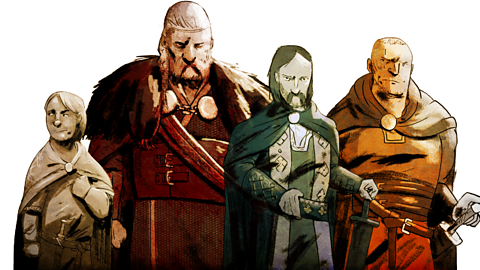
1066: The Battle of Stamford Bridge (3/6) video
The Battle of Stamford Bridge was the second major battle in the fight for the throne in 1066 and two of the four contenders were killed.
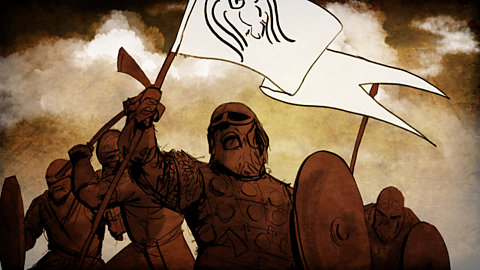
1066: The Battle of Hastings (4/6) video
William of Normandy arrives in Sussex for the decisive battle of the Norman Conquest.
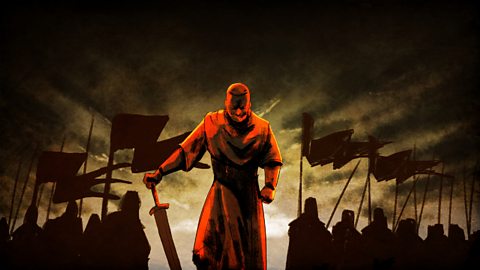
1066: King William and Domesday Book (5/6) video
How William the Conqueror secured control over England.
1066: Revolt and resistance (6/6) video
How did the Anglo-Saxons resist Norman rule after 1066?