Voiceover:
In a world without maths,a land where people forgot, who will save the day?
Mrs Sharma:
It’s Charlie’s party next week, how many sausages will we need?
Mr Sharma:
Errr, 248?
Mrs Sharma:
Oh no, that’s far too many. How about…three?
Mr Sharma:
Three is definitely not enough, we need four sausages for each child.
Mrs Sharma:
Ooo…let’s count it out, what can we use? I know, I’ve got some chocolate buttons.
Mr Sharma:
Great.We’ll use those for the sausages and my fingers and thumbs can be the children.
Mrs Sharma:
Good idea, pop your hands on the table.We’ll have one finger for each of the children that are coming to the partyand I’ll put four chocolate buttons, I mean sausages, next to each finger.Then we’ll count how many sausages there are.
Mr Sharma:
Okay, how many children are coming?
Mrs Sharma:
Eleven.So, 1, 2, 3, 4, 5, 6, 7, 8, 9, 10. Oh, I’ve only got 10 fingers.
Charlie:
Yeah it’s really bad, they’re hopeless. I’ve sent you some pictures of last year’s party…and the year before.
…thanks,
but don’t tell them I called you.
Mrs Sharma:
One for you, and one for you,
one for you and…oh
I thought I already gave you one.
Mr Sharma:
These sausages taste funny.
Mrs Sharma:
Stop eating them, you’re getting chocolate all over the children.
Narrator:
This is a job for…Multiplication Boy.
Multiplication Boy, you know what to do. So there are 11 children coming and they need 4 sausages each.
That’s 11 lots of 4 sausages, these are some pretty big numbers, are you sure you can handle it?Have you got your number line?
Oh no, no number line. You’re going to have to do this in your head. Do you know your 11 times tables? Okay, how about your 4s? No? Oh dear.
Right 1 times 10 equals 10, 2 times 10 equals 20, 3 times 10 equals 30, 4 times 10 equals 40, Okay 4 lots of 10 are 40.Oh yes, that means 10 lots of 4 also equals 40 because multiplication is commutative, so you can swap the numbers over and the answer is still the same.
Mr Sharma:
Amazing!Ah…oh.
Narrator:
So if there were 10 children coming to the party and they each had 4 sausages you would need 40 sausages. That’s very good, but Multiplication Boy,there are 11 children coming.
40+4=44, Yes!
Excellent. Add one more lot of 4, 11 times 4 equals 44. Good work.Wow, that was a narrow escape. You managed to do that even though you didn’t know your 4s or your 11s.So they need 44 sausages in total. You had to use a bit of addition there.Don’t worry, I won’t tell anyone.
Video summary
Mr and Mrs Sharma can’t work out how many sausages to buy for Charlie’s birthday party.
They are trying to count it out using chocolate buttons, but they are getting in a right mess.
This sounds like a job for Multiplication Boy!
Multiplication Boy comes to the rescue, but loses his trusty number line on route.
Can he find another way to work out the answer? What if he uses the commutative law of multiplication and facts he already knows?
And will Mrs Sharma have any chocolate button left by the end of it all?
This clip is from the series A World Without Maths.
Teacher Notes
Children might explore multiplications problems where the answers are just outside their current knowledge of the times tables.
For example, you might set out a small pile of toys and a set of party bags and try this problem: ‘Mr and Mrs Sharma really need some help planning the rest of Charlie’s party!
There are 11 children coming to the party. They want to put two toys in each party bag. What is the calculation we need to do? How many toys will they need?’
To explore the commutative law you might ask: ‘Does it matter which way around the numbers go before the equals sign? Is 11 x 2 the same as 2 x 11? ‘ For those children who are confident you could ask ‘How can you prove this to me?’
Some children might use the objects or pictures to help them. Others may be ready to use known facts and addition to solve the problems.
This clip will be relevant for teaching Maths at KS1 and KS2 in England and Wales, and First and Second Level in Scotland.
Multiples of two, five and ten. video
Multiplication Boy and Divider Girl keep their maths superpowers sharp with a competition to count in twos, fives and tens.
How to use arrays to multiply. video
Multiplication Boy helps Mr Sharma buy pencils for the school, using arrays to multiply.
What is multiplication? video
Multiplication Boy uses repeated addition to help Dave work out how many bricks he needs to build a new wall for Mrs Sharma.
The relationship between multiplication and division. video
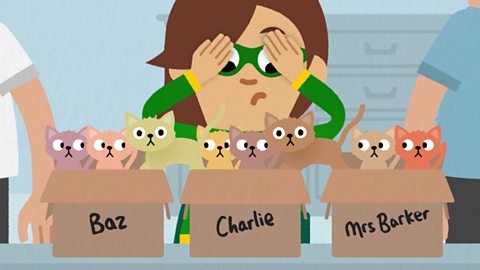
Baz and Dave use division and multiplication to solve a tricky problem with kittens.
Dividing using repeated subtraction. video
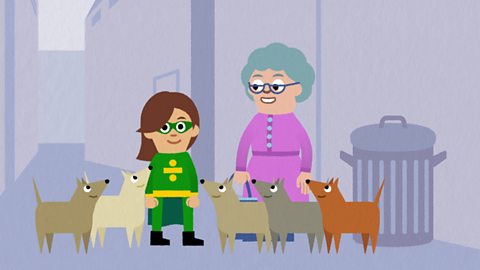
Divider Girl uses repeated subtraction to help Mrs Barker with a division problem involving some hungry pups.
How to use mental methods to divide. video
Divider Girl helps Charlie with a division problem, using her multiplication facts.