Voiceover:
In a world without maths,a land where people forgot, who will save the day?(Dave whistles)
Dave:
Oh no, I’ve run out of bricks.Hi Sally… Yeah, that’s right, another brick please…ok, thanks.Thanks Sally.
(Dave whistles)
Oh no.I’ve run out of bricks!Hi Sally…yeah that’s right…how did you know? Ok, thanks.Thanks Sally.
Mrs Sharma:
Cup of tea Dave?
Dave:
Ooo I’d love one.
Dave:
Two sugars please. Oh no no no no no!I’ve run out of bricks!
Mrs Sharma:
How are you getting on?
Dave:Err not bad, yeah, should be done in a couple of years.
Mrs Sharma:
A couple of years? This sounds like a job for…Multiplication Boy!
Narrator:How can Multiplication Boy help Dave to get Mrs Sharma’s wall built faster? Adding one brick at a time is taking forever.Dave needs to know how many bricks it’ll take to build the whole wall in advance.That’s right, he needs to use multiplication.
Multiplication has a special symbol of it’s own, but really it’s just repeated addition. Now let’s have a closer look at that wall.The wall’s made of sections. Each section is 1, 2, 3, 4, 5 bricks high.
Dave has finished one section, but there’s four more to go.
So how many bricks will Dave need to finish the wall?He could ask Sally for five bricks and build a section. Then order another five bricks and build the next section. Another five, and another five.
We can write this down as 5+5+5+5 or 4 lots of 5 or 4 x 5
Dave:
Ok great, I’ll call Sally.
Hi Sally
(offscreen) Sally:
Alright Dave, how’s it going?
Dave:
Yeah good. Can I order…5 bricks?
(offscreen) Sally:
Oh my goodness, 5, are you sure?
Dave:
Oh hang on, err let me just check.Are we sure about this? No? Ah. Err sorry Sally, I’m going to have to call you back.
Narrator:
Dave could order groups of 5 bricks at a time, but he’d still need 4 deliveries.Wouldn’t it be better if he ordered all the bricks he needed in one go?
Dave:
Ok cool, so 4 groups of 5 bricks.
Narrator:
Hang on Dave, how many bricks is that?
Dave:
4 lots of 5.
Narrator:
Yes but how many in total?
Dave:
Oh…I don’t know.
Narrator:Multiplication Boy, did you bring your number line?Let’s count it out.
One group of 5, takes us to 5. Next group of 5, takes us to 10, so 2 groups of 5 is ten. Next group takes us to 15, 3 groups of 5 is fifteen. One more group takes us to 20. 4 groups of 5 is twenty. We can write this out as4 x 5 = 20So Dave will need 20 bricks to finish the wall.
Dave:
Hi Sally, huh, you’re not going to believe this…I need 20 bricks.
(offscreen) Sally:
20 bricks! You’re having a laugh. Are you sure?
Dave:
Yup! 20 bricks please Sally.
(offscreen) Sally:
Wow, you’ll probably get the whole job done with that lot.
Dave:
That’s the plan.
Narrator:
Great.Well done Multiplication Boy. Now Dave has enough bricks to finish the wall in one go.
Video summary
Dave is building a new garden wall for Mrs Sharma. It’s taking a very, very long time.
He is doing his best but keeps running out of bricks.
This sounds like a job for Multiplication Boy.
Can Multiplication Boy help Dave with some repeated addition on his number line?
Will Dave be able to calculate exactly how many bricks to order to get the whole wall finished in one go?
Will Mrs Sharma’s wall ever actually get finished?
This clip is from the series A World Without Maths.
Teacher Notes
Children could explore multiplication problems linked to the story, using objects or pictures to support their understanding.
For example: Dave drinks 5 cups of tea a day, and has 2 sugar cubes in each cup.
How many sugar cubes will Mrs Sharma need to keep Dave going for the day? How many groups of 2 will you need? How might you write out the calculation?
Some children might use a number line to jump on in steps of the number they are multiplying.
This clip will be relevant for teaching Maths at KS1 and KS2 in England and Wales, and First and Second Level in Scotland.
Multiples of two, five and ten. video
Multiplication Boy and Divider Girl keep their maths superpowers sharp with a competition to count in twos, fives and tens.
How to use arrays to multiply. video
Multiplication Boy helps Mr Sharma buy pencils for the school, using arrays to multiply.
What is multiplication? video
Multiplication Boy uses repeated addition to help Dave work out how many bricks he needs to build a new wall for Mrs Sharma.
The relationship between multiplication and division. video
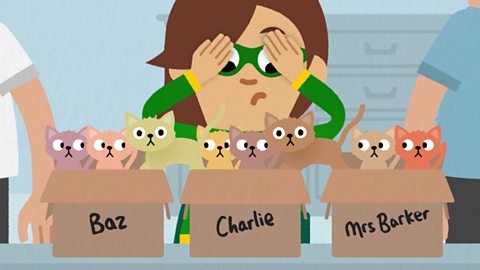
Baz and Dave use division and multiplication to solve a tricky problem with kittens.
Dividing using repeated subtraction. video
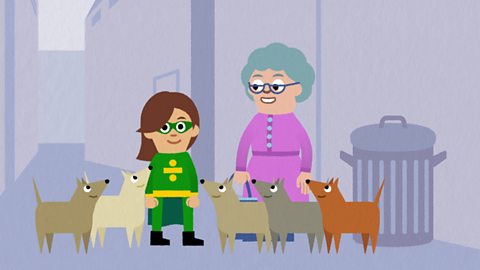
Divider Girl uses repeated subtraction to help Mrs Barker with a division problem involving some hungry pups.
How to use mental methods to divide. video
Divider Girl helps Charlie with a division problem, using her multiplication facts.