Due to the sensitive nature of the subject matter, we strongly advise teacher viewing before watching with your pupils. Careful preparation should be undertaken to prepare pupils before playing them this potentially traumatic and triggering story. The film includes descriptions of the racism and hostility black people faced in Britain in the '60s and '70s, as well as accounts of the stop and search tactics used by the police. The film also includes a section of archive film showing Enoch Powell's infamous 'rivers of blood' speech.
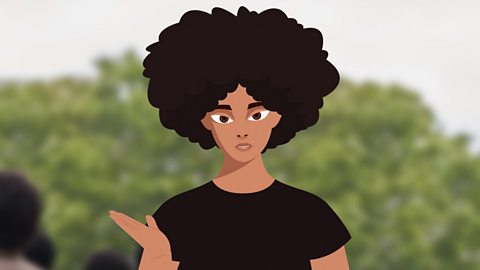
SHANEQUA PARIS:In 2020, the world shook following the killing of George Floyd, with demonstrations across the globe in support of the Black Lives Matter movement.
But what if I told you that the demands of the movement were nothing new? That 50 years ago there were black activists protesting on the streets in the UK, in the courts and in the media? That their efforts were caught on camera and they made headlines too, just like the activists of today? So, let's take a look at some of the people who devoted their lives to changing the system and confronting racism in Britain a generation ago.
Although black people have lived in Britain for centuries, after the Second World War nearly half a million people migrated to the UK. Many came from the Caribbean and they played a key role in rebuilding the nation of what they saw as the mother country.
But the welcome they received was not what they were led to expect. They were discriminated against, had to put up with poor housing, and regularly faced hostility from white Britain. In August of 1958, violence exploded on the streets of Notting Hill in West London as gangs of white boys, known as Teddy Boys, started to attack the local black community and anyone who tried to protect them. And nine months later, in the same area, a man called Kelso Cochrane was murdered by a white gang.
For black people living in the UK, it felt like their lives did not matter.
WINSTON TREW:First day at school, I'm the only black boy in the school, and a white boy walks up and punches me in the face. So, my first experience coming to this country was racism and violence.
SHANEQUA PARIS:Politicians also openly voiced their hostility towards immigrants and black people. In April of 1968, Conservative MP Enoch Powell gave what would become an infamous speech, known as the 'Rivers of Blood' speech. He spoke out against a multicultural future, painting a picture of a nation scared and ruined by immigration.
ENOCH POWELL:In this country, in 15 or 20 years' time, the black man will have the whip hand over the white man. We must be mad, literally mad as a nation, to be permitting the annual inflow of some 50,000 dependents.
SHANEQUA PARIS:As well as racism being promoted by those with real political power, black people in Britain also regularly experienced harassment from the police. The police's power to stop and search people they suspected had committed a crime was used disproportionatelyagainst black men.
LINTON KWESI JOHNSON:In those days, it was clear to the black youth of my generation that the Metropolitan Police Force had declared war against the youth of my generation.
SHANEQUA PARIS:In the 1960s, Peter Edrich was a new police officer. He saw first-hand that some police officers were unfairly targeting black people, using stop and search and raiding house parties. During a raid of one particular house party, things took a dark turn.
PETER EDRICH:If it had been a white peoples' party, they wouldn't have been raided. Yeah, it was racism. A police officer got hit over the head. And then after that, the one man they thought had smashed the beer can over the police officer's head, they took him into a cell and there was one police officer from Kilburn, a really big fella, he just beat him up.
SHANEQUA PARIS:By 1968, there were around a million black and Asian people in the UK. And although the country became an increasingly dangerous place for them to live, they were not going to give up without a fight. All over Britain, young black people began forming their own groups to stand up to the injustices they were facing in everyday life.
LEILA HASSAN HOWE:I was ready to join a movement. There were lots of us, it was a young movement. A young movement of young men and women. There were The Fasimbas, there was the Black Liberation Front, Black Panthers, there was the Black Unity and Freedom party.
SHANEQUA PARIS:Out of the movement came an explosion of photography, of books and magazines made for people in the Black Power movement. And one leading figure was this young, charismatic woman, Altheia Jones-LeCointe.
Altheia had come to England from Trinidad to study at university. Living in the UK, she became involved in community groups who were organising against racism.
ALTHEIA JONES-LECOINTE:Since we've come here, we've suffered a long chain of abuses by the police with the active knowledge and support of the British State.
SHANEQUA PARIS:Altheia helped set-up the British Black Panther movement, one of the first Black Power movements in the UK, and very soon she became its leader.
LINTON KWESI JOHNSON:She was bright, she was articulate, and I decided I wanted to go to meetings to find out more about this Black Panther movement.
SHANEQUA PARIS:Under her leadership, the Black Panthers focused on fighting against police brutality, discrimination in education and poor housing conditions.
Aggressive policing was common, but for some people experiencing harassment made them want to change the world. People like a fearless woman called Olive Morris. Born in Jamaica, Olive Morris moved to Britain in 1961 when she was nine years old with her mother and father. At just 17, she stepped in to stop the police forcefully arresting a black man in Brixton. She was outraged and began protesting against police brutality in Brixton, keeping up the campaign for a decade.
ZAINAB ABBAS:Olive Morris was the most fearless black woman I have ever met.
SHANEQUA PARIS:She also regularly protested about a lack of housing and began a campaign to occupy empty homes, called squatting.
H.O. NAZARETH:She was a woman with a lot of guts and she saw squatting as a political movement.
SHANEQUA PARIS:Olive also helped find empty buildings in Brixton to turn into bookshops and meeting places for the black community. One of these became the home of Race Today, a black-run magazine all about race in Britain. The editor of the magazine was a lawyer and all-round political heavyweight, Darcus Howe. Darcus had arrived in the UK as a student in 1961, and he immediately became awareof the treatment of black people at the hands of the British police.
DARCUS HOWE:The policeman who frames a black man is doing so with a confidence that the system is going to give him a conviction. And you cannot ask the policeman to change his racist clothing if you don't change the society, and that is the only solution. The black community says stop it and stop it now!
SHANEQUA PARIS:The unfair treatment of black people and negative stereotyping of them by the police would come under the spotlight because of one restaurant, the Mangrove restaurant in West London. This successful black-owned business was continually targeted by the local police, who claimed it was home to criminal activity. Just like the house parties, the restaurant was regularly raided by police, who even tried to have it shut down. Altheia Jones-LeCointe stepped in to organise a peaceful protest.
ALTHEIA JONES-LECOINTE:I believe the Mangrove, what they seek to do is not to close down a restaurant, but to close down what they see as an area where black people can collectively put up some kind of resistance to day-to-day harassment by the police.
SHANEQUA PARIS:But the outcome was not what any of the protesters expected. On Sunday the 9th of March in 1970, 150 protesters, led by Darcus Howe, gathered outside the Mangrove restaurant. There, the protesters came face-to-face with 500 police officers. That's three police officers for every protester. It was then that the protest became violent. Nine members of the Black Panthers were arrested, including Darcus Howe and Altheia Jones-LeCointe. They became known as the Mangrove Nine. They were charged and put on trial for inciting a riot, something that could have meant five years in prison. They said they were charged because of police prejudice, but to prove their innocence, they had to convince the court. Altheia and Darcus decided to represent themselves so they could spell out the case to the jury, twelve ordinary members of the public.
DARCUS HOWE:At the end of the day, I knew that there were white people I could convince, ordinary whites, working whites that I could speak to about what their police was doing to me, and win.
SHANEQUA PARIS:The Mangrove Nine argued their case and the jury agreed that the police had wrongly arrested them, made up evidence, and lied to the court. When they were found innocent, it was the first time in Britain that a judge ruled that there was evidence of racism in the British police force. The Mangrove Nine victory meant a great deal for the Black Power movement, and the public recognition of racism showed that things could, in the future, be changed for the better.
Campaigns fought by those involved in the movement, from poor housing to police brutality, are still relevant today. And according to experts, the laws around racism and discrimination haven't changed much since the 1970s. And because of this, the fight for racial justice still continues.
Video summary
This short film for secondary schools looks at the Black Power movement in the 1960s in the UK, surveying both the individuals and the cultural forces that defined the era.
Shanequa Paris introduces some of the leading figures in the UK movement, including Altheia Jones-LeCointe, Darcus Howe and Olive Morris.
The film casts fresh light on the story of the young black people in the '60s and '70s who challenged the British establishment and helped to shape a new political and cultural landscape in the UK.
This BBC Teach film uses extracts from the BBC Two documentary, 'Black Power: A British Story of Resistance'.
Due to the sensitive nature of the subject matter, we strongly advise teacher viewing before watching with your pupils. Careful preparation should be undertaken to prepare pupils before playing them this potentially traumatic and triggering story. The film includes descriptions of the racism and hostility black people faced in Britain in the '60s and '70s, as well as accounts of the stop and search tactics used by the police. The film also includes a section of archive film showing Enoch Powell's infamous 'rivers of blood' speech.
You can also download these teaching guidelines, which were created for another BBC Teach series but contain relevant information for using videos in the classroom.
Teacher Notes
Before watching the film:
Prior to this lesson you may wish to introduce your students some of the events mentioned in this short film to provide context. For example:
- The arrival of the Empire Windrush in 1948.
- The 1948 British Nationality Act, which conferred equal citizenship status to people in Britain and her colonies.
- The Notting Hill riots in 1958 and murder of Kelso Cochrane in 1959.
- Enoch Powell’s 1968 'Rivers of Blood' speech.
You may also wish to elicit from the students what they already know about the relationship between the police and the black community. Students might provide more contemporary or American examples e.g. the killing of George Floyd.
You could also ask students if they have ever heard of 'Black Power' either in Britain or in America.
During watching the film:
Depending on the focus of your lesson, you may wish to pause this short film at certain points to check for understanding, asking such questions as:
- Why did the British Black Power movement form?
- What did the British Black Power movement focus on?
- Who was involved in the British Black Power movement?
- When was the British Black Power movement most active?
- What is the legacy of the British Black Power movement?
Following on:
You could ask students to summarise the key points of the short film. This could be done in various different ways, through storyboarding the key points, bullet points, etc. The Mangrove Nine case could act as a case study/example as part of a GCSE course. Click or tap here for another BBC Teach film about The Mangrove Nine.
After watching the video, students could research one of the activists discussed in the video: Altheia Jones-LeCointe, Olive Morris or Darcus Howe.
Another potential avenue is introducing students to primary source material related to the British Black Power movement. The National Archives and the Black Cultural Archives hold a range of source material from a variety of different perspectives. The Ansel Wong collection at the BCA includes many grassroots pamphlets and newspapers. The National Archives contains police reports on ‘black activism’, witness statements and seized Black Panther campaign material. Students could be asked to analyse how a particular source could be useful to a historian wishing to research more about the Black Power movement.
If your focus is more comparative, you could introduce students to another example of injustice or police mistreatment. This could either be from the same time period but a different location (i.e. one local to your school), or it could be from a later time period (e.g. Stephen Lawrence and the Macpherson Inquiry). Click or tap here for three BBC Teach films about the murder of Stephen Lawrence.
This short film is suitable for teaching KS3 and KS4 students. However, it raises issues of racism, unfair police treatment and resistance, and therefore might be more suitable for older KS3 students.
It could be used as part of citizenship or PSHE when looking at the historical context to 2020’s Black Lives Matter protests that occurred across Britain, or about the history of protest in Britain.
It could also fit as part of a KS3 history curriculum when looking at ‘social, cultural and technological change in post-war British society.’ For example, it could be integrated into an enquiry or scheme of work looking at migration to Britain or black British history. It could also be used when looking the history of the police or protest.
At KS4, this short film could be used to illustrate the experiences and treatment of migrants to Britain after World War Two as part of the AQA ‘Empire, Migration and the People’ or ‘Power and the People’ course, the OCR ‘Migrants to Britain’ course or the forthcoming Edexcel Migration course.
Useful follow-on content:
Uprising. video
This short film for secondary schools looks at the New Cross house fire of 1981, and the protests, unrest and accusations of indifference that followed and defined race relations for a generation.
Subnormal - A British Scandal. video
This short film for secondary schools examines how black children in the 1960s and 1970s were disproportionately sent to schools for the so-called ‘educationally subnormal’.
The Mangrove Nine. video
Rochenda Sandall, who plays one of The Mangrove Nine in Steve McQueen's Small Axe, tells the true story of this significant event in British history.