Primary > KS1 Science > Space
How do we explore space?
CHILDREN: Three… Two… One… Lift off!
MADDIE MOATE: Humans have always been fascinated by space, but for most of our history travelling into space was just an impossible dream.
CHILD: Until 1957.
MADDIE: That’s right. In 1957 we finally had the technology to make that dream a reality. The first thing humans sent into space was this - a satellite called Sputnik 1. The next challenge was to send a person into space. Which happened in 1961.
CHILD: I wonder what it felt like being the first person in space?
MADDIE: Then, in 1969, a huge rocket called Saturn 5 began the long journey to the moon. The rocket looped around the Earth twice to build up enough speed then set off across space. And three days later two astronauts called Neil Armstrong and Buzz Aldrin became the very first people to walk on the surface of the moon. But exploring space didn’t stop with the moon. Machines with no people in them have been sent to explore planets in the solar system, including Venus, Mars and Mercury. There’s a huge spacecraft that’s been orbiting the Earth for over 20 years. It’s called the International Space Station. The astronauts and scientists on board the space station feel weightless - and anything, that isn’t stuck down can float away.
CHILD: Imagine trying to eat pizza that’s floating in space!
CHILD: What else do the astronauts do up there?
MADDIE: Let’s ask our expert…
DR BECKY: Hi, I’m Dr Becky and I am a space expert. Now, astronauts on-board the International Space Station sadly aren’t just on a holiday in space. They have very important jobs to do running scientific experiments. Like studying what happens to the human body when it’s weightless in space for too long, or studying the Earth from above, or even testing out new materials that we could use to help improve life here on Earth. All of these experiments will also help us for any future space exploration missions that take us beyond Earth.
MADDIE: The machines we send into space that orbit the Earth, called satellites, have changed our lives in the last 60 years. They take pictures of the Earth and other planets so we can learn more about them and see what they look like. They help us know about the weather, they make our TVs work and they let us talk to each other. They even stop us getting lost.
All this space exploration is having an effect and the space around Earth is getting crowded. There are now thousands of satellites circling the Earth, sending back information and helping us in lots of different ways.
[To the children] What are you up to?
CHILD: We’re making space art.
MADDIE: Space is huge and our exploration of it is only just beginning. I wonder where we’ll travel and what we’ll discover next.
Video summary
Download/print a transcript of the video.
In this video, narrated by Maddie Moate, a group of children discover the history of space exploration.
They learn about the first people to travel into space, what they learnt and space expert Dr Becky Smethurst explains how we use the International Space Station to answer questions we have about space today.
Teacher notes
Download/print the Teacher notes for this unit.
Discussion points:
1. Space explorers:
- What challenges do people travelling into space have and how are these overcome?
- What do pupils think travelling into space feels like and why?
2. The space station:
- What is the International Space Station (ISS)?
- Discuss how humans can get there and what life is like on board.
- What do we learn and find out from the work of the ISS?
3. Using space:
- What do humans use satellites sent into space for?
- How do pupils think satellites sent into space stay there, what stops them from coming back to Earth?
4. Space junk:
- Over time, humans have sent a large number of satellites and other items into space. Discuss how pupils think we can get these back down to Earth?
- What is the danger of leaving ‘space junk’ in space and not bringing it back to Earth?
Suggested activities:
1. Space explorers:
- After watching the video, discuss key people who have been involved in space exploration.
- Can pupils research into some of these key people and create profiles to highlight their life and legacy.
2. Space station diary:
- Following learning from the ISS, can pupils write a diary entry as an explorer working on the ISS, describing what it feels and what life looks like on board.
- Pupils to share their diary entries and discuss key messages from these.
3. Recycled artwork:
- After learning about the issue of ‘space junk’, can pupils create a space-scape of the solar system using recycled materials?
- What key messages does such recycling give and how can we ensure we reduce, reuse and recycle, both on planet Earth and in space?
Curriculum notes:
This video aligns with Science in the National Curriculum in England, Northern Ireland, and 1st Level in Scotland. It also supports the Science and Technology Area of Learning and Experience within the Curriculum for Wales.
How does the Earth travel around the sun? video
Children visit a space centre to make discoveries about planet Earth, including its orbit around the sun and what causes day and night.
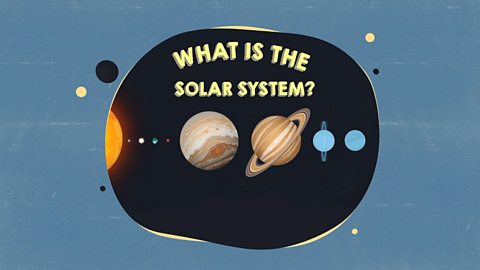
What is the solar system? video
This video explores the key characteristics of each planet within our solar system.
Primary > KS1 Science > Space
