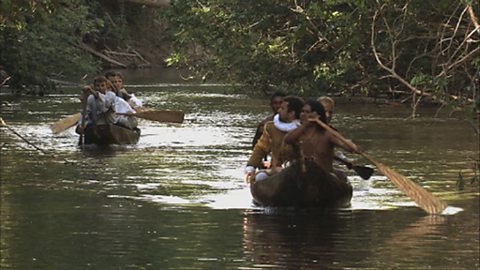
NARRATOR:'In the 16th Century the Elizabethan explorer Sir Walter Raleigh 'embarked on an epic voyage 'to discover the legendary city of El Dorado, 'a mysterious place some believed was full of gold.
NARRATOR:'400 years on and the Serious Explorers, 'a team of children from the UK, 'are on their way to Guyana in South America 'to retrace part of Raleigh's route.
NARRATOR:'When Raleigh came here, he was heading into unknown territory. 'Although he had a team of men with him and local guides to help, 'he was in an unfamiliar place, full of great danger.
NARRATOR:'If anything went wrong, 'it was unlikely anyone would come to his rescue.
NARRATOR:'400 years later 'the Serious Explorers have modern safety equipment 'that would have seemed like science fiction to Raleigh 'but remote jungles can be dangerous places.
NARRATOR:'The explorers safety is being taken care of 'by expedition leader Ben Major, 'an ex-army officer who's led expeditions 'in just about every extreme environment on earth.'
BEN MAJOR:No one expedition is the same and every expedition throws up unique challenges and the key thing about that is all about safety.
BEN MAJOR:'You do expeditions all over the globe and it might be 'one minute you're in minus 40 in the Arctic or the Antarctic, 'the next minute you're in hot sweaty tropical jungle 'in plus 30, plus 40 degrees
BEN MAJOR:'and of course your equipment, 'the way that you operate is completely different. 'and that's where, you know,' you've got a complete different rule book as to how you go about planning and delivering the expedition safely.
NARRATOR:'Part of being prepared involves practicing 'what the team will do in an emergency. 'Assistant expedition leader Polly, explains to the group 'how to deal with someone falling overboard.
POLLY:First thing we do - shout, point. "Man overboard." And I mean shout. You will be amazed at how quickly a person can disappear.
DRAMATIC MUSIC
NARRATOR:'Without warning Ben decides to give the young explorers a practical safety lesson.
BEN MAJOR:HELP!HELP!
JOSH:Keep an eye on him.
POLLY:Keep an eye and point!
JAKE:There!
MEGAN:There!
JAKE:Someone throw the buoy.
CHANELLE:A man's gone overboard. We're just making sure that we know where he is. Making sure that we're pointing at him so then you don't lose him in the water.
POLLY:Someone still pointing at him?
ALL: Yeah.
NARRATOR:'In just a few moments the strong current 'has swept him a long way from the boat 'but it's not just the current they need to think about.
NARRATOR:'The temperature of the water has a crucial impact on survival 'and in some places, even off the coast of Britain, 'a person can be too cold to swim in just 10 or 15 minutes.
BEN MAJOR:There's a door there.
POLLY:OK, down to the door.
JOSH:Pull him up.
POLLY:OK then. You alright mate? OK guys, we need to make sure now he's OK.
POLLY:OK? So–
BEN MAJOR:Well done guys. You can see how difficult that is to get people back in a boat. Nightmare.
SAMMIE:Yeah. It was really scary, like you were worried for him and then you had to like keep concentrating so that you didn't like leave him in the water too long.
BEN MAJOR:They've got to be aware of, basically the severity.' If someone goes over the side, you know you can seriously, seriously die very, very quickly in these kind of waters.
NARRATOR:'The largest part of the expedition takes place in the jungle. 'Home to thousands of different animals and plants 'so there are plenty of hazards.'
BEN MAJOR:Now if you think about the jungle, you think, you know snakes, you think large cats, that are gonna come and eat you in the middle of the night.
BEN MAJOR:You think about crocodiles all this kind of stuff and actually, what you really want to be concerned about is the small things. And that is the sun. It's incredibly hot or it's the lack of water and dehydration.
BEN MAJOR:But the biggest thing is things like insect bites, and insect-borne diseases. For example, malaria.
NARRATOR:'When one of the team becomes ill, insects are the number one suspect.'
PHEE:How are you feeling?
SHE CRIES
NARRATOR:'Chanelle has reacted badly to an insect bite 'and her face has become swollen. 'Dr. Phee wants to find out what's happened.'
PHEE:Tell me how you do feel?
CHANELLE:It feels massive.
NARRATOR:'Although she seems OK, 'the next part of the trip takes them into a very remote area. 'and Ben and Phee are worried that she could get worse. 'For Chanelle, it's devastating news.'
BEN MAJOR:If we were to take you into a remote, remote area and you were to get bitten badly, the next thing that could potentially happen could be life threatening and that's what we're concerned about and we can't guarantee your safety.
BEN MAJOR:And for that reason and that reason alone, I'm afraid we can't take you any further. I'm so, so sorry.
NARRATOR:'Because of the risks to her health, 'she's unable to continue with the expedition.'
NARRATOR:'With four fifths of Guyana covered by jungle, 'a large part of the Serious Explorers time 'is spent in the rainforest.
NARRATOR:'Before they go into such a dangerous environment, 'they need to prepare their belt kits 'which contain everything they need to survive 'if they become lost or separated from the rest of the expedition.'
BEN MAJOR:What we're gonna do now is just cover-- just trying to get you organised but most importantly it's a fundamental bit of safety kit that you need for the jungle.
BEN MAJOR:OK? And that is the belt kit. It's a belt which has got two black pouches on and it's got a water bottle pouch.
BEN MAJOR:Sometimes you get separated from your main rucksack. Yeah? And therefore you want to have your essentials on you.
NARRATOR:'The belt kits are like mini survival packs 'and the Serious Explorers have to think about 'which items they need to keep with them at all times.'
JAKE:-In the first pocket… oh in that one-- Well I will have my water bottle in there 'cause it's handy on my hip. Then second one, I'll have lunch in there if I get really hungry.
JAKE:Third one I'll have like daily things like penknife, compass and whistle and a headtorch. That's about it.
NARRATOR:-'Just like Raleigh, the Serious Explorers are sleeping in the jungle. 'It's their first night and before it gets dark 'they need to find somewhere to set up camp.
NARRATOR:'To avoid the jungle wildlife they sleep off the ground in hammocks, 'with a waterproof sheet and a mosquito net for protection.
BEN MAJOR:'Everything likes to come out at night. Snakes, scorpions, spiders.' And as soon as the light drops, it's just-- the jungle's gonna come alive and they're gonna be going "What's that? What's that?"
NARRATOR:'Ben points out something dangerous they haven't noticed.'
BEN MAJOR:We're gonna have to move you I'm afraid. All of you guys in this area 'cause this one's dead. Rotten completely yeah? With all the fungus growing on it.
BEN MAJOR:Also, the bark is just soft and you can see that I'm just-- and the last thing we want is that to come down with a stiff breeze in the night and crush Nikita or any of the others. I'm sorry guys.
BEN MAJOR:Number one killer in the jungle is deadfall. 'Dead trees or dead branches that are suspended above you 'that come down in the wind 'and that's what everyone kind of forgets.' so think about the small things not just the obvious things.
NARRATOR:'One of the most important things on any expedition is water. 'Most of the time the Serious Explorers 'are travelling on foot or in small canoes 'and taking enough drinking water would be impractical.
NARRATOR:'So like Raleigh, the team rely where they can on local sources of water 'like lakes and rivers.'
BEN MAJOR:You know, it's a hot, sweaty environment and you go through so much fluid in any one day
BEN MAJOR:and generally depending on what you're doing, you're going to need to take on board about, anything from five litres all the way through to possibly fourteen, fifteen litres a day.
BEN MAJOR:And the last thing you want to do is to have to carry that water it weighs a lot, roughly a kilogram per litre.
BEN MAJOR:So, you know, if you have to carry three or four litres it's too much and luckily in Guyana, you've got an abundance of rivers, loads of water to drink.
BEN MAJOR:However, it's not clean. It has sediment in it or it might possibly have bacteria in it and so you need to purify it and there's two main methods -
BEN MAJOR:one is to boil which obviously during the day is not that practical, you have to wait for the water to cool down before you can actually drink it whereas if you just add chemicals then you may have to wait 20, 30 minutes and then you can drink and they tend to come in sort of little dropper bottles like this.
BEN MAJOR:Where you can literally add so many drops to a litre wait half an hour and then take them on board. But water, can't, can't stress how important it is for keeping your body healthy.
NARRATOR:'The Serious Explorers are travelling through extreme environments 'that have barely changed since the time of Raleigh's expedition.'
NIKITA:That's huge.
SAMMIE:Wow.
NARRATOR:'Like all the early explorers, Raleigh was heading into the unknown 'and there were dangers all around 'but 400 years on, with access to modern equipment and expert help.
NARRATOR:'the Serious Explorers are able to take on 'even the most spectacular challenges with minimal risk.'
In the sixteenth century, Elizabethan explorer Sir Walter Raleigh embarked on an epic voyage to Guyana in the hope of finding the legendary city of El Dorado.
Four hundred years on and the Serious Explorers, a team of children from the UK, are heading to South America to retrace part of Raleigh’s route.
If anything went wrong during the expedition in Raleigh's day then it was unlikely that anyone would come to the rescue.
It is a different world for the Serious Explorers due to the availability of modern safety equipment.
Even so, in remote and dangerous places, safety depends on the experience of expedition leader Ben Major.
Every expedition throws up unique challenges, with the Serious Explorers' expedition to Guyana proving to be no exception.
This clip is from the series Seriously Raleigh.
Teacher Notes
Pupils could use a world map template to plot the route of both Sir Walter Raleigh and the children from the UK.
Pupils may write packing lists identifying what Raleigh may have taken on his expedition in comparison with the children from the UK.
Pupils may also be inspired to write diary entries from the point of view of Sir Walter Raleigh describing some of the challenges he may have come across during his voyage.
Pupils may also write travel guides for young adventurers describing ways to prevent insect bites and dehydration, as well as ways to stay safe.
During work on Tudor life, pupils could use this clip to explore methods of navigation invented during Tudor times and how this has helped people explore and discover new lands.
Curriculum Notes
This clip is suitable for teaching Geography at KS2 and KS3 Level in England, Wales and Northern Ireland and at 2nd and 3rd Level in Scotland.
More from Seriously Raleigh:
Expedition to Guyana - endangered animals in the rainforest. video
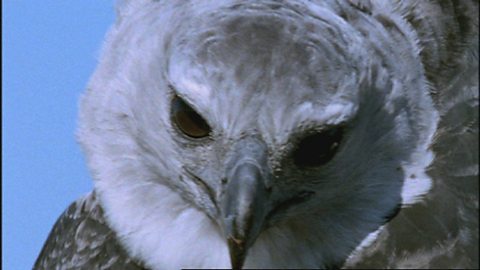
The explorers meet the region's most endangered animals, the caiman and the harpy eagle.
Expedition to Guyana - exploring Mount Roraima. video
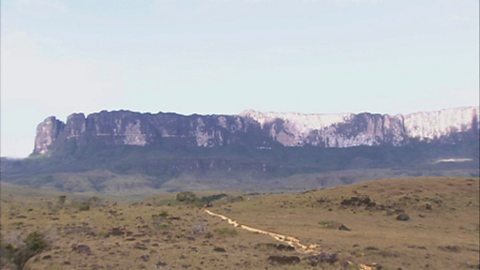
The Serious Explorers have come to Mount Roraima to relive the legend of Raleigh.
Expedition to Guyana - life in the rainforest. video
The Serious Explorers take a look at the rainforest in Guyana, a place that has hardly changed since Raleigh’s day.
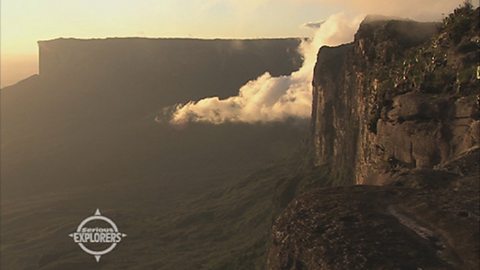
Expedition to Guyana - Mount Roraima (no narration) video
Extraordinary and stunning views of the imposing and magnificent Mount Roraima. Aerial views capture the magnificence of the mountain.
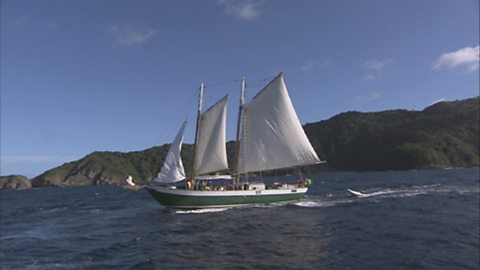
Expedition to Guyana - navigating an ocean journey. video
The Serious Explorers team are recreating Sir Walter Raleigh's ocean journey in search of El Dorado. They spend four days at sea learning about navigation tools.
Expedition to Guyana - planning an expedition. video
The Serious Explorers have taken almost a year to plan an expedition to recreate his journey. We see their planning process.
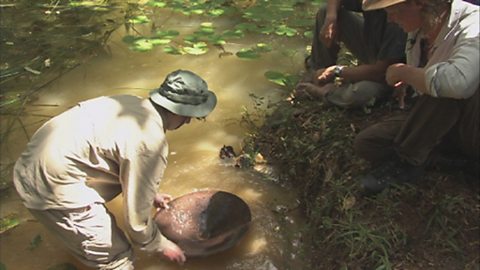
Expedition to Guyana - recreating Sir Walter Raleigh's search for El Dorado. video
The Serious Explorers team try out gold panning whilst following in Raleigh’s footsteps.
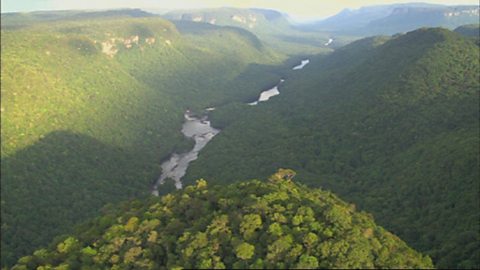
Expedition to Guyana - rivers and waterfalls (no narration) video
Views of the rivers running through the rainforest of Guyana and a glimpse into the ways in which the rivers support Guyana's rainforest communities.
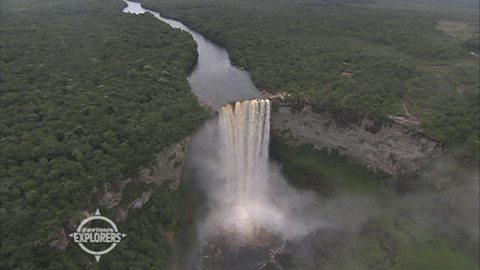
Expedition to Guyana - spending a night in the rainforest. video
The Serious Explorers spend a night in the Guyana rainforest. The UK adventurers learn to make shelters and set animal traps.
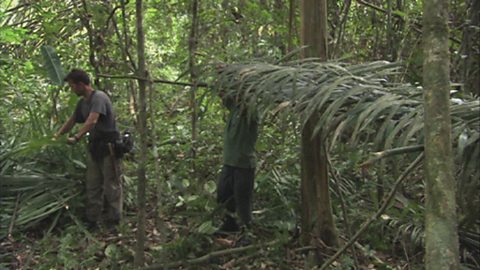
Expedition to Guyana - the Makushi tribespeople. video
The explorers join in a traditional Makushi celebration and go hunting with the tribesmen, relying on their help.
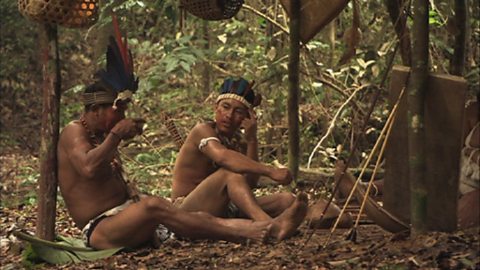
Expedition to Guyana - transportation for local tribespeople. video
The Serious Explorers try using traditional canoes like the ones Raleigh’s team would have used over four hundred years ago.