PRESENTER:'It's a chilly autumn morning on an industrial site in East London 'and six aspiring filmmakers are about to learn 'how to shoot a music video.
PRESENTER:'They meet Tom Swindell, a professional director of photography 'and singer/songwriter Aruba Red 'to hear the music and plan what they're going to film.'
TOM SWINDELL:This is a great space for us to kind of listen to the track and start getting some ideas about how we can use this location.
MUSIC: Take Me To The Light by Aruba Red
STUDENT ONE:It kind of gave me a feel of kind of sci-fi dystopia or something like that.
STUDENT TWO:It's kind of hypnotic.
STUDENT THREE:It's kind of like a really dreamy song.
TOM SWINDELL:With music videos, you have got permission to be a little bit abstract.
TOM SWINDELL:Let's see whether we want to link any particular images to the vocal.
STUDENT THREE:It'd kind of start off with you being in places where there's not really any sunlight So you'd be looking quite pale and quite cold and like kind of by the time you get to the chorus like you've warmed up.
ARUBA RED:I guess the word light kind of represents truth in this song. I was thinking about yeah, interesting shots using light.
ARUBA RED:Kind of bleached out shots. -Most music videos are shot in just one day so yeah we better get cracking.
PRESENTER:'So before you even shoot one frame you need to - 'listen to the tune a lot. 'Ask yourself what the music conveys 'and come up with some visual ideas.'
TOM SWINDELL:OK guys so yeah, this is the location. The world is our oyster, we've got many different angles we can choose from here.
TOM SWINDELL:A way I kind of help decide on my framing before I even get my camera out is to actually just kind of put your finger and thumb out like that and bring it together and that creates like a rectangle which is pretty close to the kind of frame size we're gonna be using.
TOM SWINDELL:So I think we're gonna go straight in on a close up.
PRESENTER:'To start with, Tom is filming with his own professional equipment 'but using techniques you can do with any cheaper camera.
PRESENTER:'He starts by filming the whole song in close up, 'then the whole song again in a wide shot.
MUSIC: Take Me To The Light by Aruba Red
TOM SWINDELL:And that gives you a great opportunity 'cause you can cut from the wider shot into the tighter shot and back and forth.
TOM SWINDELL:Also a nice technique that we can bring in here is panning. I've got my dancer here and I'm moving the camera nice and slowly.
PRESENTER:'Aspire to film great looking pictures by - 'finding a good location.
PRESENTER:'Remember to shoot the whole song in wide shot and close up 'before you start being more creative. 'Try some simple camera moves on a tripod.'
TOM SWINDELL:We're gonna do a tracking shot with Logic walking towards the camera delivering his lines.
PRESENTER:'A wheelchair is one way to do really professional-looking tracking shots.'
TOM SWINDELL:This is a flip camera so what I like about this is you can really move around.
TOM SWINDELL:So 'cause it’s the rap part of the song 'we're going to put a bit more dynamism into it 'and I move round him and kind of spar with him a little bit.
TOM SWINDELL:'Even on a mobile phone you can get like HD video nowadays 'which is brilliant.'
PRESENTER:'One technique with a pocket or phone camera is arm's length filming 'where the artist actually films him or herself.'
TOM SWINDELL:We're going to do a locked-off shot now. So we're gonna keep the camera on the tripod 'so that it stays absolutely still.
TOM SWINDELL:'We've got a dancer back there' we're going to move him through the frame in four different positions 'and cut out that middle bit 'so that we can kind of make him appear and reappear 'throughout the frame like magic.'
PRESENTER:'So make sure you get creative with your camerawork and try - 'tracking shots using a wheelchair, 'filming yourself at arm's length, 'lock off a shot on the tripod 'then let the action happen inside the frame.
TOM SWINDELL:Well that's a wrap guys, it's home time.
PRESENTER:'Tom and the crew have achieved an amazing amount 'in just one day of filming.
STUDENT FOUR:We learned lots of techniques.
STUDENT FIVE:I thought it was interesting how they used the cameras and the space.
STUDENT TWO:-You do this thing with your finger so if you don't have a camera at hand 'then you can kind of picture.'
STUDENT ONE:You don't need specific expensive equipment to make a film good.
STUDENT SIX:I think I learned a lot of stuff that I could use in a film project that I would do. -I'm not going to be able to stop singing it today now 'cause we've been singing it all day.
PRESENTER:-'And this is what the final video looks like.
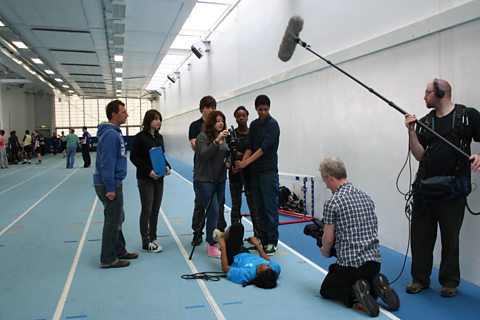
A group of young people join professional director of photography Tom Swindell and singer/songwriter Aruba Red to shoot a music video for her track 'Take Me To The Light'.
Over a single day, the group learns how to create a visual concept for the video, what simple rules to follow in order to get the best look, and how to get interesting shots with basic equipment by thinking creatively.
This clip is from the series Making Media.
Teacher Notes
Students could use this clip to help them understand what visual representation adds to a song and whether they feel this improves the song compared to just hearing it played and if so, how and why.
They could consider what effect different choices of visual representation would make and how this would affect the audience’s response to the music.
One of the students in the clip claims that music videos can be made with very few resources.
The class could discuss just how important expensive technology is to the mainstream media.
More from the series Making Media
Media Studies KS3 / GCSE: How to build a website. video
A group of young entrepreneurs learn the key concepts of user-focused web design.
Media Studies KS3 / GCSE: How to conduct an interview. video
A panel of young people assess and learn key skills for interviewing in media production.
Media Studies KS3 / GCSE: How to edit a film trailer. video
Three young film-makers learn insider tips and tricks for creating a film trailer.
Media Studies KS3 / GCSE: Research, planning and filming. video
Five young film-makers learn to research, plan and shoot a film.
Media Studies KS3 / GCSE: Editing a film. video
A guide to creating a film narrative, from preparation to storytelling techniques.
Media Studies KS3 / GCSE: The finished film. video
Short documentary about British athlete and Olympic hopeful Zara Hohn.