Tony Walsh:
This is a place where a Manchester girl, name of Emmeline Pankhurst from the streets of Moss Side led the Suffragette City with sisterhood pride.
Sally Lindsay:
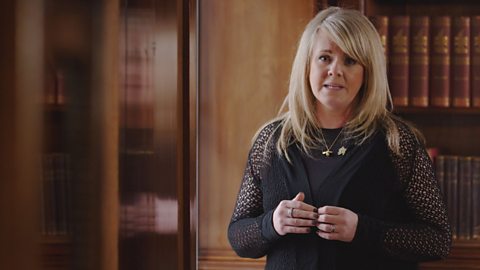
As Tony Walsh tells us in his now world famous poem, this is the place. It was right here in Manchester that the campaign for votes for women turned into a milliary operation. I want to find out the true gritty Mancunian story and discover the people and the places that turned a Manchester mother, called Mrs Pankhurst, into the leader of an army of women. I've come to the very heart of this suffragette city to the site of the Free Trade Hall, to find out more.
Sally Lindsay:
So Michael, I know about Emmeline the heroic figure, but I don't know anything about her family or her early days, your family indeed. Could you shed some light on that for me?
Michael Goulden:
Well, yes she was born Emmeline Goulden, the eldest girl in a family of 11.
Sally Lindsay:
Wow!
Michael Goulden:
And her parents, we know, were both politically active in a lot of the big causes that were taking place in Manchester at that time. And even more interesting, I think, is you can trace the radical tradition in the family back to a previous generation at least. And we know that her grandfather, Richard Goulden, would have been at the crowd that came to the great political demonstration, which turned into the massacre of Peterloo. 20 years after Peterloo, my grandparents would probably have been on this site again, taking part in the anti Cornwall league, which was a great Manchester movement of that era.
Sally Lindsay:
It was also at the Free Trade Hall that the Votes for Women campaign began in January 1868 led by Manchester botanist and reformer Lydia Becker, and her national society for women suffrage. Almost 40 years later, Emmeline's eldest daughter, Christabel, would be the next Mancunian to stand up for the nation's women at the Hall. That part of the story begins at 62 Nelson Street, now a museum and women's refuge called the Pankhurst centre. Tucked away next to Manchester Royal Infirmary, most people walk past this rather forgotten old building, but I was here after the death of Emmeline's husband Richard Pankhurst, that the mum of five took her first paid job as a registrar of births, deaths and marriages, and started to witness the hardships that working class women and young girls faced. Now a working mum paying taxes, she was growing tired of words. The time had come for deeds. On the tenth of October 1903, encouraged by her daughters, Emmeline set up a new movement. Emmeline's great granddaughter Helen Pankhurst: is here to tell me more.
Helen Pankhurst:
So this the home where the Suffragette movement started. It was called the WSPU, the Women's Social and Political Union. So here we have Christabel after having graduated in law, and she can't, she's not allowed to practice as a barrister. And here's my grandmother, Sylvia, painting. She had to, in the end, choose between painting or her commitment to a political voice and to women's right,s and she chose women's voices and women's rights.
Sally Lindsay:
So they gave up everything really didn't they.
Helen Pankhurst:
They did.
Sally Lindsay:
In 1905, Christabel Pankhurst and her friend Annie Kenney, were arrested and put in prison for spitting at a policeman at a political rally, held at the Free Trade Hall. And the militant chapter of Emmeline's Suffragettes began. Their actions resulted in national press coverage and interest in their campaign encouraged the WSPU to relocate to London. But a banner recently unearthed shows Manchester never forgot.
Helen Antrobus:
So the banner was made in 1908 by the Manchester Women's Social and Political Union, and it was made to be taken down to London on the biggest Suffragette rally that had happened so far. And it has a very, very powerful message on it. It said "First in the fight Manchester founded by Mrs Pankhurst" And that was very, very deliberate. It was there to tell people that Manchester was the place where all this had begun.
Sally Lindsay:
And we've got some fantastic archive here at Manchester Central Library, to show us just how big that movement was. So here we've got picture cards of the leading ladies of the day. So there's one here of Christabel, and there's a signed one here of Emmeline herself. And then we've got this amazing ribbon, which would be bought at the rallies, so you could wear your colours with pride. And this is the most amazing thing. This is the Holloway prison badge, which would be given to all those ladies that suffered the barbaric horrific prison sentences that were given to them. And they'd wear their badge with pride, and Emmeline Pankhurst was never seen without hers.
Sally Lindsay:
No wonder then that Manchester's new statue of Emmeline will be wearing her prison badge with pride. Sculptor Hazel Reeves: has brought along a scaled down model to show me.
Sally Lindsay:
So where is she gonna be?
Hazel Reeves:
She's gonna be in St Peter's Square.
Sally Lindsay:
Which is just–
Hazel Reeves:
Just over there, yeah.
Sally Lindsay:
Yeah. I think it's very profound for the children of Manchester as well because I think they can be inspired, especially the little girls, to come and look at her in that meeting place and know the story and know the struggle and know that was a Mancunian who did that.
Hazel Reeves:
Exactly.
Video summary
One hundred years after the ‘votes for women’ campaign won its first victory and secured electoral rights for some women, Sally Lindsay examines the life of one of its greatest campaigners: Emmeline Pankhurst.
She visits the landmark buildings that turned a Manchester girl called Emmeline Goulden into the formidable Mrs Pankhurst, the leader of the Women’s Social and Political Union - also known as the Suffragettes - and meets with Emmeline’s descendants Michael Goulden and Helen Pankhurst at the private family home that shaped her radical political views.
Sally also discovers how Manchester is paying tribute to Emmeline’s work with a new statue in the city centre by sculptor Hazel Reeves.
Teacher Notes
Students could be asked to name as many examples as they can think of which make Manchester important in history: What is it famous for? What famous people come from Manchester? What important buildings does it have?
When watching the video students could answer the following questions: What impact did her upbringing and growing up in Manchester have on her views/ideas?
In what ways were the Free Trade Hall and 62 Nelson Street significant in shaping her political views? How can we use the People’s History Museum and the Central Library to help us understand Emmeline Pankhurst and the Suffragette Movement more fully? Why do you think St Peter’s Square was selected as the sight of the new statue of Emmeline Pankhurst?
Students could then Produce a 3D map of Manchester with the key buildings plotted onto it and labels/images relating to Emmeline Pankhurst and the Suffragettes or they could create a pamphlet/guide for a visitor to Manchester detailing the buildings/places they could go to learn more about the Suffragettes and Emmeline Pankhurst.
At the end of the lesson students could be asked what have they learnt about Manchester today that makes them feel proud of the city?
Suitable for teaching History at KS3 in England, Wales and Northern Ireland and 3rd Level in Scotland.
How the Votes for Women campaign began. video
How the votes for women campaign began, and the women who led the fight for suffrage.
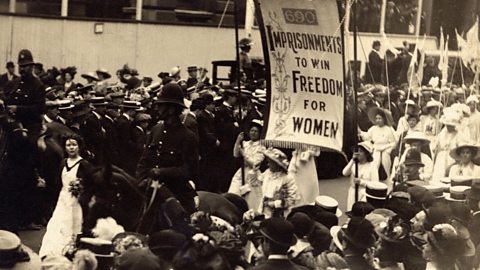
Historical sources and interpretations of Emmeline Pankhurst. video
How historical sources can tell us more about the Suffragettes leader Emmeline Pankhurst.
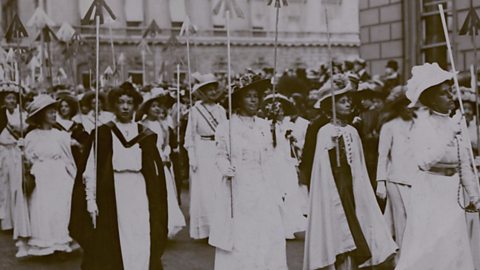
The life and work of Emmeline Pankhurst. video
Sally Lindsay reports on the life and work of the Suffragettes leader Emmeline Pankhurst.