Sally Lindsay:
The Suffragettes brought an army of women to the streets of Britain, the likes that had never been seen before or since. They burned down postboxes, they bombed buildings. They endured horrific prison sentences and barbaric force feeding. And some of them even lost their lives for their political beliefs.
Sally Lindsay:
This was a woman's revolution, marching for the right to vote. And at its head was Emmeline Pankhurst, who saw herself as a militant general, leading her troops into political battle. Born in 1858 in Victorian Manchester, Emmeline was just a teenager when she decided to support the cause for Votes for Women, also know as Suffrage.
Sally Lindsay:
So Charlotte, what was it like in the time that Emmeline was growing up.
Dr Charlotte Wildman:
So women were very much second class citizens in Britain at this point in time. They had lots of legal disadvantages. So, when a woman got married, she had to surrender all her property and her earnings to her husband. So, women were seen as biologically different, because we're seen as having smaller brains, we're seen as ill prepared for the masculine world of work, politics.
Sally Lindsay:
So almost like children.
Dr Charlotte Wildman:
Almost like children, yeah. So, cities like Manchester were built for men. For example, you'd be really hard pressed to find a toilet in the city centre for women. So, you get this sense that cities were just, you know, very difficult places for women to navigate. You know, just being a woman on your own on the streets, you risked being called a prostitute.
Sally Lindsay:
Since 1868, Manchester campaign from the National Society for Women's Suffrage, had demanded the vote. Supporters of the campaign were known as Suffragists, and unlike Emmeline's militant Suffragettes, they believed they could achieve their aims peacefully, by petitioning parliament for electoral reform. Emmeline disagreed and decided on a different approach. On the tenth of October 1903, encouraged by her daughters Christabel and Sylvia, Emmeline set up her female only militant division of the Suffrage movement, the Women's Social and Political Union or the WSPU. And they took their fight to the streets.
Helen Pankhurst:
It came on the back of more of more than 50 years of campaigning, more than 16,000 petitions, and a sense that nothing was changing.
Sally Lindsay:
There is a perception of Emmeline and the suffragettes being too militant and it went against the cause and it would have happened a lot quicker without them, What are your thoughts on that?
Helen Pankhurst:
You cannot talk about the Suffragette's actions without talking about the government responsibility for forcing them into a corner, for not giving them a voice, for treating them abominably. You've got a government with all the power that's stamping down on them, squashing them, quashing them, and they try. So they try and manoeuvre and time and time again, they're being rolled back in and they're being silenced. So, they find more and more militant ways. Never do they hurt a person. They suffer and suffer and suffer. They attack property, because they understand that property is the one thing that maybe the government worries about more than anything. I think you take it and you take it and there comes a point where you say enough, and we have to try something different. And the militancy comes from that. And just from the comfort of our seats to say oh, that was naughty, is just not good enough.
Emmeline Pankhurst (Reconstruction):
Our heckling campaign made women's suffrage a matter of news. It had never been that before. Now the newspapers were full of us.
Sally Lindsay:
Their mission eventually took them to London and Parliament. In London, the campaign to extend the franchise had long been fought by the National Union of Women's Suffrage Societies, led by Millicent Fawcett. The NUWSS was a pacifist movement, which peacefully argued for the vote. But while the organisations disagreed on the best approach, their leaders, and most of their members, did agree to suspend their campaigns, just days after World War One broke out in 1914. Instead they helped the war effort by encouraging men to sign up, by working in munitions factories and on farms, and by taking on roles as tram conductors, postal officers and doctors." Let us show ourselves worthy of citizenship, whether our claim to it be recognised or not", said Millicent. "What would be the good of a vote without a country?" Emmeline asked. In 1918, the Suffrage fight was won for women over 30 with property, and ten years later Parliament agreed equal voting rights for men and women aged over 21. A century alter, statues of both Emmeline and Millicent stand outside the Palace of Westminster in tribute to their remarkable dedication to the Suffrage campaign.
Emmeline Pankhurst (Reconstruction):
There were awake at last. They were prepared to do something that women had never done before: fight for themselves. Women had always fought for men and for their children. Now they were ready to fight for their own human rights.
Video summary
The early 20th century was a time of huge social and political change in Britain, Europe, and the wider world.
As a new middle class emerged, women recognised that they could play a bigger part in society - and believed they could only make a lasting difference if they were also allowed to vote in elections.
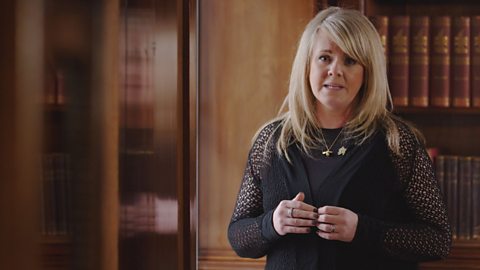
Sally Lindsay finds out more about life in Victorian and Edwardian Britain in order to understand what motivated the great leaders of the ‘votes for women’ movement - including Emmeline Pankhurst, Millicent Fawcett and Lydia Becker - to campaign for change and secure female suffrage on equal terms to men.
Teacher Notes
Students could be presented with a collage of images showing direct action by the Suffragettes and the police/government response to this.
On post-it notes/strips of paper, students could write key words/phrases to describe the images.
When watching the video students could answer the following questions: what prompted Emmeline Pankhurst to become a supporter of women’s suffrage? How did her work as a registrar influence her ideas about women? What led to the creation of the WSPU and the decision to be militant?
Students could then carry out further research into the NUWSS and the WSPU to create posters about each group.
Or they could be given different characters e.g. Lydia Becker, Emmeline Pankhurst, Millicent Fawcett, David Lloyd George, Annie Kenney, policeman etc. and create a conversation between them about their feelings/attitudes towards women’s suffrage.
At the end of the lesson students could be asked to consider what the women of 100 years ago would think about the role and position of women in today’s society.
What would they be proud of? What would they still be fighting for today?
Suitable for teaching History at KS3 in England, Wales and Northern Ireland and 3rd Level in Scotland.
Historical sources and interpretations of Emmeline Pankhurst. video
How historical sources can tell us more about the Suffragettes leader Emmeline Pankhurst.
How Manchester shaped Emmeline Pankhurst. video
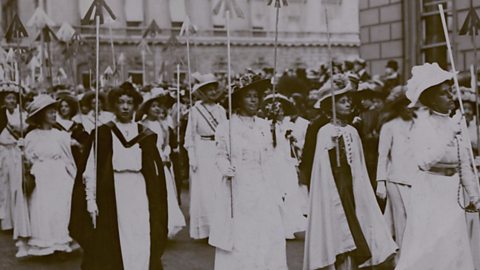
Sally Lindsay finds out how Manchester shaped the Suffragettes leader Emmeline Pankhurst.
The life and work of Emmeline Pankhurst. video
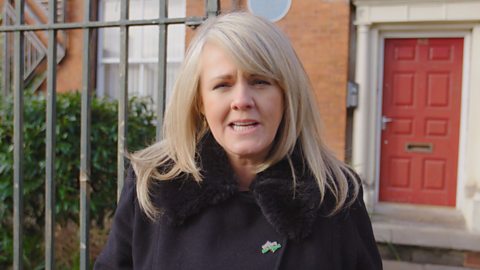
Sally Lindsay reports on the life and work of the Suffragettes leader Emmeline Pankhurst.